Common Worcester Bosch Boiler Error Codes


Written by Stephen Day
Gas Safe Engineer
Updated:
14 min read
Worcester Bosch fault codes help identify why your boiler has stopped working. Their meaning can depend on the model and any additional cause code shown on the display.
In this article
Key takeaways
- Read both the fault code and the cause code, then check them against your model's manual.
- Pressure top-ups, a thawed condensate pipe and one reset are the main homeowner checks.
- Repeated lockouts, overheating and fan faults need a Gas Safe registered engineer.
Watch our YouTube video which covers some of this blog article.
Most Worcester Bosch fault codes point to a short list of problems.
The most common Worcester Bosch codes are EA (often shown with cause code 227), which means the boiler could not detect a flame; E9 (with 224), an overheating safety cut-out; C6 and C7, fan or airflow faults; and low-pressure warnings such as CE, A1 or 1017, depending on the model.
Some of these have a simple household cause, such as a frozen condensate pipe or pressure that has dropped below 1 bar. Others need a Gas Safe registered engineer.
The code on the display tells you which safety check the boiler failed. It does not tell you which part has failed. The same letters can also mean different things on a Greenstar i, a CDi Classic and a Greenstar 8000 Style.
Once you know what a code points to, you can make the checks your manual allows and recognise when to stop and call an engineer. You can also judge whether a repair or a replacement is the sensible next step.
What Do the Most Common Codes Mean?
Worcester Bosch error codes fall into four familiar groups: ignition, overheating, airflow and pressure.
Many boilers pair a two-character fault code with a three- or four-digit cause code that narrows the problem down. The table below gives a quick lookup, and the subsections explain what each group means in practice.
Display code | Common cause code | What it points to | First step |
|---|---|---|---|
EA | 227 | Flame not detected | Check gas supply and condensate pipe |
E9 | 224 | Overheat safety cut-out | One reset, then an engineer |
C6 / C7 | Varies by model | Fan or airflow fault | Engineer visit |
CE / A1 / 1017 | Model-dependent | Low water pressure (on some models) | Check the pressure gauge |
EA and 227: Ignition or Flame Not Detected
EA with 227 means the boiler tried to light and did not sense a flame. Causes range from an interrupted gas supply to a blocked or frozen condensate pipe or a worn ignition electrode. Worcester Bosch lists a frozen or blocked condensate pipe as a known trigger for EA. In winter, that is the first thing to rule out.
E9 and 224: Overheating or Safety Cut-Out
E9 with 224 shows that a safety limiter has shut the burner down because the water inside the boiler became too hot. Poor circulation, a failing pump or sludge in the heat exchanger are frequent reasons. The cut-out protects the boiler, so repeated E9 lockouts need investigating.
C6 and C7: Fan or Airflow Faults
C6 and C7 relate to the fan and the flue. C6 points to the boiler not confirming correct airflow. C7 points to the fan not running as expected. Both involve the combustion side of the boiler, which only a Gas Safe engineer should open.
A1, CE and 1017: Check the Model Before Assuming Low Pressure
Several guides claim that A1 always means low pressure. That is inaccurate. On some Worcester Bosch boilers, CE or cause code 1017 flags low water pressure. On others, A1 relates to the pump or circulation. Look at the pressure gauge first. If it reads between 1 and 1.5 bar with the heating cool, pressure is unlikely to be the cause, and the manual for your model will give the correct meaning.
How Do You Read the Code on Your Boiler?
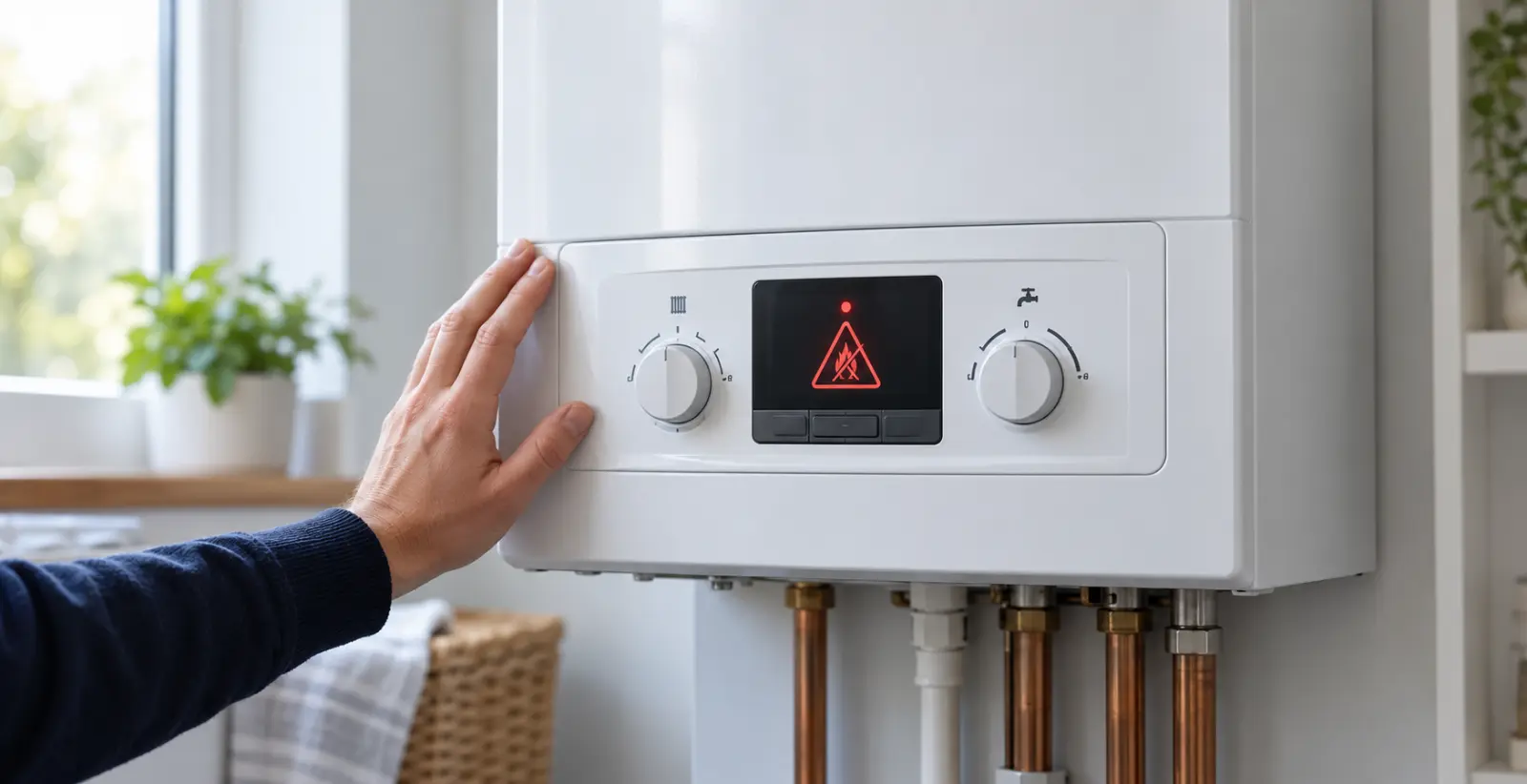
The first characters on the display are the fault code. The number shown alongside them, or after you press the information button, is the cause code. The way the display flashes, and any symbol shown with it, tells you whether the boiler has locked out or is waiting to restart on its own.
Fault Codes, Cause Codes and Flashing Lockouts
A locking fault stops the boiler until someone presses reset. It is normally shown by a flashing code, sometimes with a flashing reset symbol. Note both parts before touching anything. "EA 227" is far more useful to an engineer than "EA". On the Greenstar i, the quick info button brings up a plain-text description of the boiler's current status.
Blocking Faults, Maintenance Messages and Display Symbols
A blocking fault pauses the boiler, which then restarts itself once conditions return to normal. Worcester Bosch's gradient limitation symbol is one example. It appears when the flow temperature rises too quickly. The burner then stops for two minutes and relights. If it keeps happening, that can point to a circulation problem.
Some messages are not faults at all:
SE code: a service reminder that appears after 2,324 running hours, roughly a year's average use.
Siphon fill mode: the boiler runs at low burn for about 15 minutes to refill the condensate trap after being switched off or left unused.
Air purge mode: the pump pulses for about 15 minutes after installation or a board change, and the burner does not fire.
If either mode runs for more than half an hour, it needs an engineer's attention.
Where to Check a Code Against Your Model's Manual
The model name is printed on the front panel or under the flap. The serial number is on the data badge. Worcester Bosch publishes user manuals online, grouped by model and date of manufacture, and codes do change between versions of the same boiler. A Greenstar CDi Classic Combi, for example, has separate manuals for units built from 2012, 2014 and 2015.
What Should You Check When EA Appears?
Two causes are worth checking yourself before an EA code becomes a repair job: the gas supply and the condensate pipe. Everything past those two sits inside the sealed casing.
Gas Supply and a Frozen Condensate Pipe
Check whether your gas hob lights and whether a prepayment meter has credit. If other gas appliances also fail, the problem lies with the supply, not the boiler.
In freezing weather, the white plastic condensate pipe running outside to a drain is the usual suspect. You may hear the boiler gurgle as it tries to start.
Worcester Bosch advises pouring warm water, never boiling water, along the outside section, and then resetting the boiler. Insulating that pipework and fitting a drain cover over its end reduce the chance of it happening again.
When an Ignition Fault Needs an Engineer
If the gas supply is fine, the condensate pipe is clear and EA returns after one reset, the fault lies inside the boiler. Common culprits are a worn or dirty ignition electrode, a faulty gas valve or a flame sensing problem. All of these are Gas Safe work.
Our engineers regularly see EA faults that turn out to be electrode wear on boilers that have missed several annual services.
What Do Low-Pressure Warnings Mean?
A low-pressure warning means the sealed heating circuit has lost water. Low boiler pressure stops a combi or system boiler from firing safely, and the pressure sensor triggers the code. Topping up fixes the symptom, but a boiler that keeps losing pressure has a cause that needs finding.
How to Check Boiler Pressure and Top It Up Safely
With the heating off and cool, the gauge should read between 1 and 1.5 bar, which is the green zone on most dials. Below 0.5 bar is in the red and needs topping up. Worcester boilers use one of three filling methods:
External filling loop: two valves on a braided hose under the boiler. Open both slowly, stop at about 1 bar, then close both.
Keyed internal filling link: insert the white key with its arrow aligned to the open padlock, turn it until the gauge reads just over 1 bar, then turn it back and remove it.
Keyless filling link: pull down the blue lever under the boiler and release it once the gauge passes 1 bar.
Expect a few drips when you disconnect the loop or key. Our guide to a boiler losing pressure covers the follow-up checks in more detail.
Why Pressure Keeps Falling or Rising
Worcester Bosch says a system will need a top-up once or twice a year. More often than that points to a leak. Check radiator valves and visible joints for damp or staining. Then check the pressure relief valve pipe, which runs from the boiler to an outside wall. If its end is wet or dripping, the valve itself may be faulty.
High pressure is the opposite problem. A reading of about 2.75 bar or more sits in the red. If you have overfilled the system, bleed a radiator to bring the gauge back to between 1 and 1.5 bar.
If pressure climbs by more than 1 bar as the heating warms up, the expansion vessel probably needs recharging, which is engineer work. A boiler leaking water from underneath the casing also needs an engineer.
Why Does an E9 Overheating Fault Occur?
E9 appears when the safety temperature limiter detects water hotter than the boiler is designed to handle and cuts the burner. The limiter is a thermal safety switch, and it is doing its job when it trips.
What a Safety Cut-Out Is Telling You
Overheating points to heat not being carried away fast enough. Possible reasons include a pump that has seized or slowed, closed radiator valves, sludge restricting the heat exchanger, or low pressure reducing circulation. It is common on older systems that have never had a power flush.
On some models, the pump-blocked symbol flashes alongside the flow temperature, which narrows it down further. Our Worcester boiler E9 fault guide covers the possible causes in more depth.
When to Stop Resetting and Arrange a Repair
One reset, after checking the pressure and making sure some radiator valves are open, is reasonable. If E9 returns, leave the boiler off. Pressing reset repeatedly sends it back into the same unsafe condition and can stress the heat exchanger. The more general boiler overheating guide explains what an engineer will check.
What Do Fan and Airflow Codes Mean?
Fan and airflow codes show that the boiler cannot confirm it is moving enough air through the combustion chamber and flue to burn gas safely. The boiler locks out to prevent poor combustion.
C6 and C7: What the Display Can Tell You
The cause code shown with C6 or C7 tells the engineer whether the fan failed to reach speed or whether a pressure switch did not confirm airflow. It cannot tell you whether the fan motor, its wiring, the control board or a blocked flue is responsible.
Outside, check that the flue terminal has not been covered by ivy, scaffolding sheeting or a bird's nest. That is a visual check only, and you should not touch the flue. Our Worcester Bosch C6 boiler error code guide goes through the cause codes one by one.
Why Fan and Flue Checks Are Engineer Work
The fan sits inside the sealed combustion casing. Gas Safe Register guidance is clear that a case held on by several screws is part of the combustion circuit and must stay closed unless a registered engineer opens it.
A faulty flue or fan can let carbon monoxide into the home, so a working CO alarm near the boiler is worth having. If you suspect a gas leak, call the National Gas Emergency number on 0800 111 999.
What About Sensor and Hot-Water Faults?
Sensor codes mean the boiler has lost a reliable temperature reading. Hot-water faults without a code frequently trace back to the diverter valve. Both have limited homeowner fixes beyond a reset.
A7, D1 and E2: Temperature Sensor Warnings
The boiler measures water temperature with NTC thermistors, small sensors whose resistance changes with heat. On many Worcester models, A7 relates to the hot-water sensor and E2 to the flow sensor. D1 is linked to the return sensor on some versions.
The exact meaning varies by model, so check the cause code against your manual. An engineer will test the sensor's resistance and its wiring before replacing anything, because a loose connector gives the same code as a failed part.
No Hot Water Despite Working Heating
On a combi, working radiators with cold taps usually points to the diverter valve, which switches the boiler's heat between the heating and the hot water. Other causes include a hot-water sensor fault or a blocked plate heat exchanger in hard-water areas. The specific checks are in our guide to a Worcester Bosch boiler with no hot water.
How Do Codes Differ Between Worcester Bosch Models?
Code meanings shift between Worcester Bosch ranges and between production years of the same range. Newer Greenstar 2000, 4000 and 8000 boilers lean on four-digit cause codes, while older Greenstar models pair letters with three-digit numbers. The manufacture date on your boiler decides which manual applies.
Greenstar i and Greenstar Si Compact
The Worcester Bosch Greenstar i combi has a quick info button that shows status in plain text, which helps when a code is unfamiliar. Its current user manual covers boilers built from March 2015 to May 2023.
For Worcester Bosch Greenstar Si Compact error codes, use the manual matching your boiler's build date. There are separate versions for units built from May 2013 and from September 2014.
CDi Compact and CDi Classic
Greenstar CDi boilers use the familiar letter-plus-cause-code format. For Worcester Bosch CDi Compact error codes, the relevant manuals cover boilers built from September 2012 onwards. The Worcester Bosch CDi Classic is sold as a combi, system and regular boiler, each with its own manual. Codes that involve hot water only apply to the combi.
CDi Highflow
The Greenstar CDi Highflow is a storage combi with a built-in hot-water cylinder. That means Worcester Bosch CDi Highflow error codes include hot-water store faults that a standard combi does not have. Manuals cover builds from March 2010, May 2015 and July 2016.
Greenstar 2000 and 4000
The Greenstar 2000 has been built since January 2020 and the Greenstar 4000 since May 2021. Both pair display codes with four-digit cause codes, which is where 1017 for low pressure appears. The newer A21 code is covered in our Worcester Bosch A21 error code fix.
Greenstar 8000 Style
The 8000 Style has a colour display that shows more descriptive status messages. Worcester Bosch 8000 Style error codes are listed in manuals for units built from May 2019, with a revised edition for boilers built from May 2021.
Which Checks Are Safe to Make Yourself?
You may carry out any task that Worcester Bosch's user instructions describe for the homeowner. That covers checking pressure, topping up through the filling loop, thawing the condensate pipe, bleeding radiators and pressing reset.
Gas Safe Register confirms this is within the law. Anything behind a screwed-on casing is for a Gas Safe registered engineer.
Power, Controls and One Reset Following the Manual
If the display is blank, check the fused spur and the consumer unit. Then check that the programmer, timer and room thermostat are calling for heat, because a thermostat set lower than room temperature looks like a dead boiler.
After that, press reset once, as your manual describes, and give the boiler a few minutes to try to fire. Our boiler safety guide covers the wider precautions.
When to Stop and Call for Help
Stop and leave the boiler off if any of these apply:
The same code returns after one reset.
You smell gas, or you see sooty marks or yellow flames.
Water is leaking from inside the casing.
The pressure relief pipe is discharging.
A CO alarm sounds.
A Gas Safe engineer carries an ID card listing the appliances they are qualified to work on. You can ask to see it before any work starts.
Should You Book a Repair or Consider Replacement?
A single fault on a boiler that is otherwise sound is almost always worth repairing. Replacement becomes worth considering when faults recur, parts are costly, or the boiler is well past its guarantee.
When a Call-Out or Annual Service Makes Sense
A diagnosis visit settles what the code on its own cannot. Our repair call-outs start from £89 and cover diagnosis and, where possible, a fix that does not need replacement parts.
Any parts are quoted separately before work goes ahead. Many faults that start as a lockout, such as electrode wear and blocked condensate traps, are found during an annual service. Ours starts from £99 and includes a service report. The Worcester Bosch boiler service guide explains what the checks cover.
How Warranty, Cover and Repeated Faults Affect the Decision
Check your Worcester Bosch guarantee first. You can confirm its length with the boiler's serial number, and a valid guarantee covers parts, labour and call-out fees.
Boiler cover or a service plan changes the sums in a similar way. If a boiler is out of guarantee and throwing repeated EA or E9 faults, or the heat exchanger has failed, a new A-rated boiler starts to make financial sense. Our fixed online quotes show the price in advance, and our replacing a boiler guide sets out the practical steps.
Last updated: