


Energy Efficient Boilers: Models, Costs and Savings

Written by Stephen Day
Gas Safe Engineer
Updated:
Compare efficient gas boilers, estimate potential savings and decide whether to replace your boiler or improve the one you have.
- Which energy efficient boilers should you compare?
- How much cheaper is a new boiler to run?
- Should you replace your existing boiler?
- How much does an energy efficient boiler cost?
- What do boiler efficiency ratings actually mean?
- How to choose an efficient boiler for your home
- Detailed boiler reviews: output, controls and noise
- How to save energy with your existing boiler
- What should you do next?
- Frequently Asked Questions (FAQ)
Key takeaways
- Match the boiler to your home. Heating output, hot water and controls all matter.
- Savings depend on your current boiler. Age alone does not tell you its efficiency.
- A working condensing boiler may be worth keeping. Check settings and controls first.
- Compare the complete fitted price. Eligible combi replacements start from £1,945 including VAT.
An energy efficient gas boiler combines an A-rated condensing design with the right output, controls and installation for your home.
Worcester Bosch Greenstar 4000, Vaillant ecoTEC plus, Viessmann Vitodens 100-W and Ideal Logic+ Combi2 are models worth comparing, but no single boiler will give every household the lowest bills.
Your potential saving depends mainly on the boiler you are replacing and how much heat you use. If your existing condensing boiler works well, improving its settings and controls may be a better first step than replacing it. This guide focuses on domestic gas boilers.
What do you need help with?
Which energy efficient boilers should you compare?
Start with the heating rating and hot-water performance, then check how closely the boiler can match your home's heating demand.
This quick comparison covers four specific combi models; system and heat-only boilers are explained under choosing the right system.
iHeat supplies and installs boilers from the brands below. The comparison uses published manufacturer specifications, rather than independent laboratory testing or measured customer fuel savings.
How to read the figures: the seasonal heating rating is a standardised comparison, not a guaranteed efficiency in your home. Hot-water flow shows how much water the boiler can heat each minute. A 35°C temperature rise means, for example, heating incoming water from 10°C to 45°C.
Quick comparison of four A-rated gas combi boilers
Specific model | Seasonal heating rating | Hot-water flow at 35°C rise | Detailed review |
|---|---|---|---|
Worcester Bosch Greenstar 4000 25kW | 94% / A | 10.2 litres/minute | |
Vaillant ecoTEC plus 826 | 93% / A | 10.6 litres/minute | |
Viessmann Vitodens 100-W B1KG-30 | A | 12.0 litres/minute | |
Ideal Logic+ Combi2 30 | 94% / A | 12.4 litres/minute |
Viessmann's exact-model brochure confirms the A class; a model-specific seasonal percentage is not used here. Minimum heating outputs appear in the detailed reviews with their published water temperatures, because the manufacturers do not all describe those test conditions in the same way.
Sources: Worcester product specifications and ErP data sheet; Vaillant specifications; Viessmann B1KG brochure; Ideal Combi2 specifications. Specifications checked 4 October 2026. Hot-water figures use a 35°C temperature rise; actual delivery also depends on the incoming mains supply.
How much cheaper is a new boiler to run?
The saving depends on the efficiency improvement, how much useful heat you need and your gas unit price. A single “save up to” figure cannot describe every household.
The illustration below assumes 15,000kWh of useful space heat each year, gas at 7p/kWh including VAT, and a replacement achieving 94% seasonal efficiency in use. These are example assumptions, not a current tariff quote or a prediction that a boiler's label rating will be achieved in your home. Hot water is excluded so the space-heating comparison remains clear.
Illustrative annual space-heating costs and savings
Assumed existing efficiency | Annual space-heating gas cost | Saving if replaced by a boiler achieving 94% |
|---|---|---|
70% | £1,500 | £383 a year |
80% | £1,313 | £195 a year |
90% | £1,167 | £50 a year |
94% | £1,117 | No efficiency saving in this illustration |
Calculation: annual useful heat ÷ efficiency expressed as a decimal × gas price per kWh. Figures are rounded independently from unrounded calculations. Standing charges, hot water, boiler electricity, servicing, repairs, installation and finance are excluded. Heat demand and indoor comfort are held constant.
In this example, moving from 70% to 94% cuts gas use for space heating by around 26%. Moving from 90% to 94% cuts it by around 4%. Neither result supports assigning a fixed saving from the boiler's age alone.
A simple payback calculation also needs the installation price. An illustrative £2,500 replacement divided by £383 annual fuel savings gives about 6.5 years; divided by £50 gives about 50 years. That is not a lifespan forecast and ignores finance, maintenance differences and future prices. It shows why fuel savings alone may not justify replacing a working condensing boiler.
Should you replace your existing boiler?
Consider efficiency, condition and repair costs together. Age alone is not a reliable efficiency measurement. An older non-condensing appliance and a maintained condensing boiler of similar age can have very different performance.
Find the make and exact model in your user manual, service paperwork or an accessible external label; do not remove the casing. Ask your engineer whether it is condensing and have its condition and controls assessed. Do not use a table claiming every ten-year-old boiler has lost the same percentage of efficiency. Rising bills may also reflect colder weather, tariff changes, longer heating hours or changes to the household.
Working condensing boiler: review controls, settings and system condition first.
Inefficient boiler with recurring faults: compare a repair quote with the full replacement cost and realistic fuel savings.
Heating or hot water no longer meets your needs: have the system assessed before choosing a larger boiler.
Replacement becomes more persuasive when poor efficiency coincides with recurring faults, an expensive repair, unavailable parts or a system that no longer meets your needs. Conversely, repairing a serviceable boiler or improving controls may be the better first step. New boilers also need ongoing servicing, so a replacement does not remove that cost.
If you have an old back boiler, compare the complete conversion work, including the replacement position, flue, pipework and existing fire arrangement. Do not treat it as a straightforward wall-mounted boiler swap.
How much does an energy efficient boiler cost?
As checked on 4 October 2026, iHeat's published starting prices are £1,945 for a suitable straightforward combi replacement, £2,495 for a system replacement and £2,595 for a heat-only replacement, including installation and VAT.
These are entry prices for eligible packages, not quotations for every model in this guide. Do not assume a system-boiler starting price includes a new cylinder. See the starting-price scope and installation examples.
Changing boiler type, relocating the appliance or replacing other equipment changes the scope. A more expensive model is not automatically cheaper overall: compare the installed cost against the likely benefit in your system.
Before accepting a quote, check:
The exact boiler model, heating output and hot-water suitability.
The control model and which compensation features are included.
Flue, condensate, gas-supply and relocation work where needed.
System cleaning, filters, old-equipment removal and any cylinder work.
The warranty or guarantee duration, registration requirements, servicing conditions and who handles a claim.
Ask for the cover included in your actual package in writing. A manufacturer's advertised maximum warranty is not automatically included with every installer or installation.
What do boiler efficiency ratings actually mean?
For a new-boiler comparison, start with the seasonal space-heating efficiency on the manufacturer's ErP product fiche. ErP means Energy-related Products. A combi also has a separate water-heating efficiency figure, so check which number you are reading.
Do not mix seasonal ratings with efficiency measured at one particular operating condition. The Greenstar 4000 data sheet, for example, lists 94% seasonal space-heating efficiency and 98.9% useful efficiency at a specified low-temperature, part-load test point. Both figures can be correct, but they answer different questions. Worcester ErP data sheet.
Older SEDBUK figures also use different calculation methods. Ideal publishes 94% ErP seasonal efficiency and 89.6% SEDBUK 2009/2012 for the same Logic+ Combi range. That difference does not show the boiler deteriorating.
Keep the measurement method consistent when comparing products. Ideal efficiency data.
What makes a condensing boiler more efficient?
A condensing boiler recovers heat from its exhaust gases that an older non-condensing design would lose. How effectively it does this depends partly on the temperature of water returning from the heating system.
Lower return temperatures help it recover more heat. This is why radiator sizing, heating controls and temperature settings matter alongside the appliance itself. Energy Saving Trust boiler guidance.
How to choose an efficient boiler for your home
Choose the right system type
Boiler type | When to consider it | Efficiency consideration |
|---|---|---|
Combi | On-demand hot water without a separate cylinder, where the mains supply and simultaneous demand suit it | Avoids cylinder storage losses, but hot-water demand can require a larger burner than space heating needs |
System | A home using a separate hot-water cylinder, including households needing several outlets together | Cylinder insulation, hot-water scheduling and controls affect total energy use |
Regular or heat-only | A compatible existing system where retaining external components is sensible | A modern condensing replacement can be efficient; the system's design and condition still matter |
“Combi” does not mean “condensing”. Combi describes how hot water is provided; condensing describes heat recovery. Modern system and regular boilers can also use condensing technology. Converting to a combi solely to obtain an efficient boiler is therefore not always necessary. Energy Saving Trust's boiler-type guidance.
Check minimum output and heat loss
Minimum heating output is the lowest heat output the burner can sustain while firing. A boiler with a lower minimum has more scope to match a small heating demand without repeatedly stopping and starting. kW describes power; kWh measures energy used over time.
Ask for the home's calculated heating requirement, rather than selecting solely by bedrooms or radiator count. The maximum heating output needs to cover cold-weather demand; the minimum output matters during milder weather.
For illustration, if a home needs 3kW at a particular moment but its boiler cannot deliver less than 6kW, the burner cannot run continuously at the required output. It must cycle or rely on the system absorbing the excess heat.
That is why a larger boiler is not automatically a better one. Actual cycling also depends on water volume, controls and system configuration.
Separate heating output from hot-water performance
A combi's hot-water capacity may drive its advertised size even when the home needs much less power for heating. Compare flow rates at the same temperature rise: 12 litres/minute at a 35°C rise cannot be compared directly with 12 litres/minute at a 40°C rise. The incoming mains supply must also support the intended use.
Ask what the controls actually do
Weather compensation adjusts heating-water temperature in response to outdoor conditions. Load compensation responds to the difference between room temperature and the set temperature. Both require compatible equipment and correct setup. App access alone does not tell you whether either function is available. Ask the installer to identify the control and explain its operation in the quoted system. Energy Saving Trust heating-controls guidance.
Detailed boiler reviews: output, controls and noise
Use these specifications to check suitability after narrowing down your options. In the heating tables, 50/30°C means water leaving the boiler at 50°C and returning at 30°C. Compare outputs at matching conditions. Noise is a comfort consideration, not an efficiency score; different sound tests cannot be ranked as though they measure the same thing.
Jump to: Worcester Bosch · Vaillant · Viessmann · Ideal.
Worcester Bosch Greenstar 4000
The useful distinction between the 25kW and 30kW Greenstar 4000 combis is their hot-water performance. Both have the same published central-heating output range. Choosing the 30kW version therefore gives more hot-water capacity without increasing the minimum heating output shown below.
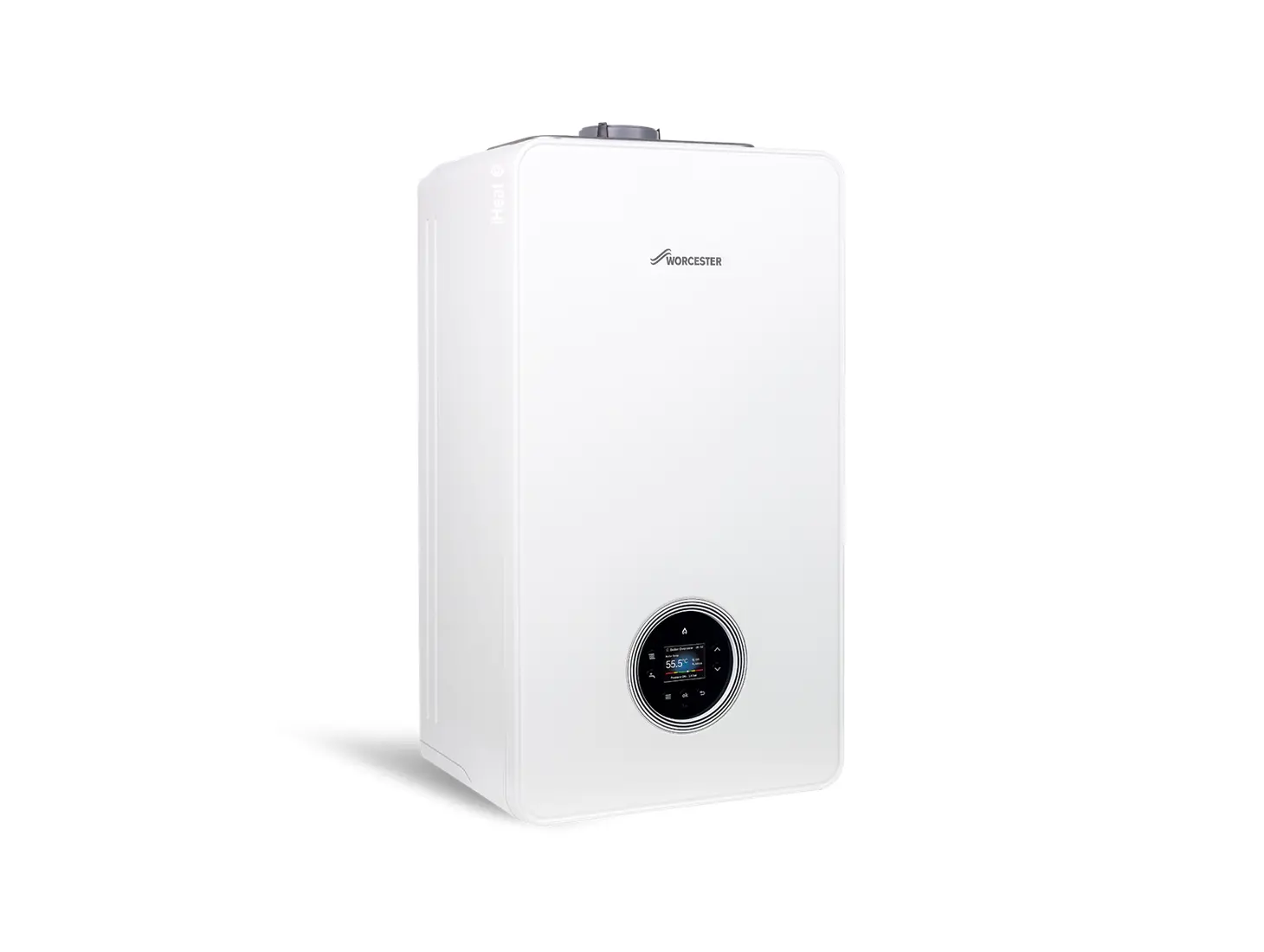
Worcester Bosch Greenstar 4000. Check the exact model and output on your quotation.
Specification - natural gas | 25kW combi | 30kW combi |
|---|---|---|
Seasonal space-heating efficiency / class | 94% / A | 94% / A |
Heating output at 80/60°C flow/return | 3.0–24.0kW | 3.0–24.0kW |
Heating output at 50/30°C flow/return | 3.3–24.7kW | 3.3–24.7kW |
Hot-water flow at 35°C rise | 10.2 litres/minute | 12.3 litres/minute |
Designed hot-water flow at 40°C rise | 9.0 litres/minute | 10.8 litres/minute |
Declared sound power | 45dB(A) | 45dB(A) |
Overall dimensions, H × W × D | 724 × 400 × 310mm | 724 × 400 × 310mm |
Figures apply to the standard natural-gas combis, not separately listed Low NOx versions. Overall height includes the lower enclosure; side-panel height is 710mm. Dimensions exclude required installation and service clearances. Sources: Greenstar 4000 brochure and installation manual, technical data.
Why minimum output matters: a low minimum gives the boiler more scope to follow a small heating load in mild weather. However, a 3kW minimum still exceeds a 2kW load. The burner may need to cycle, so radiator sizing, system water volume and controls remain relevant. Do not treat a modulation ratio as a standalone efficiency score: the actual minimum output, at the same water temperatures, is the more useful comparison.
Controls and electricity use: the range is compatible with Bosch EasyControl. Ask which controller and connectivity accessories are included. For the 25kW model, the ErP fiche declares auxiliary electricity consumption of 39W at full load, 13W at part load and 2W in standby. These are separate operating conditions, not figures to add together or multiply by every hour of the year. Control compatibility; 25kW ErP fiche.
Noise and suitability: both combis share the brochure's 45dB(A) sound-power figure. That is a declared appliance measurement, not a promise of 45dB at your kitchen table. A location near a bedroom still needs thought about wall construction and pipe vibration. Compare the two models on hot-water demand and installed price rather than assuming the larger number means better heating efficiency.
Vaillant ecoTEC plus
The ecoTEC plus 826 is worth considering where the home needs relatively little heat but still requires combi hot water. The 832 increases both heating capacity and hot-water performance. Its slightly higher seasonal rating does not, by itself, make it the more economical fit.
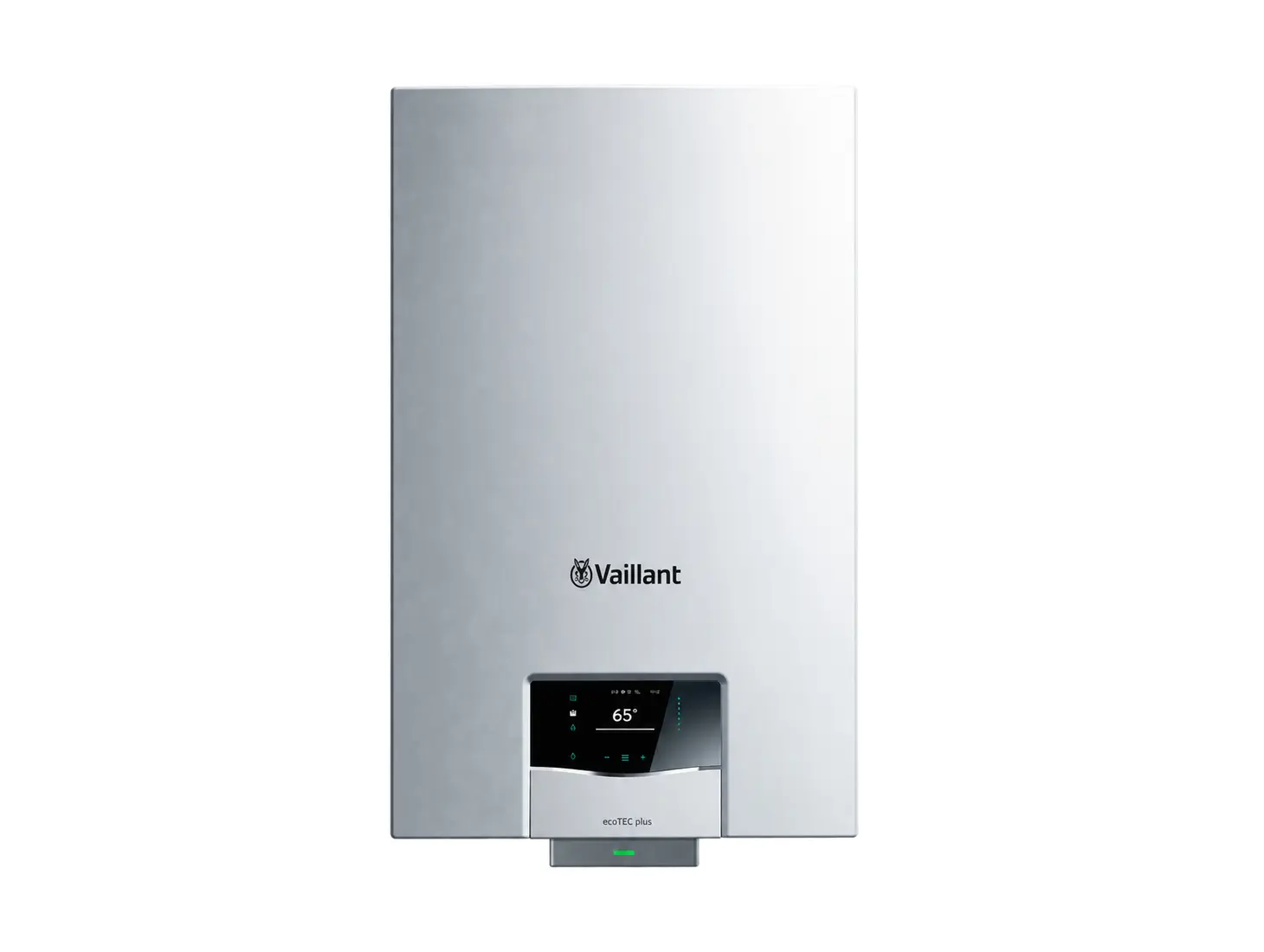
Vaillant ecoTEC plus. Check the exact model and output on your quotation.
Specification | ecoTEC plus 826 | ecoTEC plus 832 |
|---|---|---|
Seasonal efficiency / heating class | 93% / A | 94% / A |
Heating output at 50/30°C flow/return | 2.5–19.8kW | 3.5–24.9kW |
Hot-water flow at 35°C rise | 10.6 litres/minute | 13.0 litres/minute |
ErP sound power | 46dB(A) | 45dB(A) |
Dimensions, H × W × D | 720 × 440 × 352mm | 720 × 440 × 352mm |
Heat exchanger | Stainless steel | Stainless steel |
Combustion control | IoniDETECT | IoniDETECT |
Casing dimensions only. Vaillant states its combis have a flow regulator set for a 42°C temperature rise; the 35°C figures are published comparison values, not an assurance of actual tap flow under every condition. Source: Vaillant ecoTEC plus specifications.
Why the 826 can suit a smaller heating load: at the stated 50/30°C conditions, a 3kW demand sits within its output range but below the 832's minimum. That gives the 826 scope to run continuously at that load, provided the rest of the system permits it. This is an illustrative comparison, not a prediction of annual savings. The 826 must still cover the property's cold-weather heat loss and the household's hot-water needs.
What IoniDETECT adds: Vaillant describes this as combustion monitoring that supports adjustment of the gas-burning process and a wider modulation range. It does not replace a heat-loss calculation or correct an unsuitable control setup.
Choose the controls as part of the package. Vaillant's sensoCOMFORT supports weather compensation, adjusting the system's operation to outdoor conditions. App connectivity is a separate consideration: ask whether a myVAILLANT connect gateway and the appropriate controller are included. A connected boiler is not automatically configured for efficient low-temperature operation. sensoCOMFORT information.
Noise trade-off: the declared difference is only 1dB. That does not justify saying one will sound dramatically quieter in your home. Position, installation and operating load can influence what you actually hear; noise is a comfort consideration rather than a measure of gas efficiency.
Viessmann Vitodens 100-W
The current UK brochure includes the B1KG generation of the Vitodens 100-W combi. The example below is the B1KG-30, which provides 30kW continuous hot-water output but a lower maximum output for space heating. Do not substitute B1KF, system-boiler or heat-only specifications simply because the casing carries the same 100-W name.
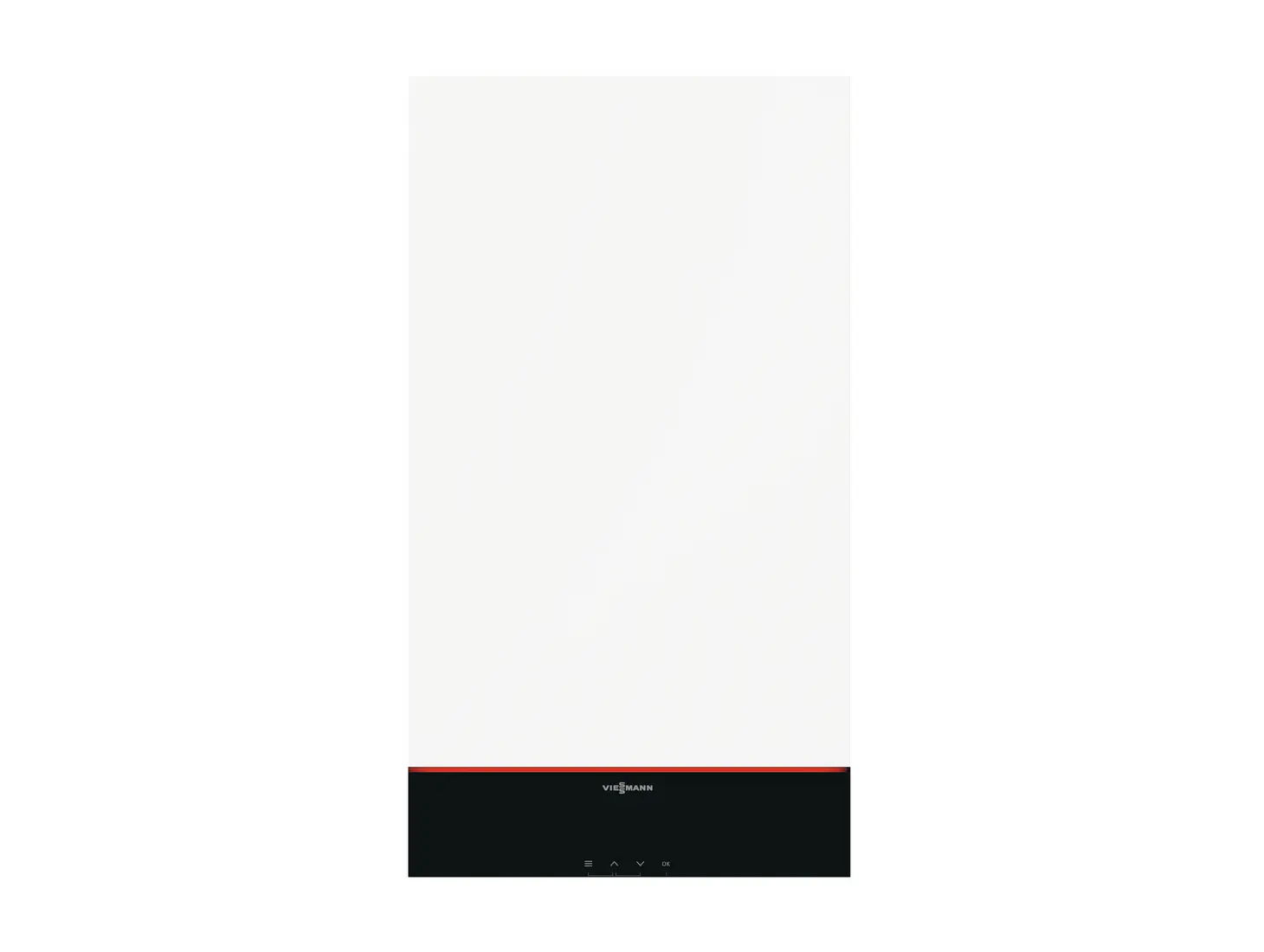
Viessmann Vitodens 100-W. Check the exact model and output on your quotation.
Specification | Vitodens 100-W B1KG-30 combi |
|---|---|
Heating / water-heating energy class | A / A |
Heating output at 50/30°C flow/return | 3.2–25.0kW |
Heating output at 80/60°C flow/return | 2.9–23.0kW |
Continuous hot-water output | 30.0kW |
Continuous hot-water flow at 35°C rise | 12 litres/minute |
Sound power at partial load, EN ISO 15036-1 | 31.9dB(A) |
Sound power at rated output for hot-water heating, EN ISO 15036-1 | 50dB(A) |
Dimensions, H × W × D | 700 × 400 × 360mm |
Heat exchanger / combustion control | Stainless-steel Inox-Radial / Lambda Pro |
Connectivity | Integrated Wi-Fi with ViCare support |
Sources: Viessmann UK B1KG brochure and Viessmann B1HG/B1KG installation manual, hosted by a distributor. Dimensions exclude installation clearances. These load-specific sound measurements must not be ranked directly against a single ErP sound-power declaration.
Efficiency rating: the UK B1KG brochure confirms an A rating for both space heating and water heating. This comparison uses those confirmed classes; it does not assign the range's advertised maximum percentage to this individual model.
Why the output range matters: the published minimum is close to the Greenstar 4000's at 50/30°C. That does not establish equal annual consumption, but it is a more meaningful starting point than comparing one boiler's low-temperature output with another's high-temperature figure. A small heating demand can still fall below either appliance's minimum.
What the technology contributes: the stainless-steel heat exchanger transfers heat to the heating water, while Lambda Pro controls combustion. ViCare provides access to operating information and heating schedules. Ask which compatible room control and weather-compensation arrangement the quote includes: Wi-Fi provides connectivity, while the control strategy determines how heat is requested.
Noise needs context: the two declared figures show why a boiler can be relatively unobtrusive at part load but more noticeable when heating hot water. Neither describes the sound level at a particular distance in your room. Do not use the 31.9dB(A) figure alone to claim this is the quietest boiler in the comparison.
Ideal Logic+ Combi2
The Logic+ Combi2's three sizes share a 94% seasonal space-heating rating, but their minimum heating outputs differ. A larger hot-water model may therefore be less well matched to a small heating load, even though its efficiency label looks identical.
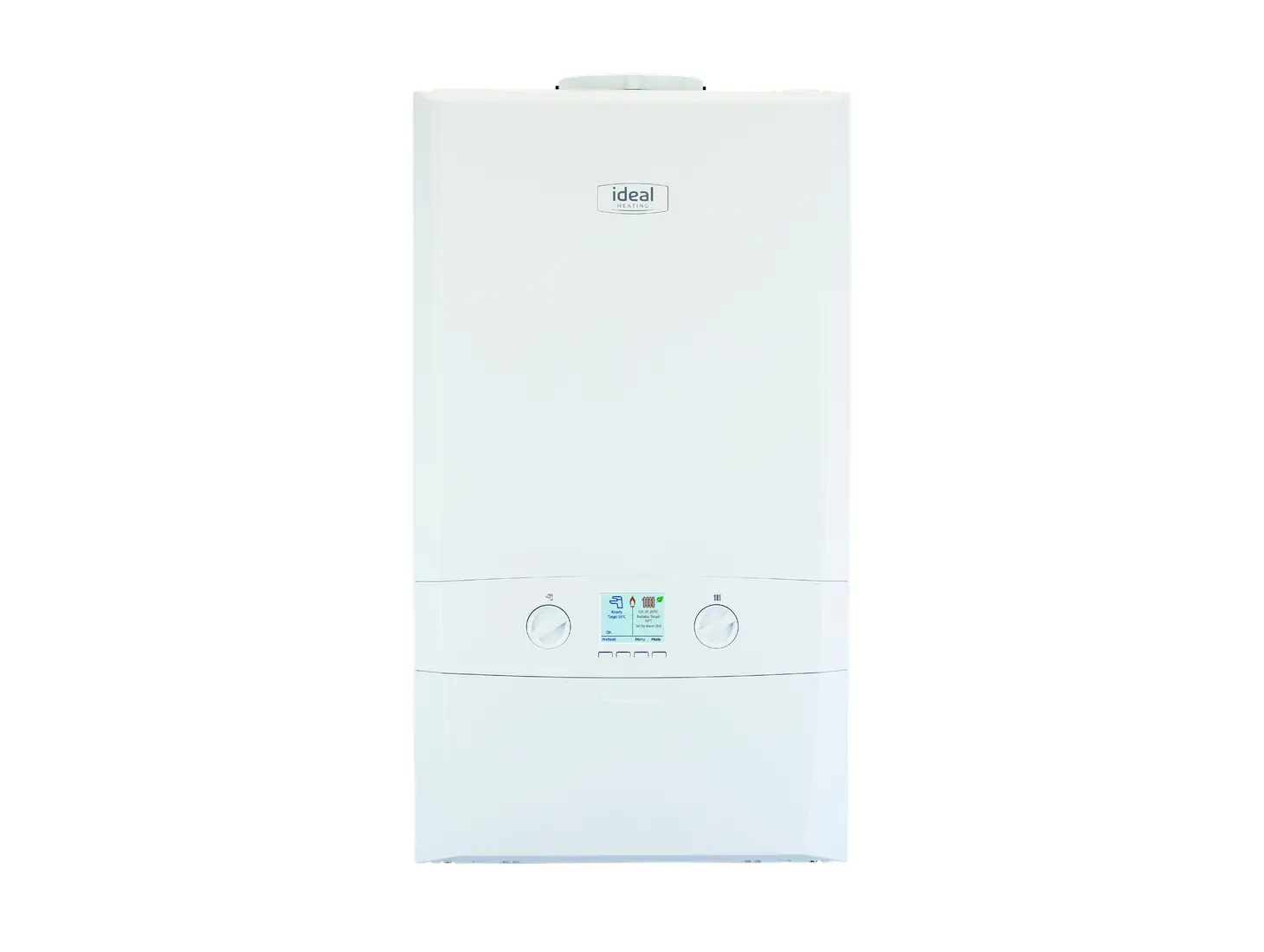
Ideal Logic+ Combi2. Check the exact model and output on your quotation.
Specification - Logic+ Combi2 | 24 | 30 | 35 |
|---|---|---|---|
Seasonal space-heating efficiency / class | 94% / A | 94% / A | 94% / A |
Heating output, mean water temperature 70°C | 4.8–24.2kW | 6.1–24.2kW | 7.1–24.2kW |
Heating output, mean water temperature 40°C | 5.1–25.6kW | 6.4–25.6kW | 7.5–25.6kW |
Maximum hot-water output | 24.2kW | 30.3kW | 35.3kW |
Hot-water flow at 35°C rise | 9.9 litres/minute | 12.4 litres/minute | 14.5 litres/minute |
Declared indoor sound power | 50dB(A) | 46dB(A) | 46dB(A) |
Source: Ideal Logic+ Combi2 specification sheet, Rev C. Figures apply to the Logic+ Combi2 generation. Ideal specifies mean water temperatures; these are not the same as flow temperatures.
What the numbers mean: moving from the 24 to the 35 increases hot-water delivery, while maximum heating output stays the same at each listed temperature condition. Minimum heating output rises. Select the smallest hot-water capacity that genuinely meets demand, rather than assuming a bigger model creates a more efficient heating system.
For example, a 4kW heating demand is below all three listed minimum outputs at a mean water temperature of 40°C. That does not mean the boilers cannot heat the home; it means continuous firing at that particular demand is unavailable. Controls and the heating system's ability to absorb heat determine how operation cycles.
Controls can improve how the system responds. Ideal's Logic2 controls guide describes load compensation through compatible Halo controls and weather compensation with Halo Wi-Fi or an appropriate outdoor-sensor arrangement. Confirm the exact controller and enabled functions in the quote. Compensation cannot reduce the burner below its physical minimum output. Ideal controls guide.
Hot-water comfort has a trade-off: Combi2 includes intelligent pre-heat. Pre-heating can shorten the wait for hot water, but keeping components warm uses energy. Ask how the setting suits your usage pattern and follow the user guide. Do not assume every comfort feature minimises fuel consumption.
Noise: the Combi2 30 and 35 share the listed 46dB(A) sound-power value. That does not make the larger version equally well suited to a small heating load: acoustic performance and minimum burner output answer different questions.
How to save energy with your existing boiler
You may be able to reduce wasted heat before buying a replacement:
Review the heating schedule. Match heating periods to occupancy while maintaining suitable warmth.
Use room and radiator controls. Avoid overheating rooms and ask for help if the controls conflict or behave unexpectedly.
Keep radiators unobstructed. Furniture and long curtains can restrict heat reaching the room.
Address heat loss. Consider appropriate insulation and draught-proofing without blocking required ventilation.
Have uneven heating investigated. System balancing, water condition and control faults may need professional attention.
Follow the service schedule. Servicing supports safe operation and can identify faults; it is not a guarantee of a particular percentage saving.
Can lowering the boiler flow temperature help?
On a suitable condensing system, lower heating flow temperatures can improve efficiency by reducing the return temperature. They can also make rooms warm up more slowly, so settings must still meet the home's needs.
Radiator-water temperature, room temperature and stored hot-water temperature are different settings.
For a combi without a cylinder, follow the manual's instructions for the user-accessible heating control. If the boiler also heats a cylinder, or you are unsure how the controls interact, ask the installer before changing temperatures: stored-water hygiene requirements must be maintained.
Do not remove the casing or alter installer settings. Energy Saving Trust flow-temperature guidance.
What should you do next?
If your boiler is working well, start with its controls and condition. Identify the exact model, review your gas consumption in kWh and ask whether the system can operate more efficiently.
If replacement makes sense, compare complete installation packages. Ask each installer to explain the chosen heating output, hot-water capacity and control setup.
Use the boiler installation cost guide to compare the work included. If moving away from gas is part of your plan, also assess whether a heat pump could suit the property.
Frequently Asked Questions
Is a 94% boiler much cheaper to run than a 92% boiler?
Usually the efficiency-only difference is modest. If both achieve those efficiencies in use, moving from 92% to 94% reduces the gas needed for the same useful heat by about 2.1%. With the 15,000kWh and 7p/kWh assumptions above, the difference is around £24 a year. Installation quality, controls and the upfront price can therefore matter more than two percentage points on a label.
How can I check whether a new boiler is actually using less gas?
Compare gas consumption in kWh rather than bill totals, since tariffs and standing charges can change.
Use periods with similar weather, occupancy and heating settings, and remember that hot-water use may differ. A cold winter after installation can mask an improvement, so a simple month-to-month bill comparison is not proof of boiler performance.
Does a more efficient gas boiler make heating carbon-free?
No. Reducing gas consumption reduces the emissions associated with burning that gas, but the boiler still uses a fossil fuel.
If reducing fossil-fuel use is a priority, consider insulation and lower-carbon heating options as part of the decision, rather than judging the boiler's efficiency label alone.
Last updated:
Written by Stephen Day
Gas Safe Engineer at iHeat
Stephen Day is a Gas Safe registered and FGAS certified engineer with over 20 years of hands-on experience in the heating, cooling, and renewable energy industry, specialising in boiler installations, air conditioning, and heat pump systems.
LinkedInArticles by Stephen Day are reviewed by iHeat’s technical team to ensure accuracy and reliability.
Contributors

Managing Director
More boiler help & advice

02nd October, 2026
F54 Vaillant Boiler Fault Code
The Vaillant F54 fault code indicates a problem with the gas supply to the boiler and may...
 Read Article

01st October, 2026
Viessmann F2 Fault
The Viessmann F2 fault means the boiler's temperature limiter has responded, placing the b...
Read Article
01st October, 2026
New Boiler Installation Costs...
Understand what to budget for a boiler replacement, how conversions and relocation affect...
Read Article