


How much does air conditioning cost to install?

Written by Stephen Day
Gas Safe Engineer
Updated:
Find out how much air conditioning costs to install and run in a UK home, including VAT relief, maintenance and practical ways to manage your energy use.
- How much does air conditioning cost to install?
- What changes your installation quote?
- Does air conditioning qualify for zero VAT?
- How much does air conditioning cost to run?
- What temperature should you set to keep costs down?
- What to budget for after installation
- How to compare quotes fairly
- Frequently Asked Questions (FAQ)
Key takeaways
- Compare supplied-and-fitted prices with the same number of indoor units and the same installation scope.
- Use electrical input or measured electricity consumption to calculate running costs; cooling capacity is a different figure.
- Qualifying fixed heat-pump installations in UK homes can receive 0% VAT until 31 March 2027.
- A moderate cooling setting and a schedule matched to occupancy help avoid unnecessary use.
Single-room air conditioning packages cost approximately £1,950 to £3,500, including professional installation and VAT.
Two-room packages can cost from £3,000 to £4,600. Your final price depends on the equipment and the work needed at your home, including pipe routes, drainage and access.
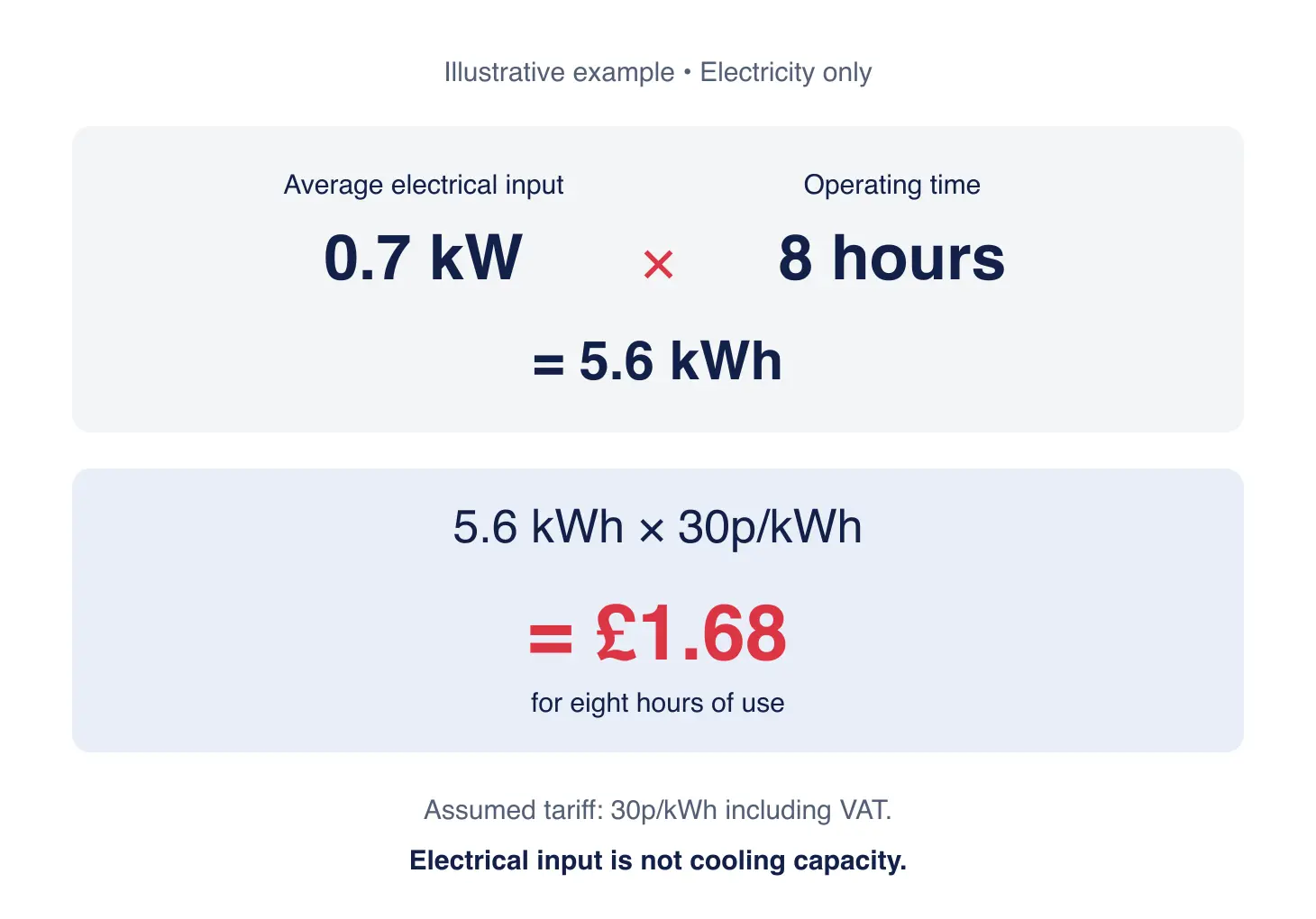
Running costs are separate. As an illustration, a system averaging 0.7kW of electrical input costs 21p per hour at an assumed electricity rate of 30p/kWh. Your actual bill depends on electricity consumption, your tariff and how long you use the system.
Prices checked on 1 October 2026. These are advertised packages, not an average of completed installations. The running-cost example uses an assumed tariff, not a current national rate.
How much does air conditioning cost to install?
The table below shows selected packages on iHeat’s air conditioning page. Each price includes installation and VAT. Check the proposed installation details before treating an advertised package as the final price for your property.
Advertised package | Indoor units | Price fitted |
|---|---|---|
Haier Revive | 1 | £2,245 |
Alpha Immergas Thor | 1 | £2,445 |
Daikin Sensira | 1 | £2,495 |
Bosch Climate 3200i | 1 | £2,575 |
Alpha Immergas Thor two-room pack | 2 | £3,795 |
Bosch Climate 5000 M two-room pack | 2 | £3,945 |
Source: iHeat air conditioning packages, checked 1 October 2026.
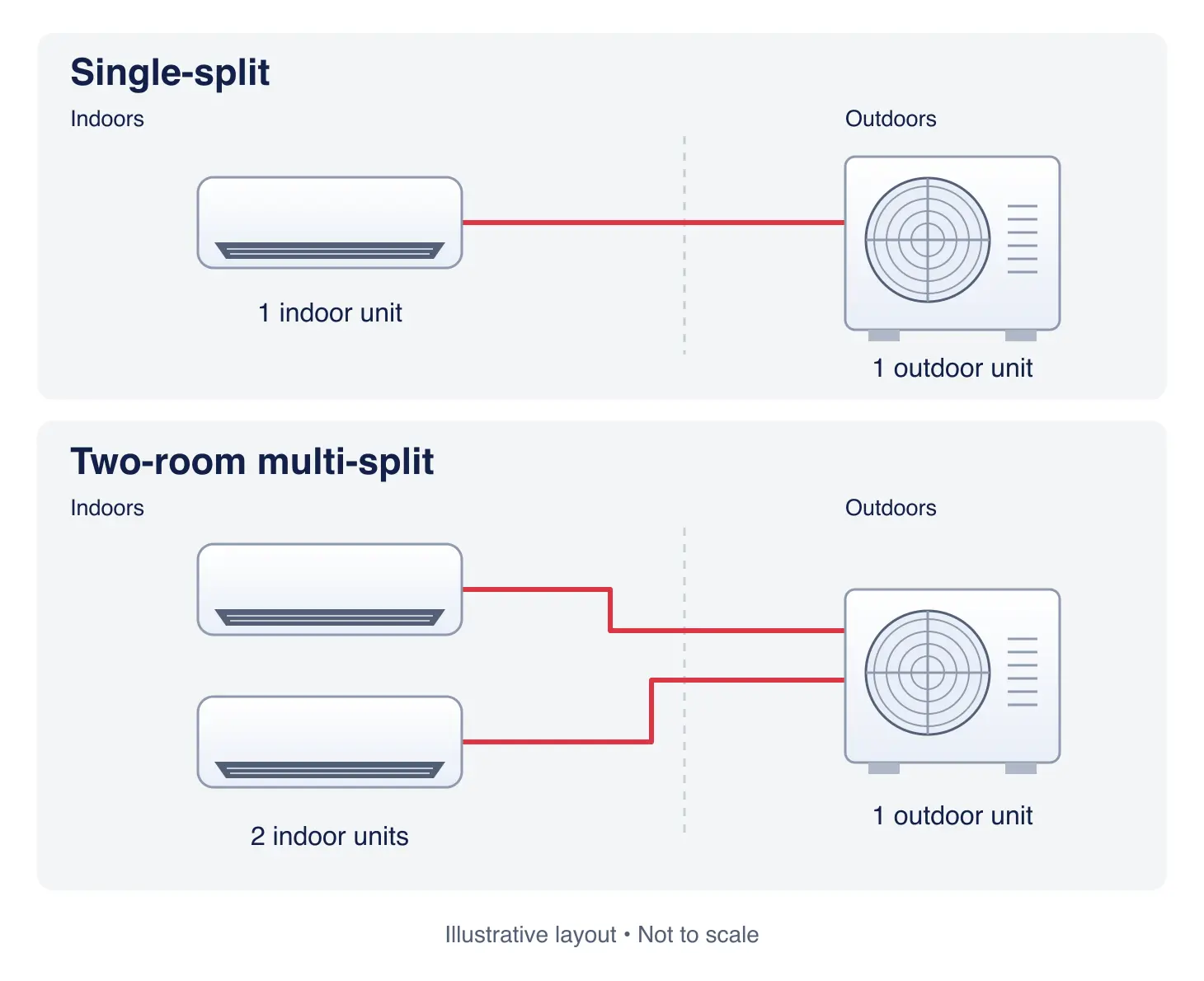
A single-split system connects one indoor unit to one outdoor unit. A multi-split system connects several indoor units to a shared outdoor unit. The number of rooms you want to control is therefore a better starting point than the number of bedrooms in your house.
For wider market context, OVO publishes an installed single-room estimate of £1,500-£3,500 and a whole-home estimate of £4,000-£10,000. Its guide does not specify VAT treatment alongside those ranges, so use them as broad context rather than a like-for-like quote comparison. Source: OVO installation cost guide.
Portable and ducted alternatives
A portable unit has a lower upfront cost and normally needs an exhaust hose vented outdoors rather than a permanent split-system installation. It can suit occasional use, but compare noise, electricity consumption and window arrangements before buying.
Ducted systems distribute air through concealed ducts. They need space for the ductwork and can involve substantial building work, particularly in an existing home. Get a design-specific quote rather than using the price of a ducted indoor unit as the total installed cost.
What changes your installation quote?
Two homes needing the same model can have different installation costs. Ask the installer to explain the following items in your quote.
Room assessment: Floor area, ceiling height, glazing, sunlight and occupancy affect the required capacity. A small sunny room may have different needs from a shaded room of the same size.
Pipe routes: Longer or concealed routes between indoor and outdoor units can mean more materials and work. Agree where any visible trunking will go.
Condensate drainage: Cooling produces water that needs a suitable drain route. Ask whether gravity drainage is possible or a pump is needed.
Electrical work: Confirm the required supply, protection and isolation, and whether any upgrades are included.
Access and finishing: High-level work, difficult outdoor-unit positions, scaffolding and making good can affect the total.
The written scope should identify the indoor and outdoor models, mounting arrangements, agreed pipework and drainage, electrical work, commissioning and handover. It should also state any exclusions.
Do not add a separate labour estimate to a price that already includes installation. Further information: Daikin’s installation cost factors.
Three ways the same home could approach cooling
One bedroom: Ask for a single-room design and a location that avoids blowing directly across the bed. The installation route and outdoor-unit position still need checking.
A bedroom and home office: Compare a two-room multi-split with separate single-split systems. Ask the installer to explain differences in equipment, routes, outdoor space and the rooms you expect to use together.
Several rooms across two floors: List each room you want to heat or cool. A three-bedroom house does not automatically need three indoor units, and a hallway unit should not be assumed to control every closed bedroom.
These are planning illustrations, not completed iHeat customer jobs or fixed installation specifications.
Does air conditioning qualify for zero VAT?
Yes, qualifying installations can. HMRC includes permanently fixed air-source heat pumps within energy-saving materials and explicitly recognises reversible units that heat and cool.
A qualifying installation in residential accommodation can receive 0% VAT across the UK until 31 March 2027. Current guidance says the rate then returns to 5% from 1 April 2027.
The relief can cover equipment supplied by the installer as part of the qualifying installation. Equipment bought on its own is normally standard-rated. Portable units do not meet the fixed heat-pump condition, and cooling-only equipment should not be assumed to qualify.
Ask your installer to confirm the VAT rate and basis on the written quote, including any separate building work. Zero-rated is not the same as VAT-exempt. Source: HMRC VAT Notice 708/6, sections 2.1, 2.3, 2.5 and 2.15.
Is there a grant for air conditioning?
The Boiler Upgrade Scheme currently lists £2,500 towards eligible air-to-air heat-pump installations in England and Wales. This is a heating-replacement scheme with property, system and installer requirements, not an automatic discount for adding bedroom cooling.
Ask an MCS-certified installer to check eligibility before relying on funding. Keep the full installation price, any approved grant and the amount you pay separate. No grant has been deducted from the package prices above. Sources: GOV.UK grant amounts and eligibility requirements.
How much does air conditioning cost to run?
Calculate the energy cost by multiplying electricity used in kilowatt-hours (kWh) by your electricity price per kWh.
If you know average electrical input instead, multiply that input in kilowatts (kW) by operating hours first.
For example:
0.7kW × 8 hours = 5.6kWh
At an assumed 30p/kWh, that costs £1.68.
The table uses three illustrative average electrical inputs. They are not measured results, model specifications or guaranteed consumption for a particular room.
Average electrical input | Per hour | 8 hours | 30 days at 8 hours a day |
|---|---|---|---|
0.4kW | 12p | £0.96 | £28.80 |
0.7kW | 21p | £1.68 | £50.40 |
1.0kW | 30p | £2.40 | £72.00 |
Assumptions: 30p/kWh including VAT, constant average input across the stated hours, and 30 days of use. Figures cover electricity only; they exclude installation, servicing, repairs and the standing charge you already pay for your electricity connection.
Cooling capacity is not electricity consumption
A unit described as 3.5kW usually has 3.5kW of cooling capacity. That is the rate at which it can remove heat under stated conditions, not necessarily its electrical input. Using that figure as consumption can give a misleading running-cost estimate.
Check the electrical-input specification for an estimate, or use measured kWh for an actual operating period. Inverter systems vary compressor output as demand changes, so rated input is not a promise of constant consumption.
What changes the bill?
Weather, sunlight, insulation, open doors and your target temperature all change the cooling required. Hours switched on also matter: maintaining one occupied room for an evening is different from cooling several rooms all day.
SEER means Seasonal Energy Efficiency Ratio. It helps compare cooling efficiency over standard seasonal conditions; it is not a guaranteed hourly result in your home. SCOP is the equivalent seasonal measure used for heating. Compare the ratings for the actual indoor and outdoor combination being quoted.
For a useful estimate, ask the installer for the expected electricity use and assumptions for your rooms. For a measured cost, multiply the system’s recorded kWh over a week by your tariff.
Use whole-home smart-meter readings cautiously because other appliances are included. Background: Energy Saving Trust on air-to-air heat pumps and running-cost uncertainty.
What temperature should you set to keep costs down?
Start around 24-26°C for daytime cooling and adjust to a comfortable level. This is a practical starting point, not a universal optimum. A higher cooling setpoint generally reduces the cooling demand, provided the room remains comfortable.
For sleeping, you could try 22-24°C if your daytime setting feels too warm. Adjust for your own comfort and avoid directing the airflow at the bed. These are comfort suggestions, not medical temperature recommendations.
Setting the controller to its minimum does not guarantee that the room will reach a comfortable temperature faster. It sets a colder target and can cause unnecessary cooling. Choose the temperature you actually want and allow the room to settle.
Match cooling to your routine. Use timers or schedules so cooling matches when you need the room. If it is unoccupied for several hours and no cooling is needed, switch off or raise the setpoint.
Reduce incoming heat. Close blinds against strong sun and keep windows closed while actively cooling. Ventilate separately when appropriate.
Check sleep mode. Use it if it suits you, checking the manual because its temperature and fan behaviour vary by model.
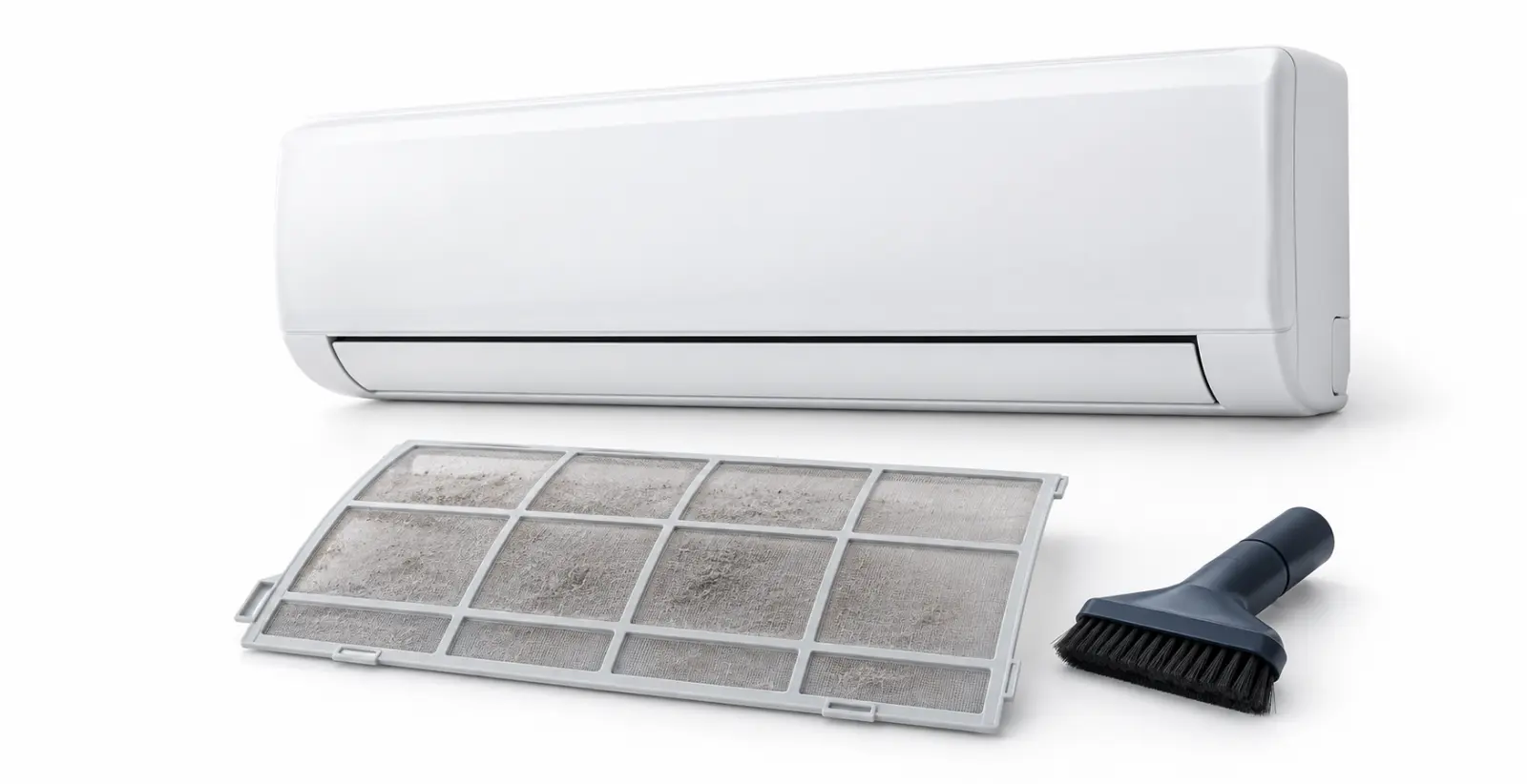
Keep airflow clear. Clean user-accessible filters as the manufacturer directs and keep airflow paths clear.
Avoid fixed savings claims such as a guaranteed percentage per degree. The result depends on the weather, building and system. Compare measured consumption over similar conditions if you want to understand your own usage.
What to budget for after installation
Allow for electricity and the maintenance your manufacturer requires. Ask for a service price covering your exact number of indoor and outdoor units, and clarify whether travel, VAT and any consumables are included. Repairs and replacement parts may be separate.
Check the warranty length, registration requirements, servicing conditions and who handles a claim. A longer warranty is useful only if you understand what it covers and what you must do to maintain it.
Use an appropriately qualified installer for refrigerant work. In Great Britain, work on stationary air conditioning containing F-gas requires the relevant qualifications; Gas Safe registration alone does not establish competence for that work. Northern Ireland has its own applicable F-gas requirements. Source: GOV.UK qualifications to work with F-gas.
Can the same system reduce winter heating costs?
A reversible air-to-air heat pump can provide room heating as well as cooling. It usually does not supply domestic hot water, so consider that separately if you are changing your main heating system. Source: Energy Saving Trust.
Whether it saves money depends on the heating it replaces, the electricity tariff and actual efficiency.
For an illustration, delivering 3kWh of heat at an assumed coefficient of performance of 3 uses 1kWh of electricity: 30p at the example tariff. A direct electric heater delivering the same heat would use about 3kWh, costing 90p.
That comparison is illustrative and does not establish savings against a gas boiler. Further reading: Daikin’s explanation of heating and cooling.
How to compare quotes fairly
Choose the rooms you want to control, then compare written quotes for the same job. Check the exact equipment, capacity assessment, installation routes, electrical work, drainage, VAT, exclusions and aftercare.
Ask separately about any landlord, freeholder or planning consent relevant to your property and location. Permission requirements should be checked before work is booked; a headline installation price does not settle them.
For occasional use, a portable unit may meet your needs at a lower upfront cost. For regular control of a bedroom, living space or home office, compare a fixed system’s installed price with its expected use and ongoing maintenance.
When you are ready for a price based on your home, start with the rooms you want to heat or cool and the possible indoor and outdoor positions.
Frequently Asked Questions
How much does air conditioning cost for one room?
iHeat’s single-room air conditioning packages start from around £2,245, including installation and VAT where applicable. Your final quote depends on the system, room requirements and installation work, such as pipework length and access to the outdoor unit.
How much does air conditioning cost to run for eight hours?
An air conditioner averaging 0.7 kW of electrical input would use 5.6 kWh over eight hours. At an electricity rate of 30p per kWh, that costs £1.68. This is an illustrative example: your actual cost depends on your tariff, system efficiency, room conditions and temperature setting.
Does a 3.5 kW air conditioner use 3.5 kW of electricity?
No. The 3.5 kW rating normally describes its cooling capacity, rather than its electrical consumption. To estimate running costs, use the unit’s electrical input or measured electricity use. Consumption also changes as the system adjusts its output to maintain the selected temperature.
Can the same air conditioning system heat my home?
Yes, a reversible air conditioning system can provide both heating and cooling. It works as an air-to-air heat pump, moving heat indoors when heating is selected. Whether it can meet your home’s heating needs depends on its output, the rooms served and the property’s heat loss.
Last updated:
Written by Stephen Day
Gas Safe Engineer at iHeat
Stephen Day is a Gas Safe registered and FGAS certified engineer with over 20 years of hands-on experience in the heating, cooling, and renewable energy industry, specialising in boiler installations, air conditioning, and heat pump systems.
LinkedInArticles by Stephen Day are reviewed by iHeat’s technical team to ensure accuracy and reliability.
Contributors

Renewables Manager
More air conditioning help & advice
02nd October, 2026
Air Conditioning Maintenance:...
A practical guide to looking after home air conditioning, from cleaning washable filters t...
 Read Article
01st October, 2026
Best wall mounted air conditio...
Compare wall mounted air conditioners for quiet bedrooms, everyday comfort and lower upfro...
Read Article
29th September, 2026
Air Conditioning vs Air Source...
A reversible air conditioner heats and cools the rooms it serves. An air-to-water heat pum...
Read Article