The best air source heat pumps available in 2026

Written by Stephen Day
Gas Safe Engineer
Updated:
18 min read
Compare current heat pump ranges, understand the differences that matter and choose a system suited to your home.
In this article
Key takeaways
- Compare exact models. Product generations and specifications differ.
- Size for heat loss. Bedroom count alone is not enough.
- Check complete costs. Include installation, upgrades and grant eligibility.
- Prioritise system design. Radiators, controls and installation affect performance.
The new Vaillant aroTHERM plus, Mitsubishi Electric Ecodan R290, Samsung EHS Mono R290, Daikin Altherma 4 H and LG THERMA V R290 Monobloc are all worth comparing for a UK home. Each offers a different combination of equipment, controls and installation options.
The best heat pump is the model that matches your home’s heat loss, heating system and available space. A higher brochure efficiency or longer advertised warranty does not automatically make it the better installation.
This guide covers air-to-water heat pumps, which supply radiators or underfloor heating and can heat stored domestic hot water.
How we have compared these heat pumps
This shortlist uses current UK manufacturer information and considers:
Suitability: whether the available models can meet the property’s heating needs.
Efficiency: performance at the temperatures the heating system will actually use.
Installation: outdoor positioning, indoor equipment and electrical requirements.
Everyday use: controls, hot water arrangements and noise.
Ownership costs: the complete installation, servicing and warranty conditions.
This is a specifications-based buying guide, not a hands-on laboratory test or a reliability league table. iHeat is a heating installer with a commercial interest in installations; inclusion here does not mean every model is available through iHeat.
Which heat pumps should you shortlist?
Start with the feature that matters to your project, then ask an installer to compare suitable sizes.
New Vaillant aroTHERM plus: consider it for a coordinated Vaillant heating system, with the updated outdoor unit and compatible controls.
Mitsubishi Electric Ecodan R290: consider it where its range of outputs, cylinder options or coastal-protection variants suit the property.
Samsung EHS Mono R290: consider it for its range of capacities and compatible SmartThings controls.
Daikin Altherma 4 H: consider it when comparing high-temperature heating capability and different indoor system configurations.
LG THERMA V R290 Monobloc: consider it as an alternative to older THERMA V R32 equipment, checking the precise size and electrical supply.
These are starting points for comparison. They are not exclusive advantages: several manufacturers offer high-temperature operation, remote controls and different installation configurations.
Which heat pumps are the best currently?
The best heat pump for your home is the one that can meet its heating and hot-water needs efficiently at the temperatures your system requires. A headline efficiency figure or familiar brand name cannot tell you that on its own.
The models below deserve consideration for different reasons. These are comparisons of published specifications, rather than results from independent testing in identical homes.
How to read the technical figures
Manufacturers publish performance at particular outdoor and heating-water temperatures. Understanding these conditions makes the numbers much more useful.
Technical term | What it means |
|---|---|
A7/W35 | Outdoor air at 7°C and heating water leaving the heat pump at 35°C. |
A−7/W55 | Outdoor air at −7°C and heating water leaving at 55°C: a more demanding operating condition. |
COP | Efficiency at a particular test condition. A COP of 4 means 4kWh of heat for each 1kWh of electricity at that point. |
SCOP | Calculated seasonal efficiency under a defined assessment method and climate. It is not a guaranteed result for your home. |
Heating output | Heat delivered in kW. Check the output available in cold weather at your required flow temperature. |
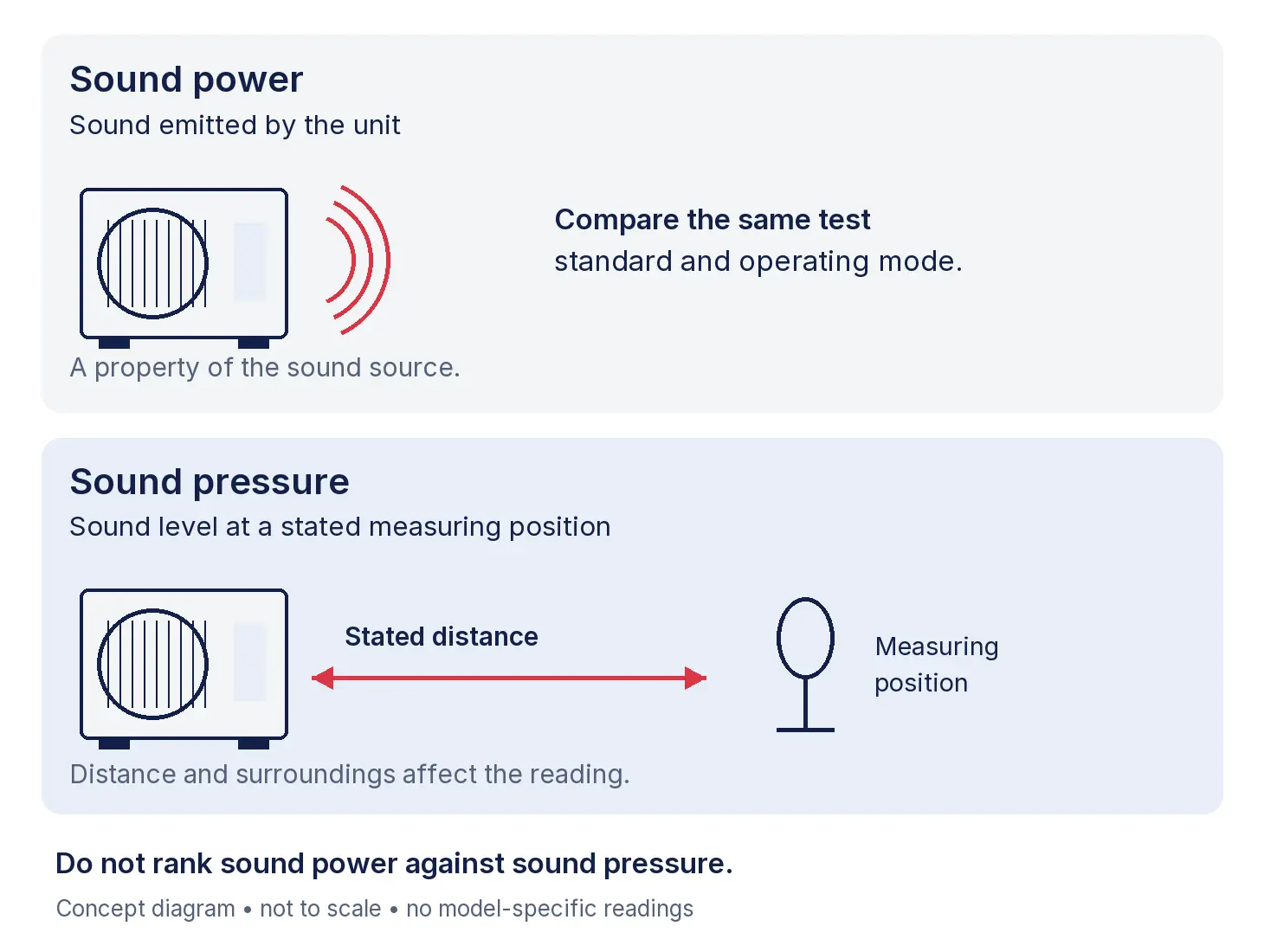
Sound power | Noise emitted by the unit. This is different from sound pressure measured at a particular distance. |
Compare figures using the same test conditions and assessment method. In particular, MCS-labelled SCOP figures and other published seasonal figures should not automatically be treated as one league table.
Vaillant aroTHERM plus
An updated range with flexible siting options
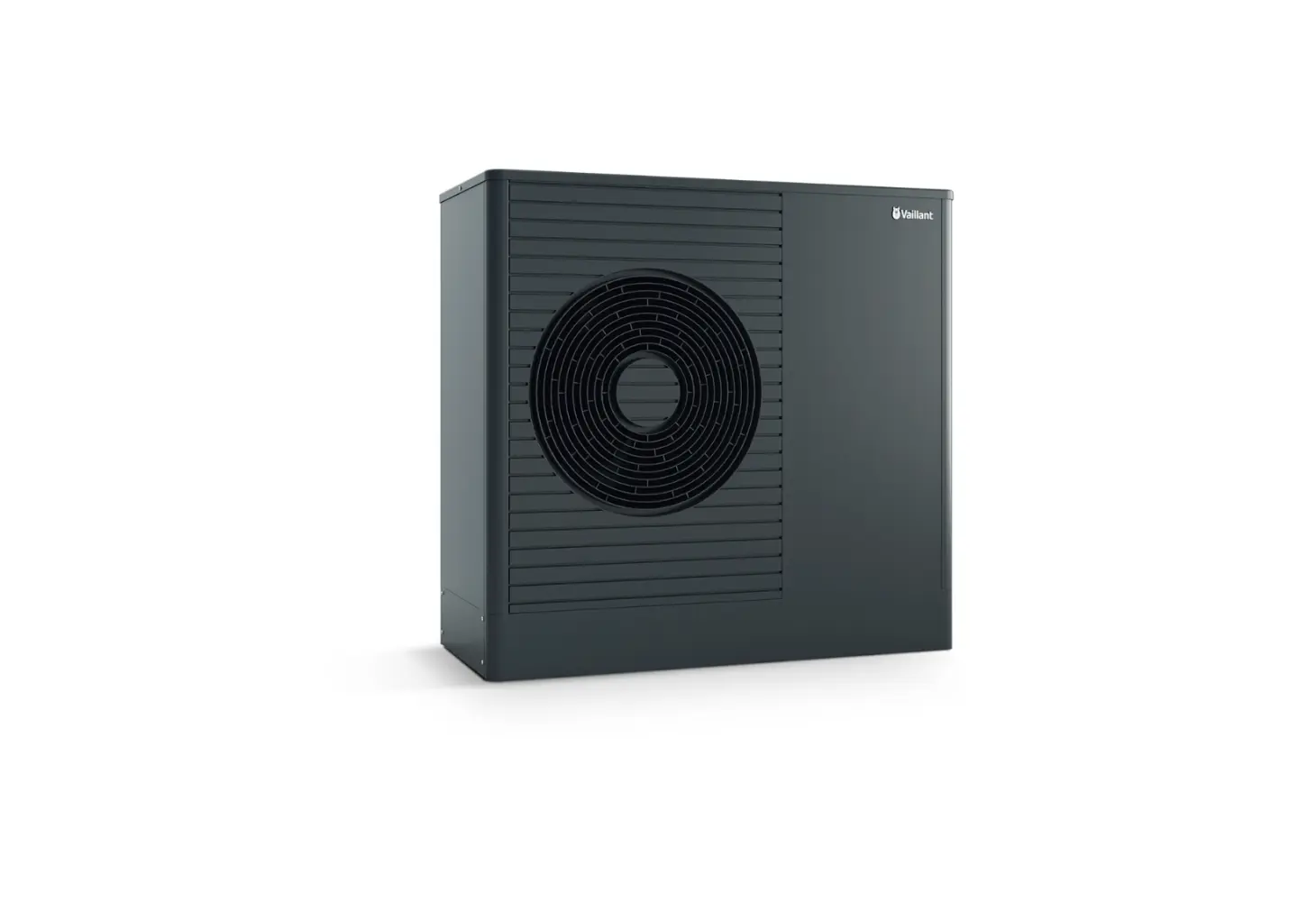
The new aroTHERM plus Series 8.1 is worth considering where the location of the outdoor unit is a significant part of the installation design.
Vaillant offers 3.5, 5, 7, 10 and 12kW versions. Its Flexible Space Function can reduce the required refrigerant protection zone in suitable installations. This does not remove the need for airflow, servicing access or compliance with the installation instructions. Vaillant’s current UK range.
New aroTHERM plus specifications
The following figures relate to the 230V Series 8.1 models, rather than the previous generation.
Nominal model size | Published SCOP: low-temperature application | Published SCOP: medium-temperature application | Outdoor unit dimensions: W × H × D |
|---|---|---|---|
3.5kW | 4.97 | 3.65 | 1,100 × 765 × 450mm |
5kW | 4.83 | 3.64 | 1,100 × 765 × 450mm |
7kW | 4.98 | 3.62 | 1,100 × 965 × 450mm |
10kW | 5.12 | 3.85 | 1,100 × 1,480 × 450mm |
12kW | 5.20 | 3.94 | 1,100 × 1,480 × 450mm |
The range uses R290 refrigerant and supports flow temperatures up to 75°C. For a cold-weather reference, Vaillant publishes 6.94kW output and a COP of 2.94 at A−7/W35 for the 7kW model. Vaillant UK technical data.
What the figures mean for your home
The difference between the seasonal figures shows why radiator sizing and flow temperature matter. A heat pump capable of producing high-temperature water can still benefit from a system designed to run cooler.
The table also shows a substantial increase in cabinet height for the 10 and 12kW models. Include the unit’s appearance and position in the survey, rather than assuming every size has the same outdoor footprint.
Warranty terms need checking alongside the equipment specification. Vaillant advertises a standard two-year guarantee, with longer cover available through qualifying installation and registration arrangements. Cylinder choice can affect the package and cost. Vaillant’s new aroTHERM plus.
Before choosing: ask the installer to identify the exact Series 8.1 model, confirm the proposed protection zone and show its output at your home’s winter design temperature.
What about the Vaillant aroTHERM pro?
The aroTHERM pro is a separate range, available in 5, 7 and 11kW sizes. Do not apply the aroTHERM plus figures above to it.
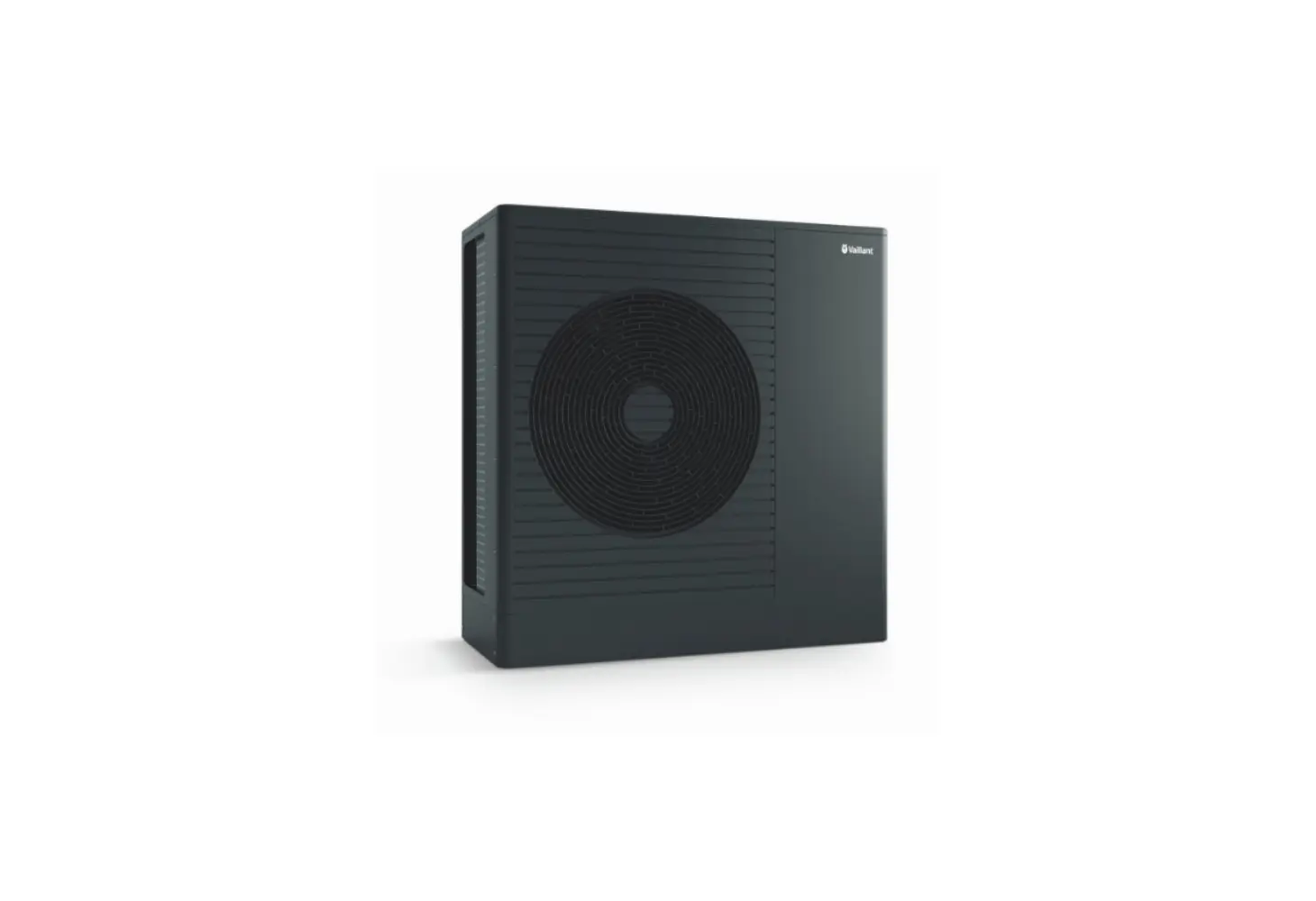
Compare the complete specification and controls package. For example, Vaillant states that myVAILLANT connect is required for app control and is not included as standard with the pro. Its standard guarantee and paid servicing or protection plans should also be distinguished when comparing quotations. Vaillant aroTHERM pro.
Mitsubishi Electric Ecodan R290
Clear cold-weather performance information
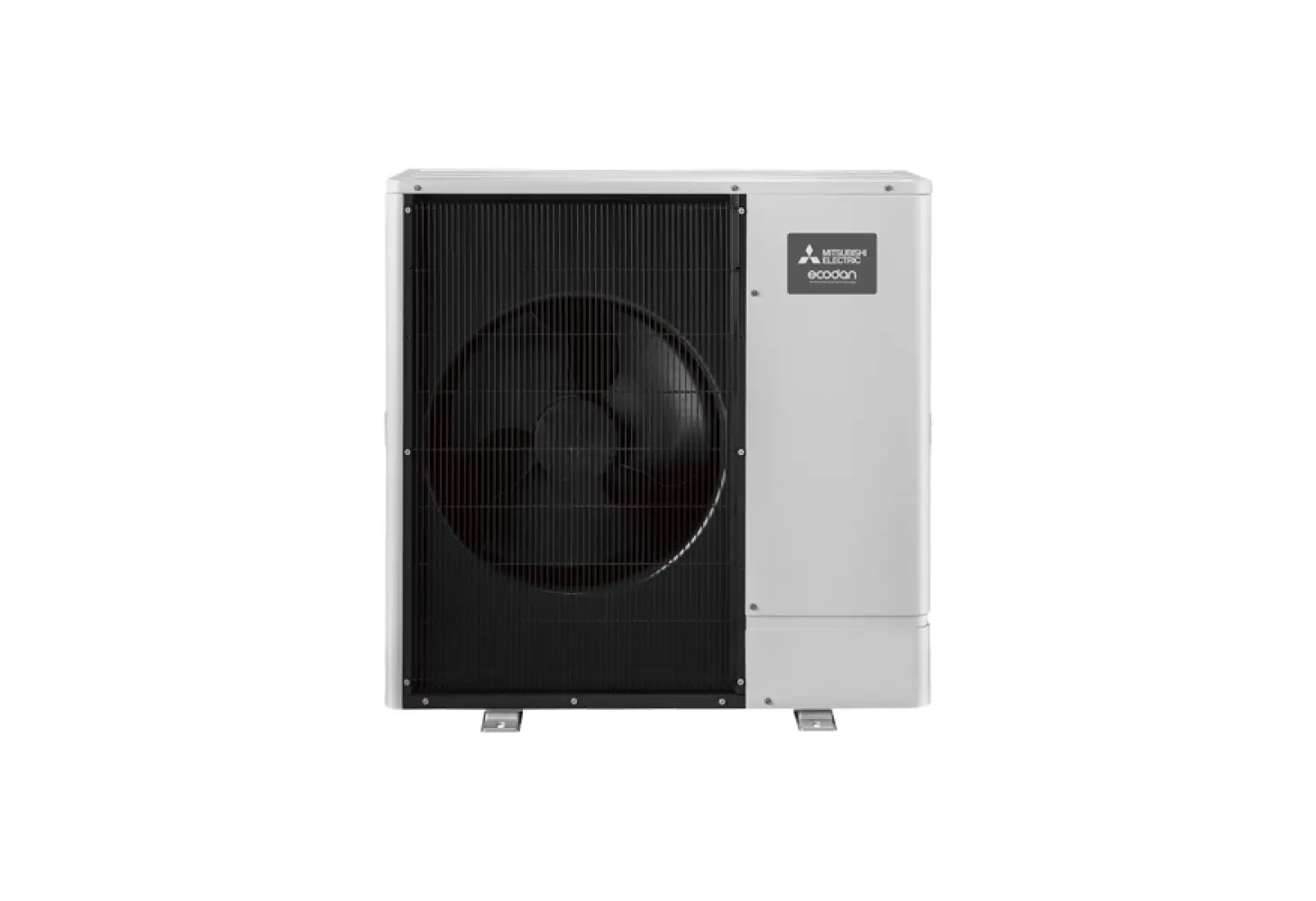
The Ecodan R290 range includes 5, 6, 8.5, 10 and 12kW models. Mitsubishi also offers coastal-protection versions, which are worth discussing if the property is exposed to sea air.
The range supports water temperatures up to 75°C, with an advertised operating range extending down to −25°C. These limits do not mean every model delivers its nominal output and maximum water temperature simultaneously in all conditions. Mitsubishi Electric’s UK Ecodan R290 range.
Ecodan R290 specifications
Mitsubishi’s UK product sheet gives the following figures for its larger models.
Model | Normal heating output at A−7/W35 | COP at A−7/W35 | SCOP at 35°C, labelled MCS | SCOP at 55°C, labelled MCS |
|---|---|---|---|---|
PUZ-WZ85V/YAA | 8.5kW | 2.60 | 4.47 | 3.51 |
PUZ-WZ100V/YAA | 10.0kW | 2.70 | 4.62 | 3.48 |
PUZ-WZ120V/YAA | 11.5kW | 2.45 | 4.71 | 3.51 |
All three use an outdoor cabinet measuring 1,050mm wide × 1,040mm high × 480mm deep. The sheet lists sound power levels of 54, 55 and 55dB(A) respectively under its stated test conditions. Mitsubishi Electric UK product information sheet.
What the figures mean for your home
The cold-weather output is more useful for sizing than the model name alone. For example, the 12kW version has a published normal heating output of 11.5kW at A−7/W35. That is a specific operating point, not a statement that 11.5kW is its maximum output under every condition.
The models share a cabinet size, but that is not a reason to choose a larger capacity. The installer should also consider how the selected unit behaves during milder weather, when the house needs much less heat.
Before choosing: request the performance at your proposed radiator flow temperature. A figure measured with 35°C water is insufficient on its own if the heating design requires 50–55°C on cold days.
Samsung EHS Mono R290
Compare the complete heating and hot-water package
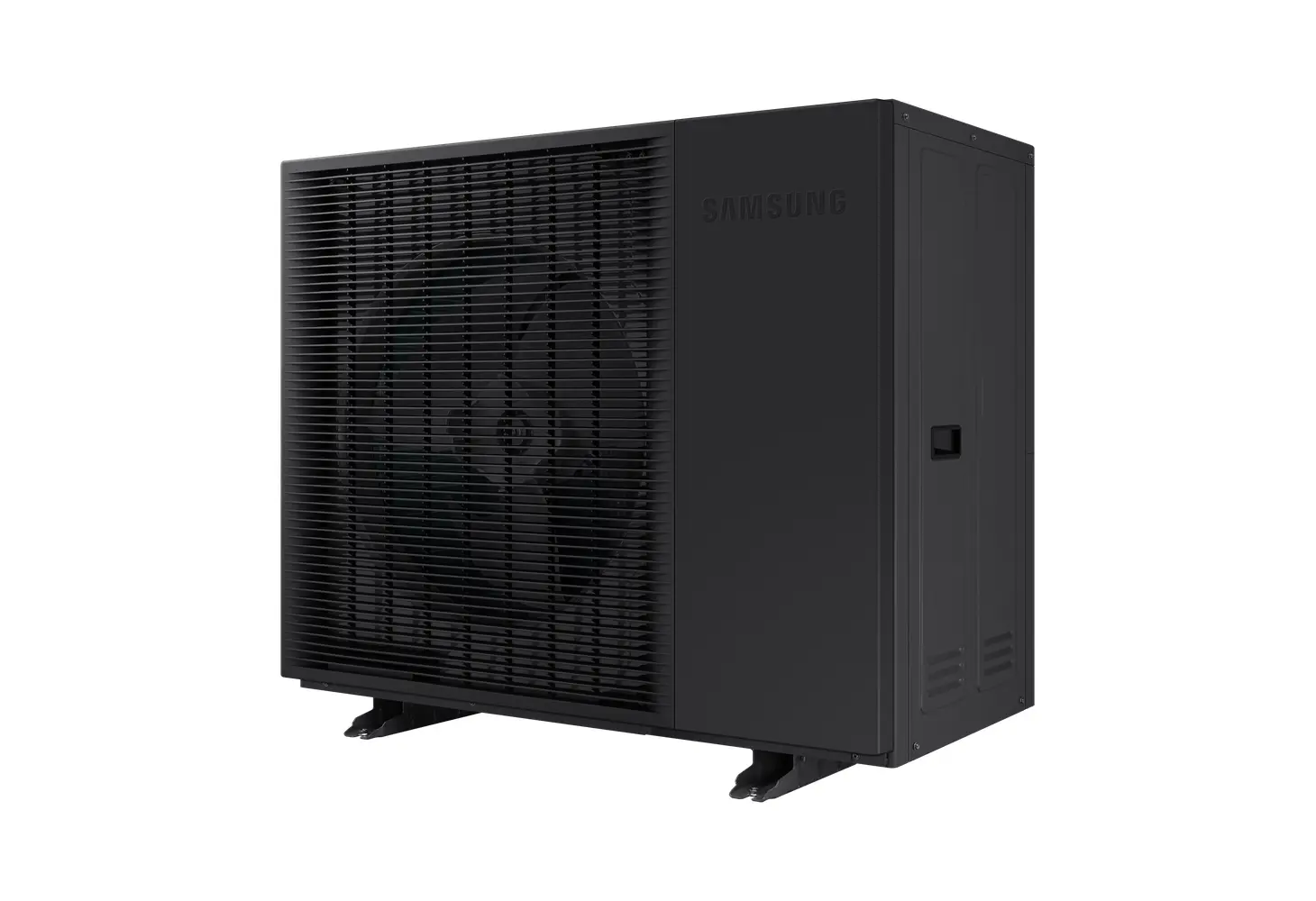
The Samsung EHS Mono R290 deserves consideration where the controls, cylinder arrangement and outdoor unit need to work together within a specific installation plan.
Samsung offers its own ClimateHub arrangements, while compatible third-party cylinders can be used with the appropriate control equipment. This makes the contents of the quotation particularly important.
Samsung EHS Mono R290 8kW specifications
These figures relate to the single-phase AE080CXYDEK/EU outdoor unit.
Specification | Published figure |
|---|---|
Refrigerant | R290 |
Nominal heating output at A7/W35 | 8.0kW |
Nominal heating electricity input | 1.63kW |
Nominal heating COP | 4.91 |
Outdoor unit dimensions: W × H × D | 998 × 850 × 500mm |
Published sound power | 59dB(A) |
Maximum heating-water temperature | 75°C, subject to outdoor conditions |
Outdoor heating operating range | −25°C to 35°C |
Samsung specifies that the 75°C water-temperature capability applies at outdoor temperatures between −10°C and 35°C. It should not be presented as a guaranteed capability at the bottom of the entire operating range. Samsung UK 8kW product specifications.
What the figures mean for your home
The 4.91 COP is a test-point figure, not an annual efficiency forecast. Electricity use will change as outdoor conditions, water temperature and hot-water demand change.
Samsung’s UK information identifies 200-litre and 260-litre ClimateHub options, alongside the alternative of a compatible third-party tank and Mono Control Kit. Cylinder capacity should follow the household’s hot-water needs, rather than simply matching the outdoor unit’s nominal size. Samsung UK 8kW product sheet.
SmartThings connectivity also requires the appropriate Wi-Fi equipment and account setup. Confirm whether this is included in the quoted package. Samsung UK specifications.
Before choosing: obtain a written equipment list covering the cylinder, controller, connectivity equipment and commissioning. Two quotations for the same outdoor unit can include substantially different systems.
Daikin Altherma 4 H
Look closely at the indoor-unit combination
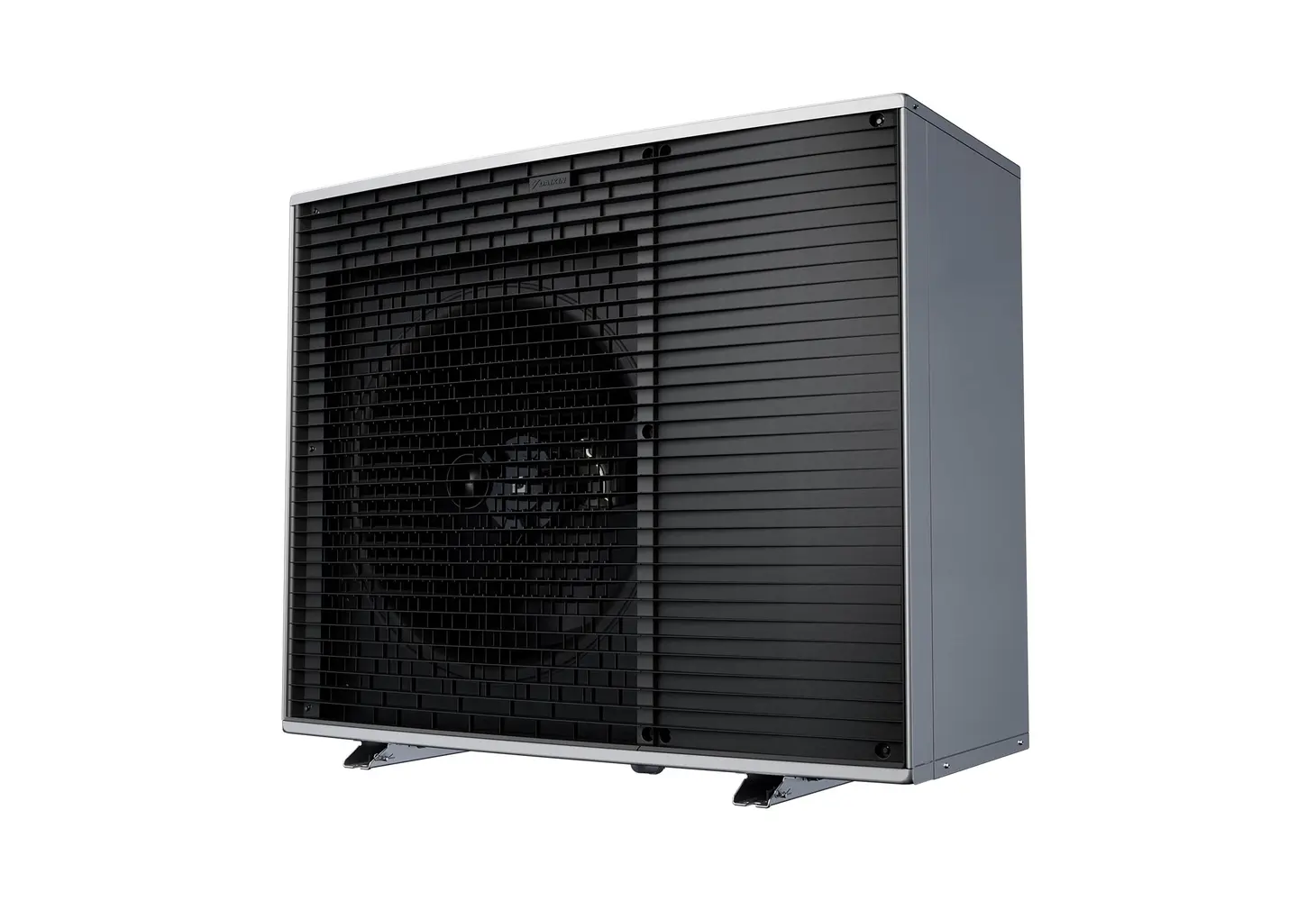
The Daikin Altherma 4 H is worth investigating for projects where higher heating-water temperatures are part of the design.
Daikin advertises 70–75°C leaving-water temperatures at −15°C outdoor temperature, depending on the model and operating conditions, using heat-pump operation. It also states operation down to −28°C. These are capability limits; they do not establish the running cost of a particular installation. Daikin Altherma 4 H product information.
Daikin Altherma 4 H specifications
The examples below use the EPSXB10P30AF indoor unit paired with the listed outdoor units. Seasonal figures are for an average climate.
Outdoor unit | Nominal output at A7/W35 | COP at A7/W35 | SCOP at 35°C | SCOP at 55°C |
|---|---|---|---|---|
EPSK06ARV3 | 5.81kW | 5.19 | 5.12 | 3.91 |
EPSK08ARV3 | 7.62kW | 5.01 | 5.15 | 3.97 |
EPSK10ARV3 | 8.11kW | 4.94 | 5.15 | 4.02 |
These are nominal test-point outputs for specific combinations. They are not maximum-output figures or the complete Altherma 4 range. Daikin UK technical table.
What the figures mean for your home
The similar seasonal figures do not make these units interchangeable. The correct selection still depends on available output at the property’s design conditions and its behaviour when heating demand is low.
The indoor unit deserves as much attention as the outdoor model. The ECH₂O combination shown here uses a thermal-store arrangement. It should not be described as though it were simply a conventional hot-water cylinder.
The listed package also includes an electrical backup heater. Its presence does not mean it runs continuously, but the proposed controls and expected use should be explained. Daikin’s ECH₂O combination.
Before choosing: ask for both indoor and outdoor model codes, the hot-water storage arrangement, and the assumptions about backup-heater use in the annual electricity estimate.
LG THERMA V R290 Monobloc
Useful performance detail at different temperatures
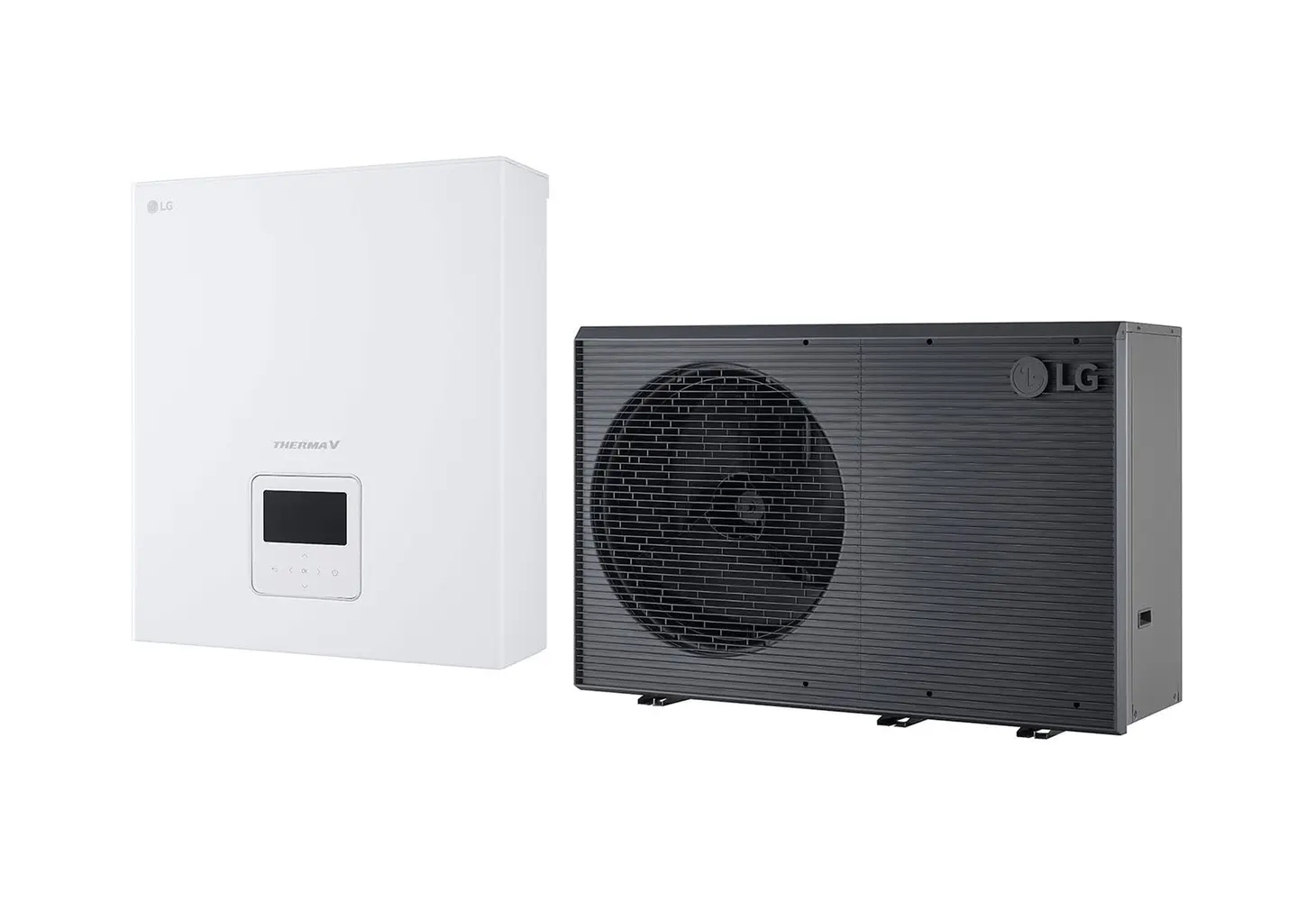
The LG THERMA V R290 Monobloc provides a useful example of why performance needs checking at more than one operating point.
For the HM123HF UB60 model, LG publishes output and efficiency at both mild and cold outdoor temperatures, with either 35°C or 55°C heating water.
LG THERMA V 12kW performance
Test condition | Published heating output | Published COP |
|---|---|---|
A7/W35 | 12.0kW | 4.70 |
A7/W55 | 10.0kW | 3.10 |
A−7/W35 | 11.8kW | 3.27 |
A−7/W55 | 9.3kW | 2.32 |
This particular model uses a three-phase electrical supply. Its outdoor cabinet measures 1,560mm wide × 1,019mm high × 520mm deep. These specifications should not be applied to every model in the THERMA V range. LG UK model specifications.
What the figures mean for your home
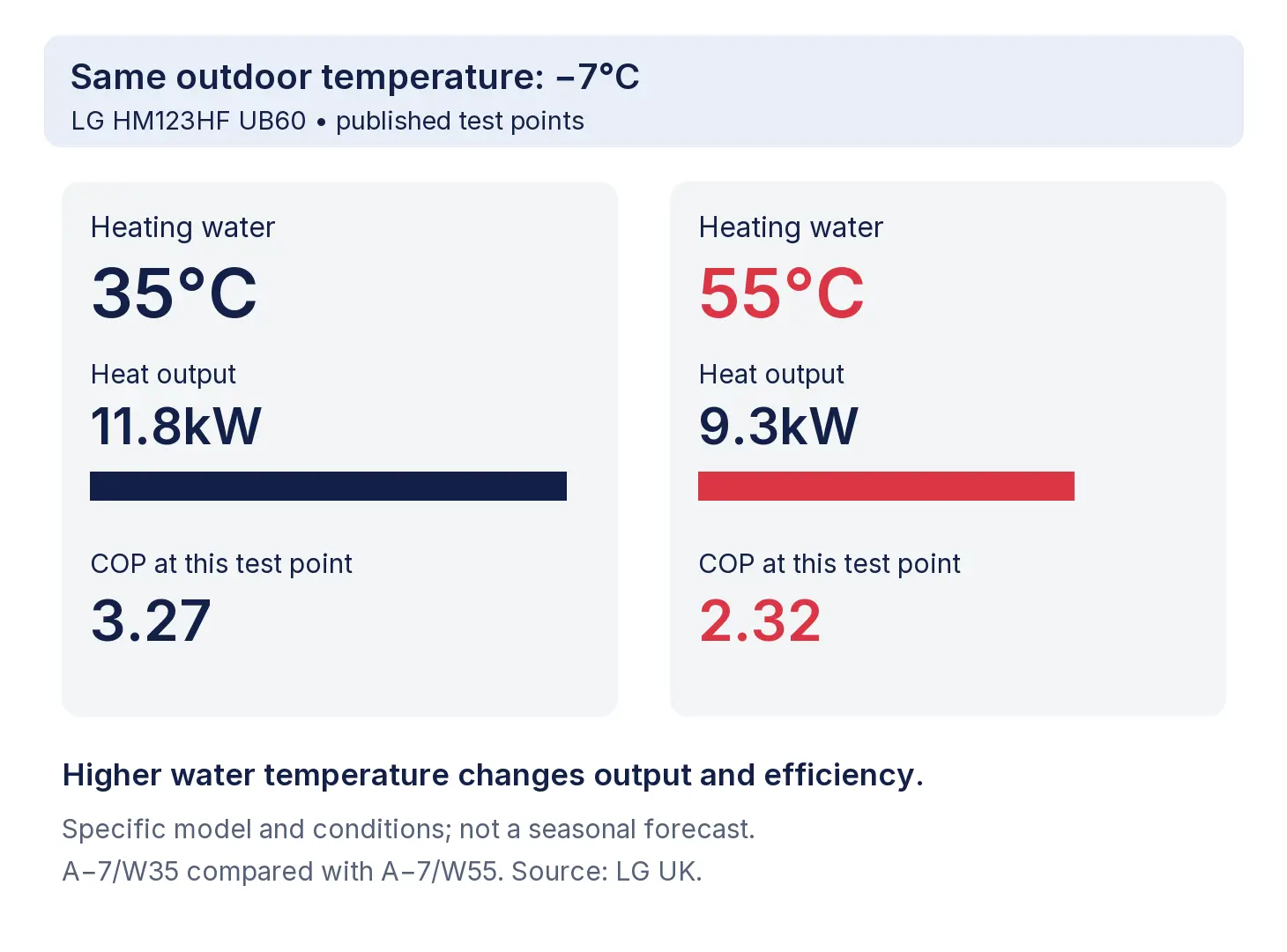
At −7°C outdoors, increasing the test water temperature from 35°C to 55°C reduces the published output from 11.8kW to 9.3kW, while COP falls from 3.27 to 2.32.
This demonstrates why a “12kW heat pump” label is not enough to establish suitability. The usable output at the required water temperature is what matters.
Before choosing: confirm the electrical supply, winter output and available outdoor space. The cabinet width is only part of the space requirement; the installation also needs the manufacturer’s specified clearances.
What should a good heat pump quotation tell you?
A useful quotation should connect the chosen product to your home’s requirements.
Information to request | Why it matters |
|---|---|
Exact outdoor and indoor model codes | Identifies the generation, capacity and equipment combination being supplied. |
Room-by-room heat-loss calculation | Establishes heating demand and helps identify any radiator changes. |
Output at the design outdoor and flow temperatures | Checks whether the selected heat pump can meet the winter heating load. |
Minimum heating output or modulation information | Helps assess operation in milder weather, when demand is lower. |
Annual electricity estimate with assumptions | Shows the expected effect of heating, hot water and any backup-heater use. |
Cylinder or thermal-store specification | Confirms how the system will meet household hot-water demand. |
Siting, clearance and noise assessment | Checks whether the proposed location is suitable. |
Itemised installation and warranty terms | Makes it easier to compare complete systems and ongoing obligations. |
A well-supported recommendation should explain why a particular model suits your home. The strongest evidence is a design that connects heat loss, radiator requirements, hot-water use and site conditions to the selected equipment.
Which heat pump is best for your type of home?
The property assessment should narrow the shortlist before brand preference determines the choice.
Smaller or well-insulated homes
Look at minimum heating output as well as maximum output.
A home with a low heating requirement may spend much of the year needing less heat than the unit’s nominal rating. Ask how the proposed model reduces its output in mild weather and how the design avoids excessive starting and stopping.
Buying a larger heat pump “just in case” is not automatically an improvement.
Older homes with radiators
Start with the room-by-room heat loss and the output of each radiator at the proposed water temperature.
An older property does not automatically need every radiator replaced. Equally, a heat pump capable of hotter water does not prove that all existing radiators and pipework can stay.
Ask which upgrades are necessary, which are optional and how each option affects expected running costs.
Larger homes or households using more hot water
Treat space heating and hot water as related but distinct design questions.
The heat pump must meet the heating requirement, while the cylinder and reheating strategy must suit baths, showers and the times hot water is needed. More occupants do not automatically justify choosing the largest outdoor unit.
Your installer should explain the cylinder capacity, expected recovery time and how hot water production fits around space heating.
Homes with limited outdoor space
Check the installed space requirement, including airflow, service access, drainage and model-specific positioning rules.
The cabinet dimensions alone are not enough. A unit that physically fits into a gap may still be unsuitable for that location.
R290 equipment also has manufacturer-specific protective-zone requirements. Have the installer assess the proposed location against the exact installation manual.
For more on matching the equipment to the property, see our guide to choosing the right size heat pump.
How should you compare heat pump efficiency?
Compare equivalent test conditions, then ask for a property-specific estimate.
Three terms commonly appear in quotations and brochures:
COP: the heat delivered per unit of electricity at a particular operating condition.
SCOP: a standardised seasonal efficiency figure for a stated climate and heating-water temperature.
Seasonal performance factor: performance over a period for a defined system; what electricity and heat are included must be clear.
A COP of 5 at one favourable test point does not mean the installed system will deliver five units of heat per unit of electricity throughout winter.
Likewise, SCOP figures at 35°C and 55°C are not like-for-like comparisons.
Why flow temperature matters
Flow temperature is the temperature of the water leaving the heat pump for the heating system.
Lower flow temperatures generally improve heat pump efficiency, provided the radiators or underfloor heating can still keep the rooms comfortable. That is why radiator assessment and weather-compensated controls matter alongside the outdoor unit. MCS domestic heat pump design guidance.
Ask for the proposed design flow temperature and the expected seasonal performance for your home, including the assumptions behind the estimate.
Check winter output, not just the model name
A nominal “8kW” heat pump does not necessarily provide exactly 8kW under every combination of outdoor and water temperature.
The installer should match the equipment’s output at the design conditions to the calculated heat loss. MCS recommends room-by-room calculations that account for the building fabric, ventilation, room dimensions and temperatures. MCS heat loss guidance.
Ask how cold-weather capacity, defrosting and any supplementary heating have been considered. Energy Saving Trust’s sizing guidance.
Which air source heat pump is quietest?
There is no useful universal winner without comparing the same measurement and operating conditions.
Brochures can quote:
Sound power: the sound emitted by the equipment.
Sound pressure: the sound level at a stated position or distance.
Quiet-mode figures: measurements under a particular restricted operating mode.
A sound-pressure figure measured several metres away cannot be ranked directly against another unit’s sound-power figure.
Ask the installer to assess the selected unit in its proposed position, including nearby windows, neighbours and reflective surfaces. If quiet mode is needed, check whether it changes the available heating output.
Choose a location and operating strategy that work together, rather than choosing solely by the smallest decibel number in an advert.
How much do the best heat pumps cost to install?
Energy Saving Trust gives an indicative air source heat pump installation cost of around £12,000, before deducting any grant. It identifies equipment size, the property and radiator upgrades as factors affecting the price. This is a broad budgeting reference, not a model-specific quotation or a promise of identical inclusions. Energy Saving Trust installation costs.
For an accurate comparison, obtain the total installed price, with VAT treatment and grant deductions shown separately.
Check that each quotation explains:
The outdoor unit and exact model code.
Indoor equipment, cylinder and controls.
Radiator and pipework changes.
Electrical work and any supply upgrades.
Base, drainage and access work.
Removal of the old heating equipment.
Commissioning, handover and warranty registration.
Exclusions and the cost of ongoing servicing.
Qualifying residential heat pump installations currently benefit from 0% VAT until 31 March 2027. Buying equipment separately or adding unrelated building work can have different VAT treatment. HMRC guidance.
How much can a grant reduce the price?
In England and Wales, the Boiler Upgrade Scheme currently offers £7,500 towards an eligible air-to-water heat pump.
Until March 2027, an additional £1,500 is available where the property is heated by oil or LPG and has no mains gas connection, subject to eligibility. That can bring the total grant to £9,000. Current Boiler Upgrade Scheme grants.
Illustrative example: a complete installation quotation of £12,000 including applicable VAT would leave £4,500 to pay after a £7,500 grant, or £3,000 after a £9,000 grant. These are calculations, not advertised installation offers.
Scotland and Northern Ireland have different funding arrangements. Do not assume the England and Wales grant applies across the UK.
Is a more expensive heat pump cheaper to run?
Not necessarily. The relevant comparison is the installed system’s expected performance, electricity tariff and total cost.
Consider an illustration using:
12,000kWh of useful heat per year.
Electricity at an assumed 25p per kWh.
Seasonal performance measured across the same system boundary.
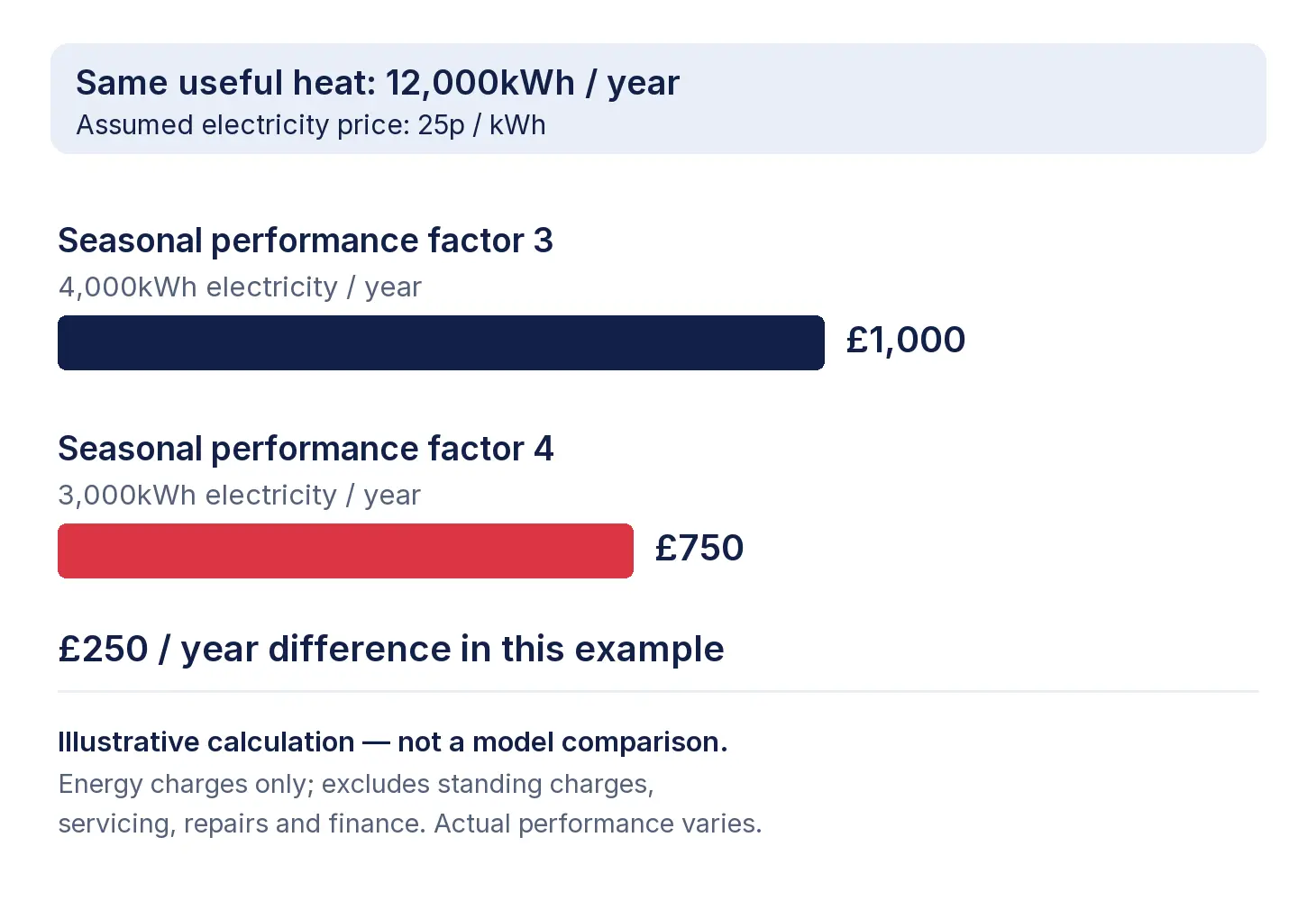
At a seasonal performance factor of 3, electricity consumption would be 4,000kWh, costing £1,000.
At a seasonal performance factor of 4, consumption would be 3,000kWh, costing £750.
The difference is £250 a year. A £1,500 installation premium would therefore take six years to recover through that saving alone, if those assumptions held.
This example excludes standing charges, servicing, repairs, finance and future tariff changes. It is not a prediction for any model.
Before paying more, ask whether the expected improvement comes from the heat pump itself, better radiators, improved controls or a more suitable overall design.
How important are warranty and local support?
Compare the cover you will actually receive, not just the longest advertised term.
Before accepting a quotation, confirm:
Whether parts, labour and call-outs are included.
Any installer-accreditation or registration requirements.
Required servicing and its cost.
Which cylinders, controls and accessories are covered.
Who handles a fault: the installer, manufacturer or a separate service provider.
Whether ongoing monitoring or a paid service plan is required.
A manufacturer’s equipment warranty and an installer’s workmanship cover may be separate.
Ask who can service the exact model locally and what happens if the original installer stops trading. Our guide to heat pump maintenance and costs explains the ongoing considerations.
Frequently Asked Questions
Should I replace an older heat pump because a newer model is available?
Not simply because a new generation has launched. Compare the existing system’s condition, measured performance, repair needs and remaining warranty with the full cost of replacement.
Does choosing an R290 heat pump guarantee lower bills?
No. R290 is a refrigerant with a low global warming potential, but refrigerant choice alone does not determine running costs.
The model’s performance, system design, flow temperature, controls and electricity tariff all affect the result.
Can I keep my existing hot water cylinder?
Possibly, but compatibility needs checking. The installer should assess its heat exchanger, capacity, controls and suitability for the proposed heat pump.
A cylinder that worked with a boiler should not automatically be assumed suitable for the new system.
Can an air-to-water heat pump cool the house too?
Some equipment supports cooling, but the whole installation must be designed for it. Compatible emitters, controls, insulation and condensation management may be needed.
Do not assume a standard radiator installation will provide useful cooling just because the outdoor unit has a cooling specification.
Last updated: