


Can You Install Air Conditioning in a Flat? Permissions and Options Explained

Written by Stephen Day
Gas Safe Engineer
Updated:
Yes, many flats can have air conditioning installed. The right system depends on your lease, permissions and the property's layout.
Key takeaways
- Many flats can have fixed air conditioning, but additional permissions may be required.
- Lease terms, freeholder consent and outdoor unit placement are often the biggest considerations.
- If a split system isn't suitable, there may be alternative cooling options for your property.
Installing air conditioning in a flat is often more straightforward than homeowners expect. While there are usually more considerations than with a house, living in a flat doesn't automatically prevent you from having a fixed cooling system.
From our experience, the biggest challenge isn't usually choosing the air conditioner itself. It's understanding the restrictions that apply to the building before deciding which type of system is most suitable. Once these have been assessed, many flat owners find they have more options than they first thought.
Can you install air conditioning in a flat?
In many cases, yes.
Whether a fixed air conditioning system is suitable depends on factors such as your lease, the layout of the building and whether there's an appropriate location for the outdoor unit. Every development is different, which is why installations are assessed on a property-by-property basis rather than using a one-size-fits-all approach.
From our experience, homeowners are often surprised to learn that the installation itself isn't always the biggest hurdle. More commonly, it's understanding the building's requirements and identifying the most suitable installation method before work begins.
Who do you need permission from?
Before arranging an installation, it's important to understand who needs to approve the work.
If you own a leasehold flat, your lease may require permission from the freeholder or management company before changes can be made to the building, particularly where an outdoor unit will be installed. If you're renting, you'll normally need your landlord's consent before a fixed system can be fitted.
These permissions are designed to protect the building, communal areas and other residents where external alterations are involved.
Depending on the property, planning rules may also apply. We explain these in more detail in our guide to planning permission for air conditioning, but for many flat owners, checking the lease is often the first step.
Why are flats different from houses?
Unlike houses, flats often share external walls, roofs and communal spaces, which means there are additional factors to consider before installing air conditioning.
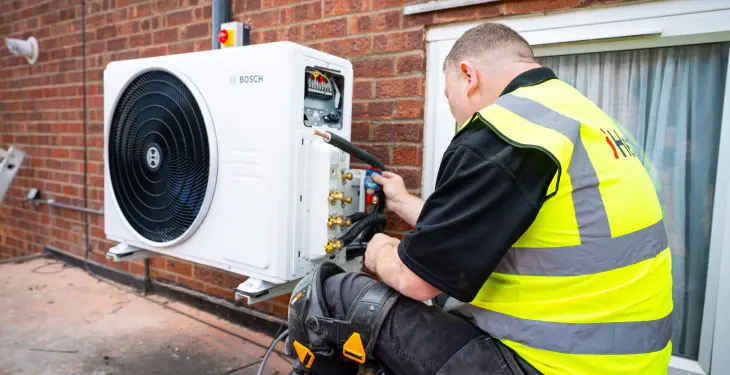
From our experience, installers need to think about more than simply fitting the equipment. They also assess where the outdoor unit can be positioned, how pipework and condensate drainage can be routed and whether the installation will comply with the building's requirements without affecting neighbouring properties.
This is why professional surveys are particularly important for flats. They help identify practical solutions while ensuring the installation is suitable for both the property and the building.
Where can the outdoor unit be installed?
For most split air conditioning systems, the outdoor unit is one of the most important parts of the installation.
Depending on the property, it may be possible to position the unit on a private balcony, terrace, external wall or another suitable location. However, the best position isn't simply the nearest outside wall.
From our experience, installers assess factors such as airflow, access for future maintenance, pipe run lengths, condensate drainage, noise and any restrictions set by the building.
Finding the right location helps the system perform efficiently while meeting the requirements of the property and its management.
What if your flat can't have an outdoor unit?
Not every flat is suitable for a traditional split air conditioning system, particularly if external equipment isn't permitted.
In these situations, there may still be alternative options. Some properties may be better suited to monobloc or internal condenser systems that don't require a separate outdoor unit, while portable air conditioners can provide temporary cooling where a fixed installation isn't practical.
From our experience, the best solution depends on the property rather than the product.
A professional survey allows installers to recommend the most suitable option based on the building's layout, any restrictions in place and your cooling requirements.
Last updated:
Written by Stephen Day
Gas Safe Engineer at iHeat
Stephen Day is a Gas Safe registered and FGAS certified engineer with over 20 years of hands-on experience in the heating, cooling, and renewable energy industry, specialising in boiler installations, air conditioning, and heat pump systems.
LinkedInArticles by Stephen Day are reviewed by iHeat’s technical team to ensure accuracy and reliability.
More air conditioning help & advice
02nd October, 2026
Air Conditioning Maintenance:...
A practical guide to looking after home air conditioning, from cleaning washable filters t...
 Read Article
02nd October, 2026
How much does air conditioning...
Find out how much air conditioning costs to install and run in a UK home, including VAT re...
Read Article
01st October, 2026
Best wall mounted air conditio...
Compare wall mounted air conditioners for quiet bedrooms, everyday comfort and lower upfro...
Read Article