Air Conditioning vs Air Source Heat Pump

11 min read
A reversible air conditioner heats and cools the rooms it serves. An air-to-water heat pump connects to your central heating and can provide hot water.
In this article
Key takeaways
- Many fixed air conditioners are air-to-air heat pumps, cooling a room in summer and heating it in winter.
- An air-to-water heat pump feeds radiators or underfloor heating and can heat a suitable hot-water cylinder.
- On 29 September 2026, iHeat advertised one-room AC supplied and fitted from £2,245 including VAT, and an air-to-water installation estimate from £10,595 including VAT. They cover different jobs.
- In England and Wales, grants may support an eligible replacement heating system, including air-to-air. Adding bedroom AC while keeping a gas boiler is not an automatic grant-funded installation.
Air conditioning and an air source heat pump use the same basic technology, but they suit very different jobs in a UK home.
For most UK homeowners, air conditioning is the better choice for cooling (and often heating) individual rooms, while an air-to-water heat pump is the better choice for replacing a boiler, because it runs your radiators and supplies hot water through a cylinder.
Picking the wrong one can leave you with a cool bedroom and the same old gas bills, or a new heating system that does little on a hot July night.
The confusion is understandable. A wall-mounted air conditioner is technically an air-to-air heat pump, and some air-to-water heat pumps can cool.
Choosing an air to air heat pump or an air to water heat pump comes down to where the heat goes: into the room air, or into the water in your central heating.
Once you know which of those your home needs, the questions about cost, grants, planning and running bills become far easier to answer for your own property.
Which System Does What in a UK Home?
When weighing up an air source heat pump vs air conditioner, the core choice is whether you need room-by-room climate control or a low-carbon heating solution for the whole property.
An air conditioner treats the air in the room where it is fitted, while a typical air source heat pump (ASHP) feeds your whole central heating system and hot water. Both move heat with refrigerant, and the delivery method decides what each one can replace.
Air-to-Air vs. Air-to-Water: What Changes?
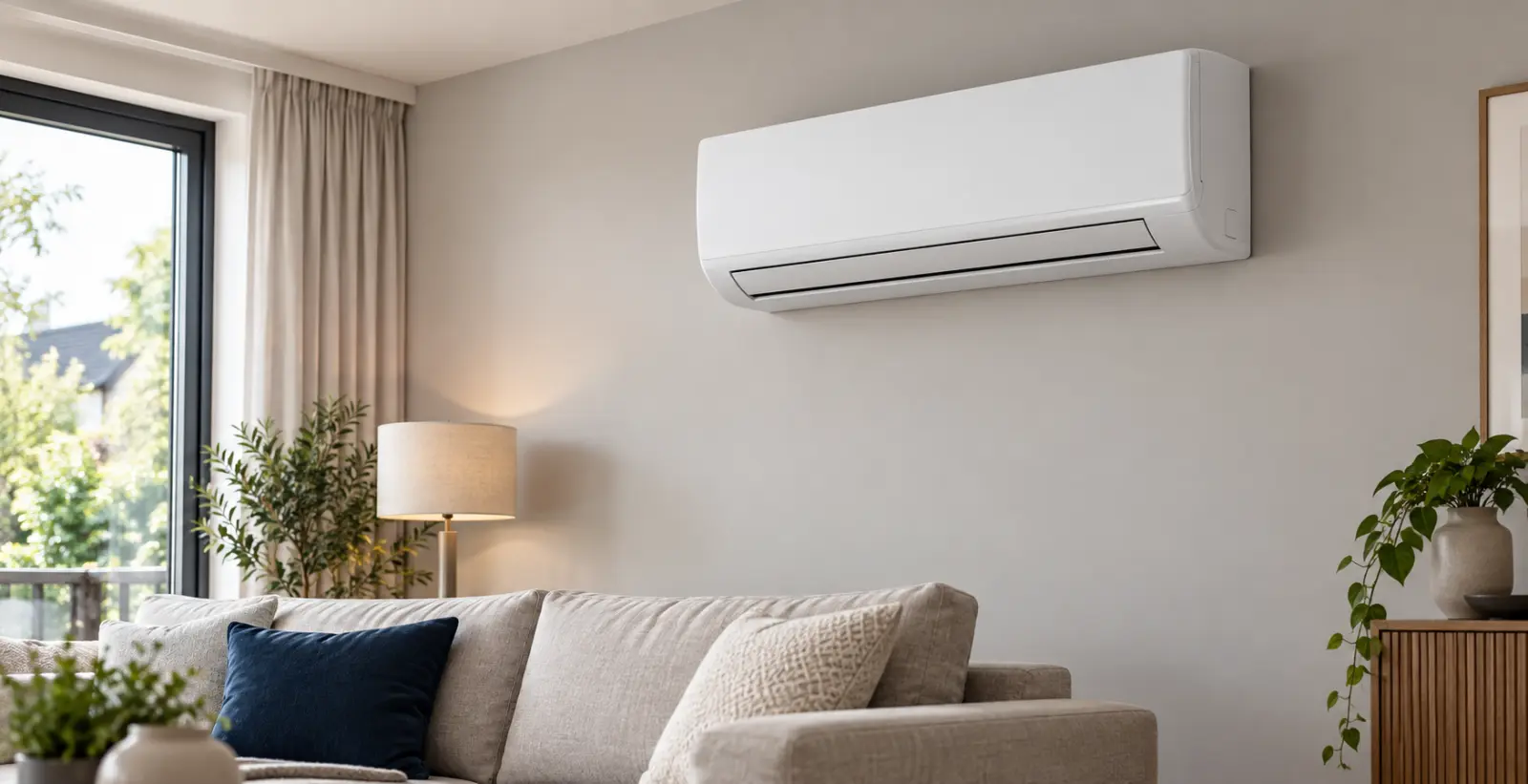
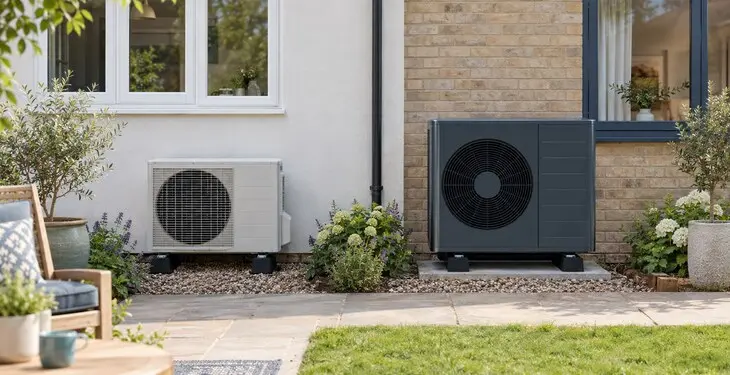
A split air conditioner is an air-to-air heat pump. The outdoor unit exchanges heat with outside air, and an indoor unit blows warmed or cooled air into the room.
Multi-split air conditioners run several indoor units from one outdoor unit, which is how many households cool multiple rooms with one AC unit.
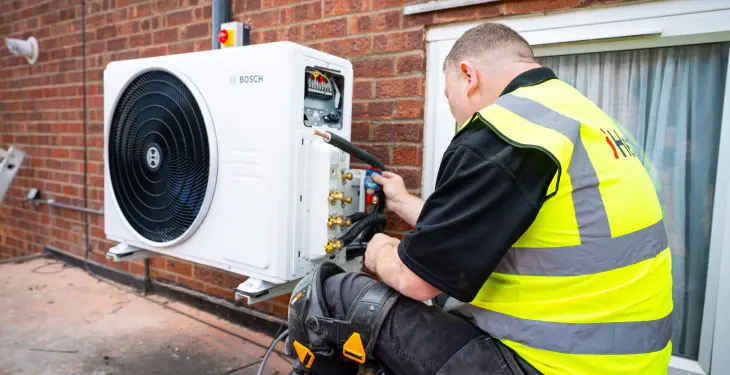
An air-to-water heat pump transfers the heat it collects into water. That water circulates through radiators or underfloor heating and heats a hot water cylinder.
This is the system most people mean when they talk about a heat pump in the UK, and it is the usual route for a low-carbon boiler replacement.
In larger properties, advanced climate systems like variable refrigerant flow (VRF) or variable refrigerant volume (VRV) can heat and cool separate zones at once.
Domestic spaces seeking both wet heating and quick airflow sometimes use time division multi (TDM) setups to run air and hydronic circuits from one outdoor unit.
When comparing heat pumps vs air conditioners, competing guides often label every air-to-air unit "just air conditioning" and every heat pump "heating only". Neither is accurate. The useful question is whether the heat ends up in room air or in water.
Which System Heats Rooms, Radiators and Hot Water?
Air conditioning (air-to-air) | Air-to-water heat pump | |
|---|---|---|
Room heating | Yes, if reversible | Yes, via radiators or underfloor |
Whole-house heating | Only with units in each room | Yes |
Works with radiators | No | Yes |
Domestic hot water | No | Yes, via cylinder |
Summer cooling | Yes | Some models, limited |
Typical installed cost | £1,500–£3,000 per single room | £8,000–£16,500 |
If you have a combi boiler, an air-to-water system needs space for a hot water cylinder, because it cannot heat water on demand the way a combi does. Our guide to different types of central heating systems explains how cylinder-based setups work.
Air conditioning leaves your existing boiler, radiators and hot water untouched. Many homes run air conditioning and a gas boiler side by side for exactly this reason.
Can Either System Heat and Cool?
Both systems can heat and cool in principle, because both rely on a reversible refrigerant cycle. In practice, most modern split air conditioners are designed to do both well in a room, while air-to-water heat pumps are designed and optimised for heating, with cooling as an occasional extra on some models.
How Does the Refrigerant Cycle Work?
Refrigerant absorbs heat as it evaporates at low pressure, even from cold outside air. A compressor then raises its pressure and temperature, and it releases that heat as it condenses inside your home.
A reversing valve switches the direction of flow. In cooling mode, heat is taken from indoors and released outside; in heating mode, the process runs the other way. A unit with this valve is called a reversible heat pump, and it is standard on most wall-mounted air conditioning units sold for UK homes.
Can Air Conditioning Provide Winter Heating?
Yes, a reversible air conditioning unit heats rooms efficiently in a British winter, and many owners use it as their main source of warmth in a conservatory, garden office or extension. It warms air quickly, so a room reaches temperature faster than with radiators.
Two limits apply. It heats only the rooms with an indoor unit, and it provides no hot water. For a whole house, you would need an indoor unit in most rooms plus a separate arrangement for hot water, such as an existing boiler or immersion heater.
Can an Air-to-Water Heat Pump Provide Summer Cooling?
Some air-to-water heat pumps are reversible, but useful summer cooling is the exception. Standard radiators are poor at cooling because chilled water in them produces little air movement and risks condensation on cold surfaces.
Cooling works better with fan convector radiators, which blow air across the chilled coil, or with carefully controlled underfloor systems.
The MCS installation standard requires reversible heat pumps to be designed and optimised for heating first. If summer comfort is a priority, confirm the model's cooling mode and the emitters it needs before assuming you will get it.
How Do Upfront Costs and Grants Compare?
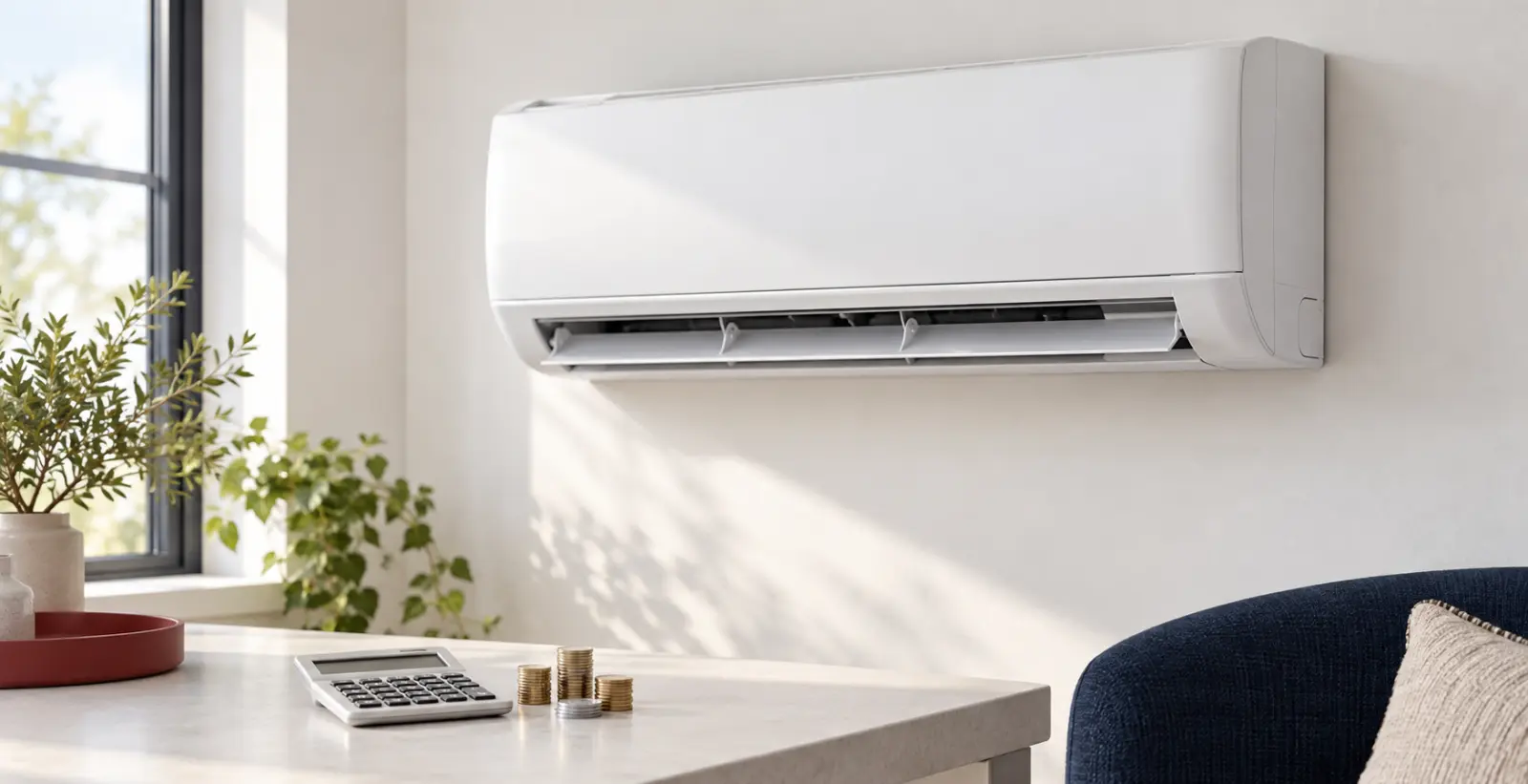
Air conditioning costs less to install, while a heat pump costs more but may attract a larger grant. Typical 2026 installed prices put a single-room split system at £1,800–£2,500, against £8,000–£16,500 for an air-to-water heat pump before any grant.
What Affects the Cost of Each Installation?
Air conditioning prices scale with the number of rooms:
Single split, one room: £1,500–£3,000
Multi-split, two rooms: £2,800–£5,000
Multi-split, three rooms: £4,500–£7,500
Ducted whole-house system: £7,000–£15,000 or more
Pipe run length, access to the outdoor unit and any electrical upgrade move the price within those bands. A back-to-back install, where the indoor unit sits directly opposite the outdoor unit through one wall, is the cheapest arrangement. Our air conditioning costs guide covers the detail.
Heat pump installation depends on heat loss, system size and what else needs changing. Adding a hot water cylinder when replacing a combi adds around £500–£1,500, and larger or additional radiators add more. Our guide to heat pump radiators explains why many homes only need some replaced. Heat pump installations also carry 0% VAT until 31 March 2027.
At iHeat, heat pump work starts with a free virtual survey, followed by a £399 home survey and heat-loss report that counts towards installation if you proceed.
Who Can Get the Boiler Upgrade Scheme Grant?
The Boiler Upgrade Scheme grant is available in England and Wales and is claimed by an MCS-certified installer, then deducted from your quote. Current amounts are:
£7,500 for an air-to-water or ground source heat pump
£2,500 for an air-to-air heat pump
£9,000 for air-to-water or ground source systems in eligible off-gas homes replacing oil or LPG, from 21 July 2026 to 31 March 2027
The new system must replace existing fossil fuel or electric heating, be sized to meet the property's full space heating needs, and meet minimum efficiency standards. Hybrid systems that keep a gas boiler are not eligible, so most air conditioning bought for summer cooling will not qualify.
Social housing, most new builds and properties already funded for a heat pump are excluded. Landlords letting at market rent can apply. Scotland has separate funding through Home Energy Scotland. Our air source heat pump grant guide sets out the eligibility steps.
What Will Each System Cost to Run?
Both systems produce several units of heat for every unit of electricity they use. Real-world heat pump running costs are driven by overall heat pump efficiency, your electricity tariff and your home's heat loss.
Achieving peak air source heat pump efficiency depends on maintaining lower water flow temperatures. The ratings on each product measure different conditions, which is where many comparisons go wrong.
What Do SCOP and SEER Actually Measure?
The seasonal coefficient of performance (SCOP) measures heating efficiency across a whole heating season. A SCOP of 3.2 means roughly 3.2 kWh of heat for every 1 kWh of electricity, averaged over changing outdoor temperatures and standby periods.
The seasonal energy efficiency ratio (SEER) measures cooling efficiency across a cooling season. It tells you nothing about heating performance.
An air conditioner's high SEER cannot be compared with a heat pump's SCOP, because one describes cooling and the other heating. Compare SCOP against SCOP for winter bills, and check that any air-to-water figure reflects the flow temperature your radiators will need.
How Do Tariffs, Home Design and Usage Affect Bills?
Tariff choice has a large effect. Using Ofgem's price cap unit rates for 1 October to 31 December 2026 (26.32p/kWh electricity, 7.97p/kWh gas), here is an illustrative space-heating comparison for a home needing 12,000 kWh of heat a year:
System | Energy used | Annual space-heating cost |
|---|---|---|
Heat pump, SCOP 3.2 | 3,750 kWh electricity | About £987 |
Gas boiler, 90% efficient | 13,333 kWh gas | About £1,063 |
These figures exclude standing charges, hot water and servicing. A heat pump tariff with cheaper periods lowers the electricity figure, provided you calculate the average rate across all your usage.
Insulation and design count as well. Heat pumps perform best in well-insulated homes with correctly set weather compensation. Our guide to the most efficient way to run an air source heat pump covers settings. For cooling, see air conditioning running costs in the UK.
How Do the Carbon Impacts Compare?
Replacing a gas boiler with an air-to-water heat pump cuts heating carbon emissions, because the home stops burning gas and the electricity used is multiplied by the heat pump's efficiency. Domestic heat accounts for around one fifth of UK carbon dioxide emissions.
Air conditioning used mainly for cooling adds electricity demand without displacing gas, so its carbon footprint rises with use. Used as a room's main heating in place of electric panel heaters, it lowers emissions.
Pairing either system with solar panels, solar PV and renewable electricity reduces the carbon footprint further.
Which Option Fits Your Home?
Your current heating, hot water arrangement and summer comfort needs decide the fit. The notes below cover the most common UK situations.
When Is Air Conditioning the Better Fit?
Air conditioning suits you if:
Your boiler has years of life left and your goal is cooler bedrooms or a home office
You want heating and cooling for a conservatory, loft room or garden room
You are replacing electric panel heaters in a few rooms
You live in a flat without space for a cylinder
Older properties bring extra siting questions, covered in our guide to retrofitting air conditioning in older homes.
When Is a Heat Pump the Better Fit?
An air-to-water heat pump fits when your boiler is due for replacement and you want low-carbon central heating with hot water. It works best with reasonable insulation, outdoor space for the unit and room for a cylinder.
Off-gas homes on oil or LPG have a particular incentive while the £9,000 grant runs. Our air source heat pump pros and cons guide covers the trade-offs.
When Might You Install Both?
Some households fit an air-to-water heat pump for central heating and hot water, then add a split air conditioner in the hottest bedroom. This gives reliable whole-home heating with targeted summer cooling.
Only one Boiler Upgrade Scheme grant is available per property, so plan which system claims it. iHeat quotes for both, which helps when you are comparing the combined cost.
What Should a Survey Check Before Installation?
A proper heat pump survey should include:
A room-by-room heat loss calculation
A review of radiator sizes and flow temperatures
Hot water demand and cylinder location
Outdoor unit siting, noise and permitted development rules
Electrical supply and notification to the network operator
Under permitted development in England, an air source heat pump must comply with MCS 020(a), must not be used solely for cooling, and its outdoor unit must not exceed 1.5 cubic metres on a house or 0.6 cubic metres on a block of flats.
Listed buildings and front-facing walls in conservation areas fall outside these rights. Wales updated its rules on 1 June 2026, and Scotland has its own. Cooling-only air conditioning needs a planning application.
Last updated: