


Tesla Powerwall vs Duracell Dura16: Cost, Specs & Performance Compared

Written by Bethany Armstrong
Renewables Manager
Updated:
Tesla Powerwall is a premium all-in-one system, while the Dura16 offers more storage for your money with a modular setup.
- Tesla Powerwall vs Dura16: quick comparison
- Core difference: all-in-one vs modular
- Real-world performance: what actually saves money
- Cost and value: where the Dura16 stands out
- Performance and output: where Tesla has the edge
- Installation and setup: what homeowners need to know
- Noise, usability and day-to-day experience
- What happens when you add solar?
- Which system is right for your home?
- Final thoughts: which battery makes more sense?
Key takeaways
- Tesla Powerwall is simpler and more powerful as an all-in-one system.
- Dura16 offers significantly lower cost per kWh and more storage for the money.
- The best option depends on whether you prioritise simplicity or value and scalability.
If you’re considering home battery installation options, one of the most common questions is whether it’s worth paying more for a premium system like Tesla, or going for a higher-capacity, better-value option like the Duracell Dura16.
Both systems can reduce your electricity bills. Both can shift your usage away from expensive peak rates. But they approach it in different ways.
We install both types of systems across UK homes, so this comparison is based on how they perform in real-world setups, not just spec sheets.
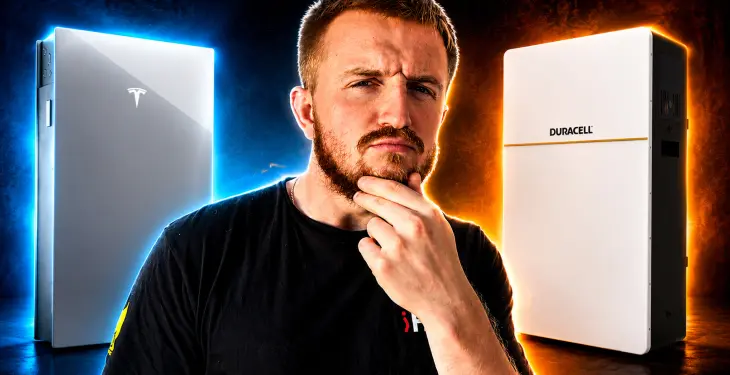
This video shows how the Tesla Powerwall 3 and Duracell Dura16 perform in a real iHeat installation, covering setup, costs, and actual savings in a UK home.
Tesla Powerwall vs Dura16: quick comparison
Feature | Tesla Powerwall 3 | Duracell Dura16 |
Usable capacity | 13.5 kWh | 14.4 kWh |
System type | All-in-one (battery + inverter) | Modular (separate inverter) |
Output | Up to ~11.5 kW | Up to ~6.6 kW (with G3 inverter) |
Cost (installed) | ~£8,000–£8,500 | ~£5,695 |
Cost per kWh | ~£630/kWh | ~£395/kWh |
Warranty | 10 years | 10 years |
Cycle life | Not always stated clearly | ~8,000 cycles |
Expandable | Limited | Yes (modular system) |
Costs are typical UK estimates and vary depending on property, inverter setup, and installation complexity.
Core difference: all-in-one vs modular
The biggest difference comes down to how the systems are built.
Tesla Powerwall 3 combines the battery and inverter into a single unit. That makes installation cleaner and simpler, with fewer components to manage.
Dura16 separates the battery and inverter. That gives more flexibility, especially if you want to expand the system later or tailor it to a specific setup.
So the choice is not just about price. It is about whether you value a simpler all-in-one system, or more storage for your budget.
Real-world performance: what actually saves money
Both systems save money in the same way.
They allow you to:
charge using cheaper off-peak electricity
store that energy
use it during expensive peak hours
Battery performance is measured in usable capacity, not total capacity, which is why figures like 13.5 kWh and 14.4 kWh matter when comparing systems.
On a recent UK installation we carried out, a home spending around £1,300 to £1,400 per year on electricity saw projected savings of roughly £900 annually after installing a Dura16 battery and switching to a time-of-use tariff.
Actual savings depend on your tariff, usage patterns, and how consistently the system is used to shift energy to off-peak hours.
Cost and value: where the Dura16 stands out
This is where the Dura16 becomes difficult to ignore.
At around £5,695 installed, it delivers:
more usable storage than a Powerwall
a much lower cost per kWh
Compared to a Powerwall at roughly £8,000 to £8,500, the difference in cost per unit of stored energy is significant.
This makes the Dura16 particularly strong for higher-usage homes where total storage capacity and cost per kWh have a bigger impact on savings.
That said, Tesla’s higher price reflects:
integrated design
higher output
simpler setup
Performance and output: where Tesla has the edge
Tesla Powerwall 3 delivers higher output, which means it can:
run more appliances at once
handle higher peak demand
feel more hands-off in day-to-day use
For homes with:
very high demand
multiple large electrical loads
a preference for simplicity
Tesla often feels more seamless.
The Dura16 still comfortably powers most homes, but it is designed more around efficient energy shifting rather than maximum output.
Installation and setup: what homeowners need to know
Battery installs in the UK now follow stricter safety guidance.
In simple terms:
systems are usually installed outside, in a garage, or on an external wall
they should not be placed in lofts, bedrooms, or escape routes
ventilation and fire safety must be considered
the system must be fully tested and signed off
These rules come from UK safety guidance designed to reduce fire risk and ensure long-term system reliability.
For homeowners, this means the location is not just about convenience. It is about long-term safety and compliance.
Noise, usability and day-to-day experience
One area that often gets overlooked is how these systems feel to live with.
The Dura16 uses passive cooling with no fans, so in real-world testing it is effectively silent.
Tesla systems are also quiet, but may include active cooling depending on setup.
In terms of control:
both systems allow app-based monitoring
both automate charging and discharging
both can integrate with time-of-use tariffs
What happens when you add solar?
Battery-only systems already reduce bills by shifting energy usage.
Adding solar changes the system from shifting energy to actually reducing how much you need to buy from the grid.
Instead of just buying electricity cheaply, you also:
generate your own energy
reduce grid reliance
In a similar real-world scenario, adding a small solar system reduced annual electricity costs to roughly £400 to £550, depending on usage.
Actual savings will vary depending on system size, generation levels, and household demand.
Which system is right for your home?
Tesla Powerwall may suit you if:
you want a simple, all-in-one system
you prefer a more hands-off setup
you are happy to pay more for integration and output
Duracell Dura16 may suit you if:
you want the best value per kWh
you have higher energy usage
you want flexibility to expand later
you are focused on payback and savings
Final thoughts: which battery makes more sense?
For most homeowners, the decision is less about the brand and more about how you want your system to work day to day.
If you want a simpler, all-in-one setup with higher output, Tesla is often the better fit.
If you want more storage for your budget and flexibility to build over time, the Dura16 stands out.
In both cases, the real benefit is the same. You move away from reacting to energy prices and start managing them.
Last updated:
Written by Bethany Armstrong
Renewables Manager at iHeat
Bethany Armstrong is a renewables expert and operations manager at iHeat, specialising in heat pump solutions and solar project delivery across the UK.
LinkedInArticles by Bethany Armstrong are reviewed by iHeat’s technical team to ensure accuracy and reliability.
More solar & battery storage help & advice

29th September, 2026
Choosing A Solar Inverter: Hyb...
For most UK homes, the best inverter depends on roof complexity, shading, and future batte...
 Read Article

29th September, 2026
Best Solar Monitoring Apps UK:...
Tesla, Sigenergy, Duracell, and Hanchu offer solar monitoring apps with unique features su...
Read Article

21st July, 2026
Solar Generation vs Export: Wh...
Generation measures all the electricity your solar panels produce, while export only measu...
Read Article