


UK Government’s £15bn Warm Homes Plan Explained: Who Qualifies and What It Really Means

Written by Bethany Armstrong
Renewables Manager
Updated:
A clear explanation of the UK Warm Homes Plan, who qualifies, and what it means for homeowners.
- Why the UK Warm Homes Plan exists
- What is the £15bn Warm Homes Plan?
- Warm Homes Plan funding breakdown explained
- Who qualifies for the Warm Homes Plan?
- Lessons from previous schemes
- Consumer protection and installer standards
- Timeline, VAT and policy context
- Is £15bn enough to upgrade 5 million homes?
- What the Warm Homes Plan means for homeowners now
- UK Warm Homes Plan: what it really means
Key takeaways
- The plan targets low-income and low-EPC homes first.
- It is not a universal free upgrade scheme.
- Delivery quality will determine its real impact.
Why the UK Warm Homes Plan exists
The UK Warm Homes Plan was announced against the backdrop of the energy bill crisis and rising household costs.
Following the 2022 spike in wholesale gas prices, typical annual energy bills rose dramatically. While government intervention capped extreme increases, the structural issue remains: most UK homes still rely heavily on gas.
Currently:
Around 86% of homes in England use gas heating
Roughly 2.7 million households are classified as living in fuel poverty
Homes and buildings account for around 21% of total UK emissions
Cold, inefficient homes do not just increase bills. They contribute to damp, respiratory illness and long-term health pressures.
The Warm Homes Plan positions home upgrades as a long-term solution rather than repeated short-term crisis support.
What is the £15bn Warm Homes Plan?
The £15bn Warm Homes Plan is a multi-year government strategy designed to improve energy efficiency and reduce dependence on volatile gas markets.
Its headline goals include:
Upgrading up to 5 million homes
Lifting 1 million households out of fuel poverty by 2030
Accelerating electrifying heating in the UK
Expanding insulation and low-carbon technology uptake
It is not a single application scheme. It combines new funding, existing grants and loan-backed mechanisms.
Understanding the breakdown is essential before assuming eligibility.
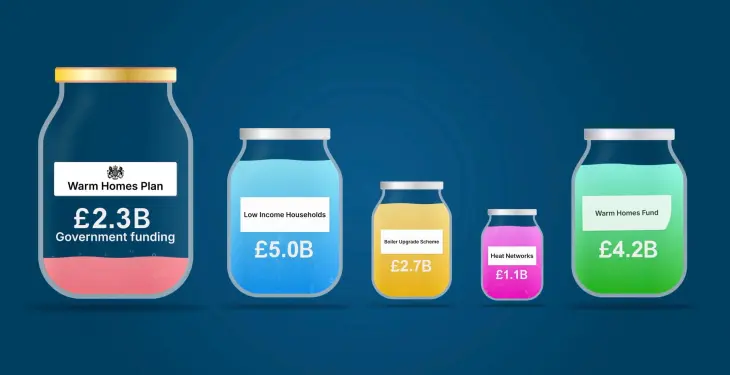
Warm Homes Plan funding breakdown explained
The £15bn is actually divided across several funding streams.
£5bn for low-income household upgrades
Just over £5bn is allocated to low-income households for measures such as:
Loft and cavity wall insulation
Solar panels and battery storage
Heat pumps
Eligibility is typically based on:
Household income, often below around £36,000
Living in a home rated EPC D, E, F or G
Local authorities are expected to identify and administer qualifying households.
This part of the Warm Homes Plan grants UK support is targeted, not automatic.
£2.7bn for heat pump grants
Approximately £2.7bn supports the existing government heat pump strategy through the Boiler Upgrade Scheme.
Homeowners in England and Wales can currently receive:
£7,500 towards an air source or ground source heat pump
This funding is already active and runs to 2030.
The Warm Homes Plan builds on this rather than replacing it.
£1bn for heat networks
Just over £1bn is allocated to expanding heat networks in dense urban areas, allowing shared heating infrastructure to replace gas systems more efficiently.
£5bn for the Warm Homes Fund
Around £5bn is assigned to the Warm Homes Fund.
Unlike grant schemes, this funding supports:
Low or zero-interest loans
Private investment into upgrades
Households who do not qualify for fully funded support
There is no universal entitlement. Standard affordability checks will apply.
Who qualifies for the Warm Homes Plan?
Eligibility depends entirely on which funding route applies.
For fully funded upgrades:
Income thresholds generally apply
The property must typically have a low EPC rating
Local authority approval is required
For loan-based funding:
Normal lending criteria apply
It is not income-free borrowing
It is important to be clear.
The UK Warm Homes Plan does not mean every household will receive free solar panels, free batteries or a free heat pump.
If you see advertisements suggesting universal eligibility, treat them cautiously.
Lessons from previous schemes
Past policies help explain current scepticism.
The feed-in tariff history in the UK shows how strong early solar incentives drove rapid adoption before closing to new applicants in 2019.
It was replaced by the Smart Export Guarantee, which pays households for exported electricity at market rates.
ECO scheme problems in the UK damaged public trust. Reports of poor installation quality, confusing rules and dissolved companies created lasting concern.
The Warm Homes Plan recognises that scaling up installation without maintaining standards risks repeating those issues.
Consumer protection will be central.
Consumer protection and installer standards
One growing issue during the energy bill crisis has been the rise of lead generation websites advertising:
“Free solar”
“Free heat pumps”
“Limited time government funding”
before requesting personal data.
The Warm Homes Plan is still being rolled out in stages. Any website claiming immediate guaranteed eligibility should be approached carefully.
A responsible approach includes:
Confirming eligibility through official routes
Checking installer accreditation
Ensuring systems are MCS certified
Avoiding pressure-based marketing
Large-scale delivery only works if installation quality and aftercare are consistent.
Timeline, VAT and policy context
Several policy factors affect timing decisions.
The Boiler Upgrade Scheme runs until 2030
ECO4 is extended until 2026
0% VAT on many energy-saving technologies runs until March 2027
After March 2027, VAT is expected to return to 5% unless extended.
For example, a £10,000 system would increase by £500 if 5% VAT applies.
The Warm Homes Plan sits within broader UK energy policy 2020–2030, focused on reducing gas dependence and stabilising long-term energy costs.
Waiting for a new funding announcement does not automatically mean greater financial benefit.
Is £15bn enough to upgrade 5 million homes?
On paper, £15bn is significant public investment.
In practice, delivery at this scale requires:
Rapid workforce expansion
Installer training
Supply chain resilience
Strong oversight
The government estimates the transition could support around 180,000 jobs across manufacturing and installation.
The real question is not only funding size, but delivery quality.
If upgrades perform well and savings are realised, confidence grows. If quality slips, public trust weakens.
What the Warm Homes Plan means for homeowners now
If you:
Live in a low EPC-rated property
Have a lower household income
Are struggling with energy costs
you may qualify for targeted support as schemes open locally.
If you do not meet income thresholds, loan-based options may eventually become available.
However, it is important to understand:
Existing heat pump grants UK 2026 funding already exists
Insulation funding routes are active in some areas
Solar and battery systems are not automatically free under this plan
The decision to upgrade should be based on:
Your EPC rating
Your annual energy usage
Available active funding
Long-term savings potential
not headlines alone.
UK Warm Homes Plan: what it really means
The UK Warm Homes Plan is a long-term structural strategy to address fuel poverty, electrify heating in the UK and reduce exposure to volatile gas markets.
It combines:
Targeted grants
Existing heat pump funding
Insulation upgrades
Loan-backed investment
It is not a universal giveaway.
For eligible households, it could significantly improve comfort and lower bills. For others, it may offer structured finance rather than full funding.
£15bn is a substantial commitment. Whether it transforms 5 million homes will depend less on the headline number and more on how effectively and responsibly those upgrades are delivered.
Last updated:
Written by Bethany Armstrong
Renewables Manager at iHeat
Bethany Armstrong is a renewables expert and operations manager at iHeat, specialising in heat pump solutions and solar project delivery across the UK.
LinkedInArticles by Bethany Armstrong are reviewed by iHeat’s technical team to ensure accuracy and reliability.
More solar & battery storage help & advice
03rd October, 2026
The best angle and direction f...
Discover how roof angle, direction and shading affect solar generation—and why your roof m...
 Read Article

30th September, 2026
Solar Panel Grants
Find out what help is available towards solar panel installation, who may qualify and how...
Read Article

30th September, 2026
Tesla Powerwall 3 Price UK: 20...
A clear guide to Tesla Powerwall 3 pricing in the UK, what affects installation costs, and...
Read Article