


Air Conditioning Maintenance: Filter Cleaning, Servicing and Costs

Written by Stephen Day
Gas Safe Engineer
Updated:
A practical guide to looking after home air conditioning, from cleaning washable filters to arranging professional servicing.
- How often should air conditioning be maintained?
- How often should you clean aircon filters?
- How do you clean an air conditioner filter?
- What else can you do between services?
- What should a professional air conditioning service include?
- How much does air conditioning maintenance cost?
- When should you call an engineer before the next service?
- Is annual air conditioning servicing a legal requirement?
- Frequently Asked Questions (FAQ)
Key takeaways
- Plan for annual servicing, following your manufacturer’s requirements.
- Check filters regularly: some models specify cleaning every two weeks.
- Wash only washable filters. Specialist inserts may need different care.
- Report persistent faults. Filter cleaning does not replace diagnosis or servicing.
Home air conditioning needs regular filter cleaning alongside professional servicing, usually once a year. Some manufacturers recommend cleaning the main air filters every two weeks, but the correct interval and method depend on your model, filter type and how much you use it. Follow the unit’s manual and warranty conditions rather than applying one schedule to every system.
This guide focuses on fixed home air conditioning, including single-split systems serving one room and multi-split systems serving several rooms.
How often should air conditioning be maintained?
Separate the professional service schedule from the cleaning you do between visits. A yearly service is a common recommendation for domestic air conditioning, while filters can need attention much more frequently.
Worcester Bosch recommends annual servicing and identifies spring as a useful time to prepare for summer. If you also use the system for heating, spring or autumn can work well. Heavy use and dusty surroundings call for closer attention to filters.
Maintenance task | When to do it | Who should do it? |
|---|---|---|
Check and clean the main air filters | At the manual’s interval; some models specify every two weeks | Homeowner, where access and cleaning are permitted |
Clean or replace specialist filter inserts | According to the instructions for that particular filter | Homeowner or engineer, depending on access |
Check for blocked air inlets and outlets | During routine cleaning and after visible debris builds up | Homeowner, without dismantling equipment |
Arrange professional servicing | Usually annually; confirm the required schedule | Suitably qualified air conditioning engineer |
Investigate leaks, persistent odours or poor performance | When the problem appears | Engineer if basic permitted checks do not resolve it |
This is a planning guide. Your equipment’s instructions take priority.
A multi-split system does not automatically need servicing twice as often simply because it serves more rooms. It does, however, have more indoor units to inspect and clean. Make sure the maintenance appointment covers every indoor unit and the outdoor equipment.
How often should you clean aircon filters?
Some home air conditioners need their main filters cleaned every two weeks during use. Start with the instructions for your exact model rather than waiting for the annual service.
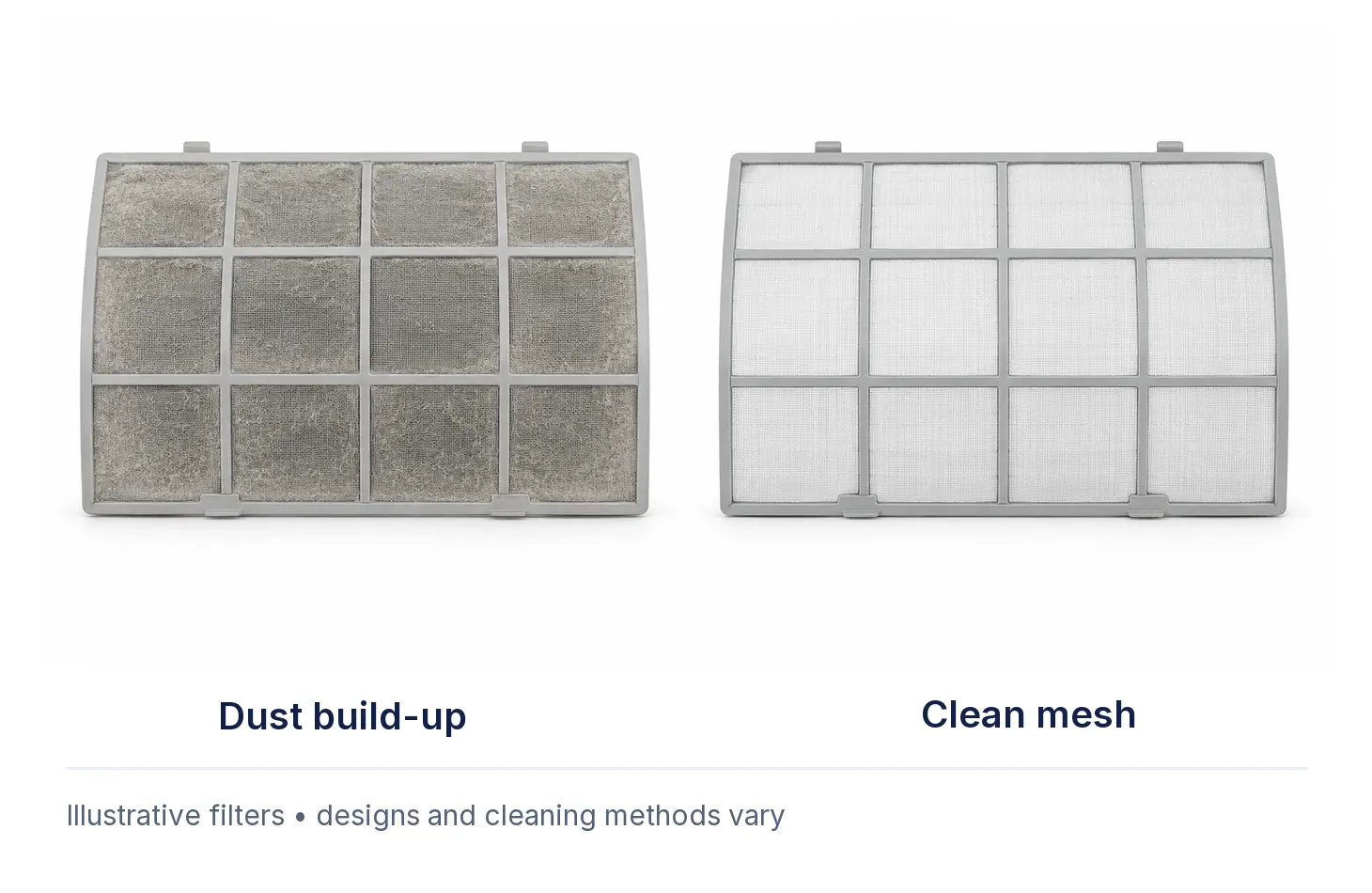
For example, Samsung’s UK cleaning guidance recommends a two-week interval and explains that dust can build up before the cleaning reminder appears. Daikin also recommends fortnightly cleaning in its split-system maintenance advice. Samsung filter-cleaning guidance, Daikin maintenance tips.
That does not make two weeks a universal replacement deadline. Inspection, cleaning and replacement are different tasks.
What changes how quickly filters get dirty?
The amount of dust collected depends on the room and operating hours. A bedroom unit used occasionally may accumulate dirt differently from one running daily in a busy living space.
Pay closer attention during heavy use, dusty building work or periods when you notice visible dust on the filter. Pets can also make it useful to inspect more often.
Keep a simple record of when you check and clean each indoor unit. If a filter is already heavily coated by the next scheduled check, shorten the inspection interval and discuss persistent contamination with your installer.
Do filters need replacing every year?
There is no universal rule that all air conditioning filters must be replaced annually.
The main mesh filter may be reusable, while a smaller deodorising or air-purifying insert can have its own cleaning and replacement requirements.
As one model-specific example, Daikin’s CTXA/FTXA-A user guide specifies fortnightly cleaning for the main air filters, but six-monthly cleaning and three-year replacement for the listed deodorising and silver-particle filters. Those intervals apply to the filters identified in that manual, not every Daikin product. Daikin CTXA/FTXA-A user guide, section 7.
Filter type | What to check before cleaning |
|---|---|
Reusable mesh filter | Whether vacuuming, rinsing or both are permitted |
Disposable filter | Replacement specification and interval; do not assume it can be washed |
Deodorising or specialist insert | Its separate care instructions and replacement schedule |
If a filter is torn, distorted or no longer fits correctly, ask for the correct replacement part. Do not substitute a different filter material without manufacturer approval.
How do you clean an air conditioner filter?
Only clean filters that the user manual identifies as accessible and suitable for homeowner maintenance. If the unit is difficult to reach safely, arrange assistance rather than stretching from furniture.
For a washable filter, the general process is:
Follow the manual’s shutdown and access sequence. Isolate the power before handling the filter; some motorised panels have a specific opening procedure.
Remove the filter carefully. Use the illustrated release points and avoid touching internal metal fins.
Remove loose dust. Use gentle vacuuming where the manufacturer permits it.
Wash only if allowed. Follow the specified water temperature and cleaning-product instructions.
Let the filter dry fully. Follow the drying instructions, commonly air-drying in shade.
Refit it securely. Close the user-access panel before restoring power.
These are general steps, not a substitute for the removal instructions for your model. Daikin air-to-air maintenance guide
Do not spray cleaning liquid into the assembled indoor unit or treat every small filter insert as washable. If cleaning requires removing service covers or accessing wiring, leave that work to an engineer.
What else can you do between services?
Keep airflow unobstructed and notice changes in how the system operates. These checks help you identify when maintenance or diagnosis is needed.
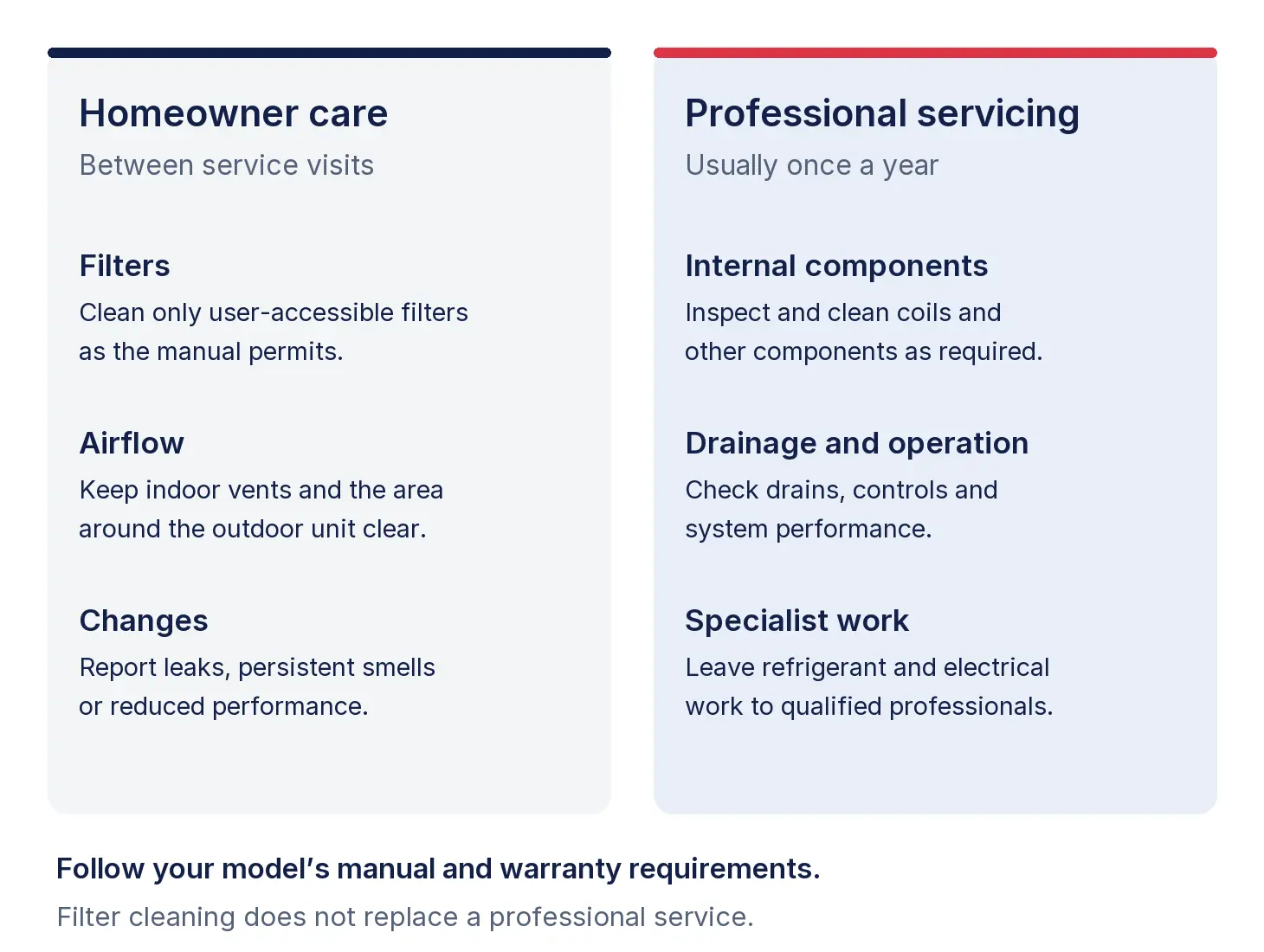
Keep curtains and furniture away from the indoor air inlet and outlet.
Keep loose leaves and vegetation clear of the outdoor unit’s surrounding space, without reaching through its grille.
Wipe accessible exterior surfaces using the method allowed in the manual.
Note new noises, persistent smells, water leaks or reduced airflow.
Check the selected mode, temperature and timer before assuming poor comfort means a fault.
Leave internal coil cleaning, electrical checks, drain-system work and refrigerant work to a suitably qualified professional. Routine homeowner maintenance should not involve dismantling the system.
What should a professional air conditioning service include?
Ask for a written service checklist covering the whole installation. A quick filter rinse alone is not the same as inspecting the indoor units, outdoor unit, drainage and operating performance.
The precise work depends on the equipment and its condition. Ask whether the visit covers:
Area | What to confirm |
|---|---|
Filters and indoor components | Inspection and the level of cleaning included |
Coils and airflow | Condition checks and assessment of restricted airflow |
Condensate drainage | Checks of the drain arrangement and any fitted pump |
Outdoor equipment | Condition, obstructions and visible wear |
Controls and operation | Response to settings and heating/cooling operation |
Refrigerant circuit | Appropriate checks and investigation if a problem is suspected |
Service record | Findings, completed work and separately quoted repairs |
Manufacturer guidance includes airflow, controls, dirt and wear checks; individual providers specify their own cleaning and drainage scope.
Tell the engineer about intermittent problems before the visit. A fault that appears only after several hours of use may not be obvious during a brief test.
Does air conditioning need routine regassing?
Refrigerant should not be treated as a consumable that needs topping up every year. If an engineer identifies a low charge, the reason needs investigating rather than simply adding more refrigerant repeatedly.
Where a leak is found, the relevant repair and follow-up checks matter. GOV.UK guidance requires applicable F-gas leaks to be repaired as soon as possible and the repair checked within a month. Work on equipment containing F-gas requires the relevant qualifications. GOV.UK leak-check guidance, F-gas qualifications.
How much does air conditioning maintenance cost?
The price depends on how many units are being serviced, access and the work included. Compare the total for your installation rather than an unexplained “per unit” figure.
As a published example checked in October 2026, FireFlow in Bridgwater and Somerset advertises £144 including VAT for the first split, plus £60 including VAT for each additional indoor unit serviced on the same visit. Its stated scope includes filters, indoor coils, refrigerant-pressure checks, drainage inspection and heating/cooling tests. This is one provider’s price, not an iHeat tariff or UK average. FireFlow’s published service prices.
Before booking, confirm:
Unit count: how many indoor and outdoor units are included?
Cleaning scope: routine cleaning or a more extensive internal clean?
Access: are high-level units or access equipment covered?
Fault finding: is diagnosis included if you already have a problem?
Extras: are replacement filters, parts and repairs charged separately?
Final total: does the quotation include VAT and travel charges?
A maintenance plan may package servicing with other benefits, but check the terms. An annual service, breakdown call-out and parts-and-labour cover are different things.
When should you call an engineer before the next service?
Do not wait for the scheduled service if the unit develops an ongoing fault. Cleaning a dirty filter may help restricted airflow, but it will not fix every cooling, drainage or electrical problem.
What you notice | Appropriate next step |
|---|---|
Weak airflow | Check permitted filter cleaning and visible obstructions; arrange diagnosis if it persists |
Water dripping from the indoor unit | Stop using it and arrange an inspection; keep clear of wet electrical equipment |
Persistent musty odour after filter cleaning | Ask for inspection of internal cleanliness and drainage |
Burning smell or repeated electrical tripping | Stop operation, isolate safely if possible and contact a qualified professional; do not repeatedly restart it |
The model’s troubleshooting instructions should guide the response. Daikin’s user guide, for example, directs users to stop operation and shut off power when unusual conditions such as burning smells occur. Daikin user guide, troubleshooting section.
For water leaks, our guide to why an air conditioner leaks water explains the distinction between normal drainage and water escaping indoors.
Is annual air conditioning servicing a legal requirement?
Routine servicing, statutory leak checks and energy-efficiency inspections are separate requirements. Avoid assuming that every home system has the same legal inspection schedule.
F-gas leak-check obligations depend on the refrigerant, charge and applicable rules. Ask the engineer to establish what applies to your installation, including any differences between Great Britain and Northern Ireland. GOV.UK F-gas guidance.
In England and Wales, systems with a combined effective rated cooling output above 12kW can require an energy inspection at intervals no longer than five years. Several smaller units under one person’s control can count together. This inspection is additional to routine maintenance; Scotland and Northern Ireland have separate requirements. Government air conditioning inspection guidance.
Separately, your manufacturer’s warranty may impose servicing conditions. Keep the service records and check the terms for your equipment.
Frequently Asked Questions
Does a filter-cleaning reminder mean the filter is definitely dirty?
Treat it as a maintenance prompt and follow the manual. Samsung notes that dusty conditions can cause blockage before its filter reminder appears, so the display should not replace regular checks.
Does a self-cleaning function replace servicing?
Do not assume it does. Check what the function actually cleans and which tasks remain in the manual. Daikin advises using automatic filter cleaning where fitted, while separately recommending professional attention for dirty internal components.
Can a different company service my air conditioning?
Check your warranty and any maintenance agreement first. Daikin says customers can continue using their installer where that installer provides maintenance. Whichever company you use, confirm suitable qualifications, familiarity with the equipment and a written service record.
Last updated:
Written by Stephen Day
Gas Safe Engineer at iHeat
Stephen Day is a Gas Safe registered and FGAS certified engineer with over 20 years of hands-on experience in the heating, cooling, and renewable energy industry, specialising in boiler installations, air conditioning, and heat pump systems.
LinkedInArticles by Stephen Day are reviewed by iHeat’s technical team to ensure accuracy and reliability.
Contributors

Renewables Manager
More air conditioning help & advice
02nd October, 2026
How much does air conditioning...
Find out how much air conditioning costs to install and run in a UK home, including VAT re...
 Read Article
01st October, 2026
Best wall mounted air conditio...
Compare wall mounted air conditioners for quiet bedrooms, everyday comfort and lower upfro...
Read Article
29th September, 2026
Air Conditioning vs Air Source...
A reversible air conditioner heats and cools the rooms it serves. An air-to-water heat pum...
Read Article