


Do You Need Planning Permission for Air Conditioning UK?

Written by Stephen Day
Gas Safe Engineer
Updated:
Most UK homeowners don’t need planning permission for air conditioning if it meets permitted development rules.
- When planning permission is not usually required
- Quick guide: do you need permission for AC?
- When planning permission may be required
- Placement, size and noise: what actually matters
- Building regulations and installation standards
- What if you are unsure?
- So, do you need planning permission for air conditioning?
- Thinking about installing air conditioning?
Key takeaways
- Most UK homes do not need planning permission for air conditioning.
- Flats, listed buildings, and some locations have stricter rules.
- External unit placement and noise are the mains considerations.
- A compliant installation matters as much as the unit itself.
Air conditioning is becoming more common in UK homes, especially as systems now provide both cooling and heating.
One of the first questions homeowners ask is whether they need planning permission before installing a unit.
For most houses, the answer is no. If the system is designed for residential use and installed in a suitable location, it will usually fall under permitted development. The key is understanding when that applies and when it does not.
Working with an experienced air conditioning installer can also help ensure the system is positioned correctly and meets current UK planning and noise regulations.
When planning permission is not usually required
For a typical house, installing air conditioning is normally straightforward.
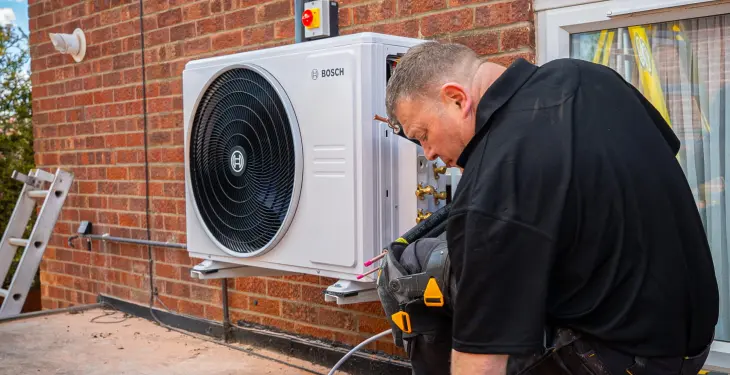
In most cases, you will not need planning permission if the external unit is installed at the side or rear of the property, is reasonably sized, and does not create excessive noise. These types of installations are generally covered under permitted development rights.
For most homeowners, installing a standard wall-mounted system in a discreet location will fall within these rules. In most residential installs we carry out, planning permission is not required, but placement, noise, and property type are always checked before confirming a system.
Modern systems are typically designed to meet residential size and noise expectations, which is why they often fall within permitted development.
Quick guide: do you need permission for AC?
Situation | Planning permission needed? |
Standard house, rear or side installation | Usually no |
Flat or maisonette | Often yes |
Listed building | Yes (consent required) |
Conservation area or protected location | Sometimes |
Large or multiple external units | Possibly |
When planning permission may be required
There are a few situations where planning permission becomes more likely.
Flats and maisonettes are the most common example. Permitted development rights are more limited, so external units often need approval before installation.
Listed buildings are another clear case. Even small external changes usually require consent, including air conditioning units.
Homes in conservation areas or other protected locations may also face tighter restrictions. This does not always mean permission will be refused, but it does mean the installation needs to be considered more carefully.
These rules fall under permitted development guidance, but local councils can interpret them slightly differently. That is why checking your specific property is always recommended if you are unsure.
Placement, size and noise: what actually matters
Even when planning permission is not required, there are still expectations around how systems are installed.
External units should be positioned in a way that does not negatively impact the appearance of the property. In most cases, this means avoiding prominent front-facing walls and choosing a more discreet side or rear location.
Size also matters. The unit should be proportionate to the property and not appear overly bulky or out of place.
Noise is another key factor. Modern air conditioning systems are designed to be quiet, but poor placement or incorrect installation can still cause issues. A correctly installed system should operate at a level that does not disturb neighbours in normal use.
Building regulations and installation standards
Planning permission is only one part of the process. The installation itself must also meet UK building and electrical regulations.
When installing air conditioning in the UK, it is important to make sure the system is fitted safely, positioned correctly, and installed in line with current standards.
This includes safe electrical connections, proper mounting, and correct handling of condensation drainage. Systems must also be installed in a way that ensures long-term safety and performance.
These requirements are based on UK building regulations and planning guidance, designed to ensure systems are installed safely and do not negatively impact neighbouring properties.
For homeowners, this means the quality of the installation is just as important as the system you choose.
What if you are unsure?
If you are unsure whether your installation falls within permitted development, the safest approach is to check early.
This can involve reviewing your local council’s guidance, confirming whether your property has any restrictions, or speaking to an experienced installer who understands how these rules apply in practice.
In most cases, this can be confirmed quickly before installation, avoiding delays or unexpected issues later.
So, do you need planning permission for air conditioning?
For most UK homeowners, planning permission is not required. If you live in a standard house and the system is installed in a suitable location, it will usually fall within permitted development rules.
The main exceptions are flats, listed buildings, and properties in protected areas, where approval may be needed.
Thinking about installing air conditioning?
The simplest way to avoid planning issues is to choose a system designed for residential use and have it installed in line with current UK guidelines.
In most cases, that means planning permission is not something you need to worry about from the start.
iHeat offers fixed-price air conditioning installations with systems that provide both heating and cooling, along with fast online quotes and professional installation designed to meet UK standards.
Last updated:
Written by Stephen Day
Gas Safe Engineer at iHeat
Stephen Day is a Gas Safe registered and FGAS certified engineer with over 20 years of hands-on experience in the heating, cooling, and renewable energy industry, specialising in boiler installations, air conditioning, and heat pump systems.
LinkedInArticles by Stephen Day are reviewed by iHeat’s technical team to ensure accuracy and reliability.
More air conditioning help & advice

02nd October, 2026
Air Conditioning Maintenance:...
A practical guide to looking after home air conditioning, from cleaning washable filters t...
 Read Article

02nd October, 2026
How much does air conditioning...
Find out how much air conditioning costs to install and run in a UK home, including VAT re...
Read Article
01st October, 2026
Best wall mounted air conditio...
Compare wall mounted air conditioners for quiet bedrooms, everyday comfort and lower upfro...
Read Article