


Best wall mounted air conditioning units

Written by Stephen Day
Gas Safe Engineer
Updated:
Compare wall mounted air conditioners for quiet bedrooms, everyday comfort and lower upfront costs and understand what makes a system right for your home.
- Which wall mounted air conditioner should you shortlist?
- How much does wall mounted air conditioning cost?
- What size wall mounted air conditioner do you need?
- Which air conditioner is best for a quiet bedroom?
- Should you choose a single-split or multi-split system?
- How much does wall mounted air conditioning cost to run?
- Can wall mounted air conditioning replace your heating?
- What should you check before installation?
- Does wall mounted air conditioning need maintenance?
- What if you cannot fit an outdoor unit?
- How to choose the best system for your home
Key takeaways
- Choose the right output before choosing the brand.
- Compare normal operating noise, not just quiet mode.
- Check whether Wi-Fi and electrical work cost extra.
- Multi-room systems share outdoor-unit capacity.
- Higher efficiency matters more when you use the system often.
The Mitsubishi Electric MSZ-AY is a strong starting point for a quiet bedroom, while the Daikin Perfera is worth considering when airflow control and additional comfort features matter.
For a more straightforward installation, compare the Bosch Climate 3200i and Daikin Sensira. Budget-conscious buyers should also check the Haier Revive package against equivalent installed quotes.
These are recommendations for different needs, based on published specifications and available package information. The right choice still depends on the room’s heating and cooling requirements, the installation layout and the complete price.
Which wall mounted air conditioner should you shortlist?
A useful comparison starts with your main priority. A bedroom needs comfortable overnight operation. A home office needs airflow that avoids your desk. A system used for winter heating needs its heating performance checked as carefully as its cooling.
This guide covers fixed split systems: an indoor wall unit connected to an outdoor unit. It is based on UK manufacturer information, rather than a hands-on test or a survey of long-term reliability.
Commercial disclosure: iHeat sells and installs air conditioning. Its published range includes Haier Revive, Daikin Sensira and Bosch Climate systems. Mitsubishi Electric MSZ-AY and Daikin Perfera are included as wider-market alternatives; confirm availability with your chosen installer.
Mitsubishi Electric MSZ-AY: a strong choice for quiet bedrooms
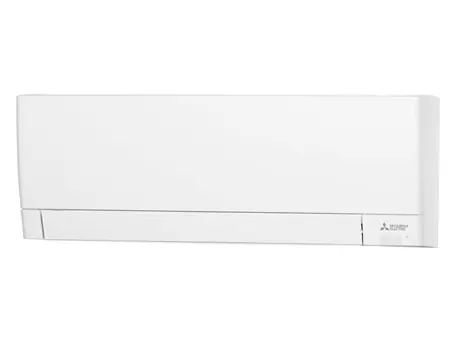
The MSZ-AY deserves a place on a bedroom shortlist because its published data combines low minimum noise with efficient cooling.
For the MSZ-AY35VGK2 indoor unit paired with MUZ-AY35VG2, Mitsubishi Electric lists:
3.5kW nominal cooling capacity.
SEER 8.7, with an A+++ cooling rating.
SCOP 4.7, with an A++ heating rating.
Indoor cooling sound pressure from 18dB(A) at the lowest fan setting to 42dB(A) at the highest.
SEER and SCOP are seasonal efficiency measures, explained later. These figures apply to this particular pairing, not every MSZ-AY size or multi-split combination. Mitsubishi Electric UK product information.
The practical attraction is low-speed operation once the room is comfortable. The limitation is that 18dB(A) is not a promise of constant noise at full cooling output.
Choose it when: low background noise is a priority and the installation quote is competitive.
Check before buying: the exact model suffix, required output and whether the unit can maintain your bedroom temperature comfortably at a low fan speed.
Daikin Perfera: a strong choice for airflow and comfort controls
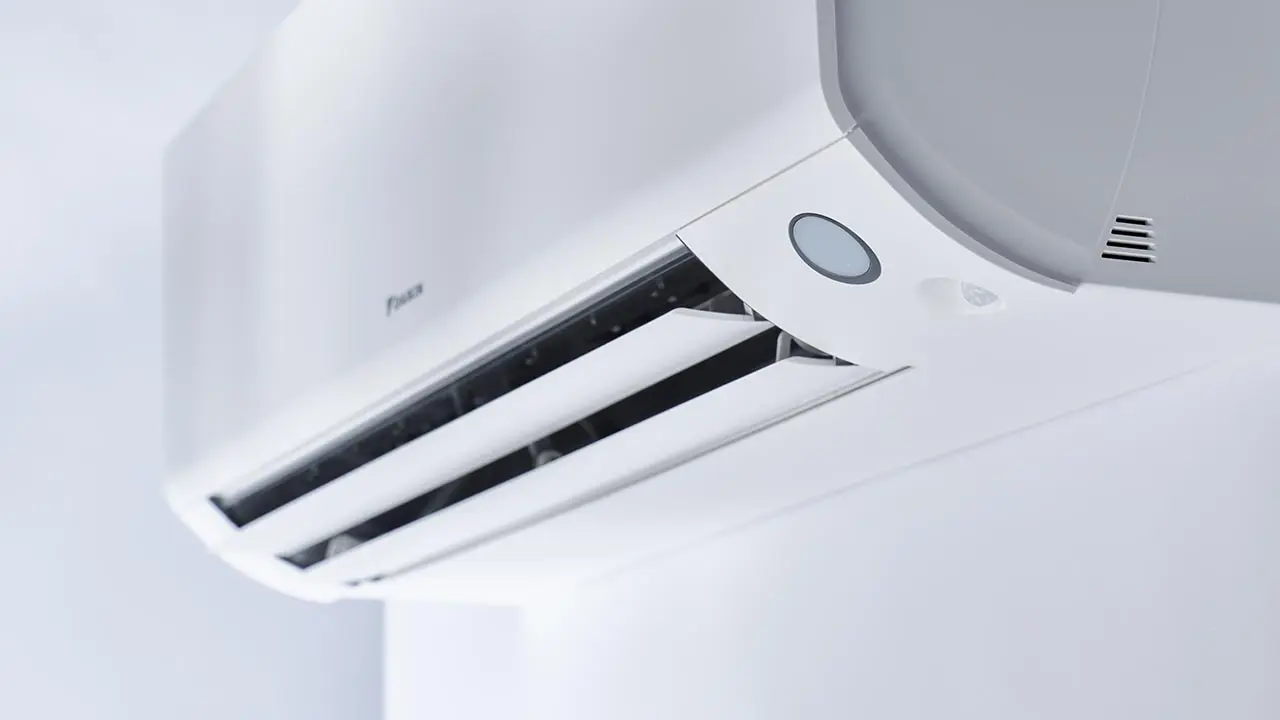
The Perfera FTXM-A is worth considering if you want more control over how air moves around the room.
Daikin lists automatic vertical and horizontal airflow, app control and a two-area motion sensor that can direct airflow away from an occupied zone. The range advertises seasonal ratings up to A+++ for heating and cooling, and indoor sound pressure as low as 19dB(A), depending on the model and operating conditions. Daikin Perfera product information.
Those airflow features may be useful in a living room where the sofa and dining area occupy different parts of the space. They also give you more flexibility than a unit whose airflow direction needs more manual adjustment.
The trade-off is whether the additional features justify the installed price. A room used occasionally may not benefit enough to make a more expensive package worthwhile.
Choose it when: adjustable airflow, connected controls and frequent use matter.
Check before buying: the exact indoor/outdoor pairing and its own efficiency data. A range’s “up to” rating should not be treated as the rating of every model.
Bosch Climate 3200i: a practical option for everyday heating and cooling
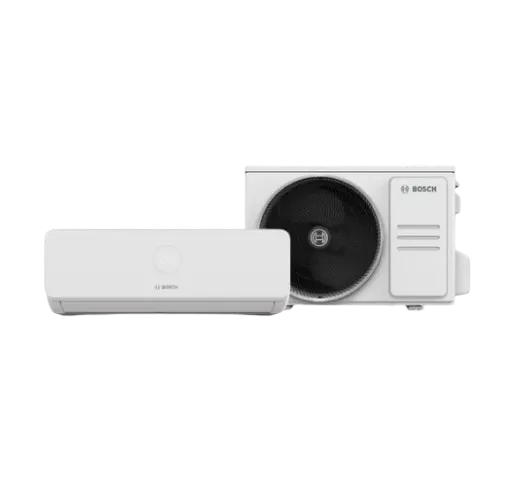
The Climate 3200i is worth comparing when you want a conventional wall mounted system with straightforward controls.
For the CL3200iU W 35 E / CL3000i 35 E pairing, Bosch’s UK literature lists a cooling SEER of 7.0. The indoor sound-pressure figures run from 21dB(A) in silent mode to 37dB(A) at high fan speed.
The indoor unit measures 802mm wide, 200mm deep and 295mm high, before allowing for the installation clearances specified in the manual. Bosch lists a separate Wi-Fi gateway for app control, so check whether it is included in your package. Bosch UK air conditioning brochure.
Choose it when: you want a relatively shallow indoor unit and the full installation package suits your budget.
Check before buying: app-control accessories, the precise guarantee terms and stock availability.
The manufacturer displayed an air conditioning stock-shortage notice when this guide was checked. An installer may hold separate stock, but confirm availability before planning around a fitting date. Worcester Bosch availability notice.
Daikin Sensira: a straightforward alternative to feature-heavy models
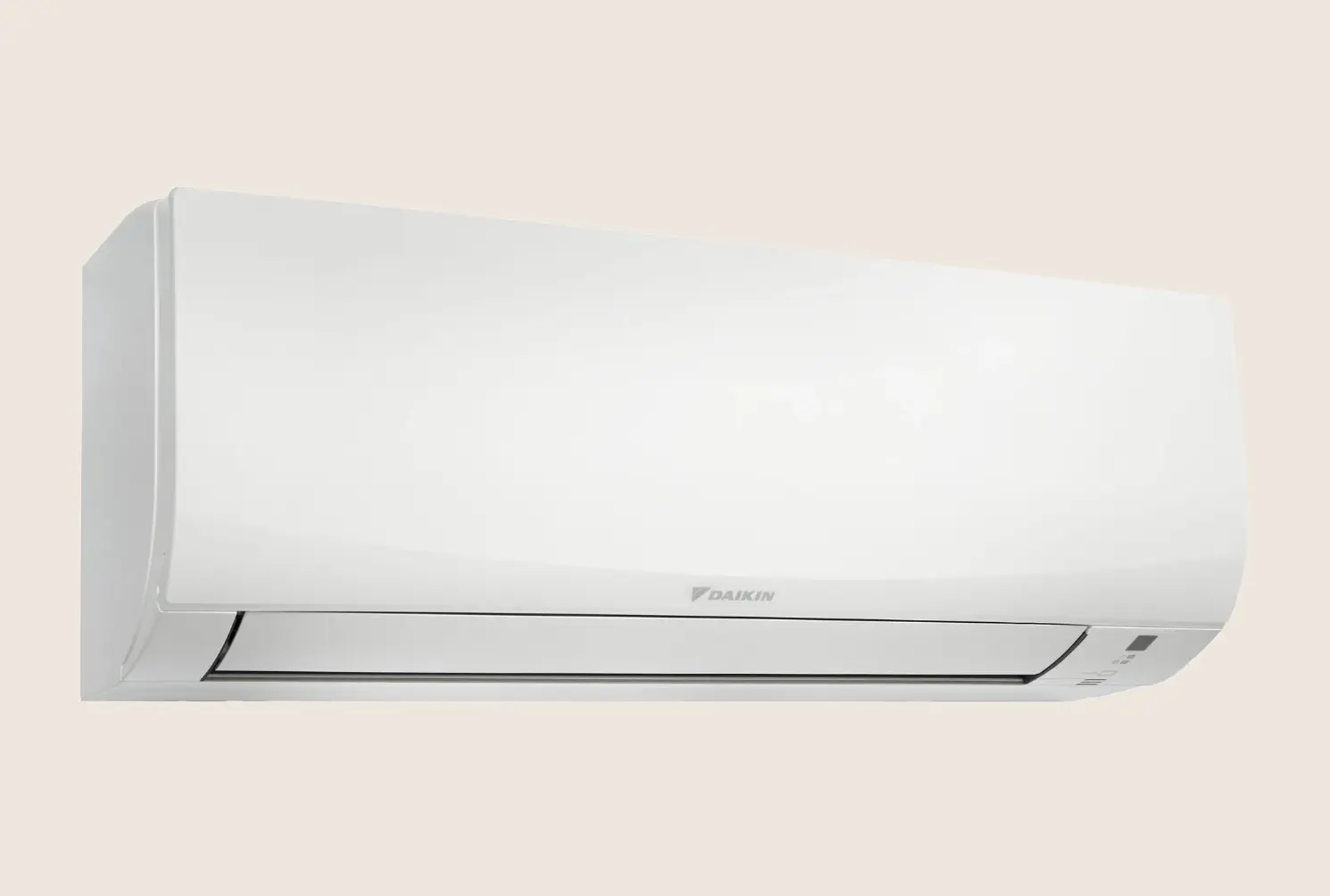
The Sensira FTXF-F is worth comparing if your main requirement is reliable temperature control without choosing a model primarily for additional sensors or advanced airflow features.
For the FTXF35F5V1B / RXF35F5V1B pairing, Daikin publishes:
SEER 6.5, with an A++ cooling rating.
SCOP 4.2, with an A+ heating rating for the average climate.
3.3kW nominal cooling capacity, alongside a 3.5kW cooling design load used in its seasonal data.
That distinction illustrates why a model’s “35” label or a retailer’s size category is not a complete specification. Daikin Sensira pairing data.
Daikin advertises operation down to 20dB(A) across the FTXF-F range, but the applicable figure and conditions should be checked for the quoted size. This does not establish Sensira as the quietest option in this shortlist. Daikin Sensira product information.
Choose it when: you want to compare a simpler Daikin package against more highly specified alternatives.
Check before buying: the generation, accessories and complete installed price.
Haier Revive: worth checking for a lower upfront price
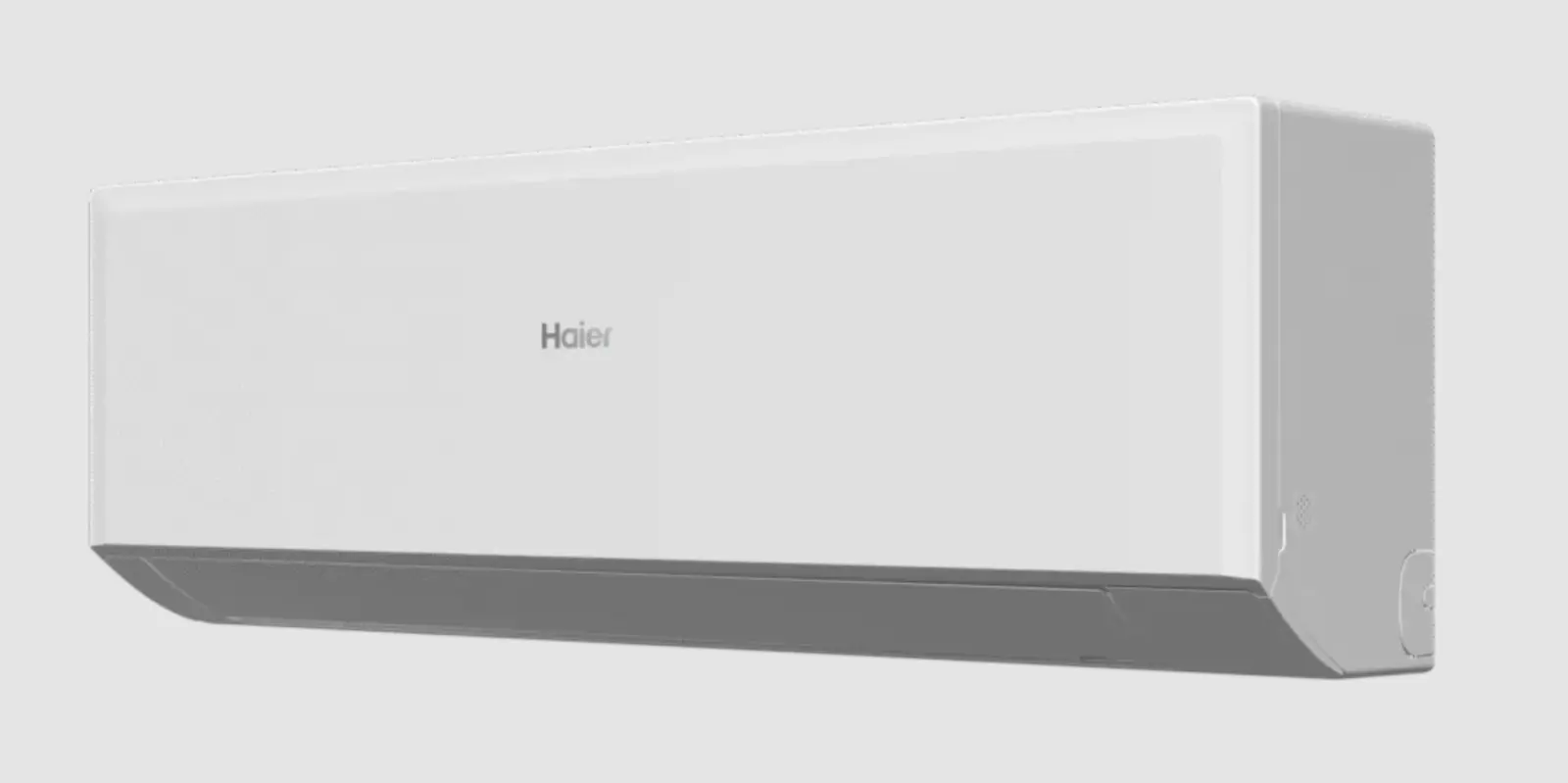
Haier Revive is the first package to check if your priority is the lowest advertised installation price among the single-room examples listed below.
That is a limited price comparison, not a claim that it is the cheapest air conditioner available across the UK.
Check the exact product name carefully. Haier also publishes a Revive Plus range with integrated hOn Wi-Fi and additional airflow controls. Do not assume a quotation labelled “Revive” includes every feature of Revive Plus. Haier Revive Plus product information.
Choose it when: upfront cost matters and the proposed system meets the room’s requirements.
Check before buying: indoor and outdoor model codes, included controls, warranty conditions and installation scope. A lower price is useful only when you know what it covers.
How much does wall mounted air conditioning cost?
As checked on 30 September 2026, iHeat’s public air conditioning page displayed these single-room packages with professional installation and VAT included:
Haier Revive, advertised as 3.5kW: £2,245.
Daikin Sensira, advertised as 3.5kW: £2,495.
Bosch Climate 3200i, advertised as 3.5kW: £2,575.
It also displayed a Bosch Climate 5000 M two-room package at £3,945, including installation and VAT. These are published package examples, not national averages or guaranteed prices for every property. iHeat’s air conditioning packages.
The public cards do not establish every installation allowance or exact model suffix. Confirm those details in your property-specific quotation.
What should an installed quote include?
Ask each installer to identify:
The indoor and outdoor units, including full model codes.
Refrigerant pipework, insulation and the permitted pipe length.
Trunking, wall penetrations and making good.
Outdoor mounting brackets or a suitable base.
Condensate drainage and any pump.
Electrical supply work and any exclusions.
Testing, commissioning and controls setup.
Warranty registration and aftercare.
A short pipe run through an accessible external wall is a different job from routing pipes across a house to an upstairs room.
Access equipment, a longer route, electrical alterations or a condensate pump can change the total. Compare quotes against the same proposed installation, rather than assuming a difference in price comes entirely from the brand.
Can you get help with the cost?
The government’s current Boiler Upgrade Scheme guidance lists £2,500 towards an eligible air-to-air heat pump. The scheme operates in England and Wales and has property, installation and heating-replacement conditions.
Do not automatically deduct this from an ordinary bedroom air conditioning quote. Ask the installer to confirm that the proposed project qualifies before including funding in your budget. Current grant amounts, scheme eligibility.
What size wall mounted air conditioner do you need?
The correct output depends on the room’s cooling load: how much heat the system needs to remove under the design conditions.
Floor area is only part of that calculation. An installer should also assess ceiling height, glazing, sunlight, insulation, occupancy, equipment and how the room connects to other spaces.
For example, two rooms with the same floor area can have very different requirements. A shaded bedroom with a modest window may gain much less heat than a top-floor office with roof windows and several computers.
Ask the installer to explain the calculation behind the proposed size. “This is what we fit in most bedrooms” is less useful than a recommendation tied to your room.
Bigger is not automatically better
An undersized system may struggle during the conditions it was meant to handle. An unnecessarily large system can also be a poor match if its minimum output is too high for the room’s lighter loads.
An inverter system adjusts its output, but only within its operating range. It cannot reduce capacity indefinitely.
The practical question is therefore:
Can this system meet the room’s peak requirement and operate comfortably when the demand is lower?
If you also want winter heating, request a heating assessment. A cooling calculation does not establish that the system will provide enough heat on a cold day.
Which air conditioner is best for a quiet bedroom?
The MSZ-AY is a sensible starting point, but there is no defensible “quietest for every bedroom” winner from minimum decibel figures alone.
Manufacturer data shows that noise changes with fan speed. The quietest setting may be appropriate once the room reaches temperature, while pulling down a hot room can require more airflow.
When comparing systems, ask for:
Indoor sound pressure at low, medium and high fan speeds.
The operating mode and test conditions.
Outdoor-unit noise information.
Whether the proposed drainage arrangement needs a pump.
Controls for display lights, beeps and overnight operation.
Sound pressure and sound power describe different things. Do not directly compare one model’s sound-pressure figure with another model’s sound-power figure.
Position can matter as much as the model
Ask the installer to show where the air will travel relative to your bed, desk or sofa.
A low-noise unit can still be uncomfortable if cold air blows directly over you. Likewise, a condensate pump or vibration transmitted through a mounting surface can affect the finished installation even when the indoor fan is quiet.
For a bedroom, review the complete arrangement: indoor position, airflow direction, drainage and outdoor location.
Should you choose a single-split or multi-split system?
A single-split system connects one indoor unit to one outdoor unit. A multi-split system connects several compatible indoor units to a shared outdoor unit.
Single-split is usually the first configuration to assess when only one room needs conditioning. Multi-split becomes relevant when several rooms need their own indoor units and outdoor space is limited.
Bosch’s Climate 5000M range supports up to five indoor units on a suitable outdoor unit. The number and combination depend on the selected system. It should be specified as a complete multi-split installation, rather than described simply as several standalone Climate 3200i systems. Bosch Climate 5000M information.
What are the trade-offs?
With multi-split, the outdoor unit’s available capacity is shared. Ask what each room can receive when the rooms you expect to use together are all calling for cooling or heating.
Also check whether the system supports your intended operating pattern. Standard domestic multi-split arrangements commonly require active indoor units to use the same heating or cooling mode; individual temperature settings do not necessarily mean simultaneous heating and cooling. Daikin explicitly describes this restriction for its Perfera multi applications. Daikin multi-system operating information.
Separate single-split systems may be worth comparing when rooms are far apart or independent operation is especially important. They need more outdoor units, but avoid making every room dependent on one shared unit.
Can one wall unit cool several bedrooms?
Do not plan a multi-bedroom installation around cool air drifting through doorways.
A landing unit does not provide the same room-by-room control as correctly positioned indoor units. Closed doors, room layouts and different heat gains all affect where the cooling is needed.
For bedrooms normally used with their doors shut, ask for a design that treats each room as its own space.
How much does wall mounted air conditioning cost to run?
Running cost depends on electrical consumption, your tariff and how long the system operates.
A unit described as “3.5kW” usually refers to a heating or cooling output. It does not mean the system continuously uses 3.5kW of electricity.
The basic calculation is:
Average electrical input in kW × operating hours × electricity price per kWh.
An illustrative daily cost
Assume a system averages 0.6kW of electrical input over six hours, with electricity costing 25p per kWh:
0.6 × 6 × £0.25 = £0.90.
That is 90p for the assumed six-hour period. It is not a measured result for the recommended models or a current tariff forecast. It excludes installation, servicing, repairs and standing charges.
Actual consumption changes with the room’s heat gains, outside temperature, thermostat setting, operating mode and system performance.
What do SEER and SCOP tell you?
SEER describes seasonal cooling efficiency. SCOP describes seasonal heating efficiency.
Higher figures indicate better efficiency under the relevant standardised conditions. They help compare correctly matched systems, but they are not guaranteed performance figures for your home.
For heating, compare the same climate category. For multi-split systems, use the data for the quoted indoor/outdoor combination rather than carrying over a single-split rating.
Is it worth paying more for better efficiency?
It depends on how much you use the system and the price difference.
Consider a simplified illustration using 1,000kWh of seasonal cooling demand and an assumed electricity price of 25p/kWh:
At an assumed seasonal efficiency of 6.5, electricity use would be about 154kWh, costing £38.46.
At an assumed seasonal efficiency of 8.7, electricity use would be about 115kWh, costing £28.74.
The difference is approximately £9.73 for that assumed cooling demand.
This calculation uses efficiency values as simplified assumptions. It is not a prediction of bills or a direct field comparison between two products. Heating use, actual seasonal performance and other operating costs are excluded.
It shows why a higher efficiency label alone may not repay a substantial purchase premium in a room cooled only occasionally. Comfort features and frequent year-round use may provide stronger reasons to choose the more expensive system.
Can wall mounted air conditioning replace your heating?
A reversible air conditioner is an air-to-air heat pump: it can transfer heat into the room as well as remove it.
That makes it useful for a home office, garden room or other space where you want heating and cooling. However, a standard wall mounted split system does not normally provide hot water for taps and showers. Energy Saving Trust’s air-to-air heat pump guide.
Before replacing an existing heating system, ask for:
A room-by-room heat-loss assessment.
Available heating output at the local winter design temperature.
An explanation of cold-weather and defrost operation.
A plan for rooms without indoor units.
A separate hot-water solution where needed.
A statement that a unit “operates down to” a low outdoor temperature does not tell you how much heat it supplies, or its efficiency, at that temperature.
For occasional supplementary heating, the decision is simpler. For primary heating, the complete design matters more than the cooling brochure.
What should you check before installation?
Refrigerant work must be done by a qualified installer
The split systems discussed here require specialist installation. Work on equipment containing fluorinated refrigerants is subject to qualification requirements; it is not a DIY pipe-connection job. Government F-gas qualification guidance.
Ask who will carry out the installation and what certification applies to the company and technician.
Agree the visible details
Before booking, request a clear explanation of:
Where each indoor and outdoor unit will sit.
Where pipes and trunking will run.
How condensate will drain.
How the electrical supply will be provided.
How the equipment will remain accessible for servicing.
These details affect appearance, noise and future maintenance. Agreeing them before installation is more useful than discovering on the day that a prominent pipe route is required.
Check permissions for your property
Ask the installer to confirm the applicable planning and building requirements for the location and installation. Requirements can differ across the UK and by property type.
If you rent or own a leasehold flat, establish what permission is needed from the landlord or freeholder before ordering equipment. Permission to alter an external wall should not be assumed.
Compare warranty conditions
A longer advertised warranty is useful only when you understand its coverage.
Check whether it includes parts and labour, who handles a claim, what registration is required and whether servicing conditions apply. Ask separately about workmanship cover.
Also request the servicing price. Comparing the installation quote without considering the cost of maintaining warranty eligibility leaves part of the ownership cost unanswered.
Does wall mounted air conditioning need maintenance?
Yes. Follow the manufacturer’s instructions for accessible filter cleaning and arrange professional maintenance appropriate to the system and its use.
Ask the installer to demonstrate routine user maintenance at handover. You should know how to access the permitted filters, use the controls and recognise when professional attention is needed.
A self-cleaning function should not be treated as a replacement for all maintenance. Confirm what the function actually cleans and what remains your responsibility.
Does it bring fresh air into the room?
Standard domestic split systems generally recirculate indoor air. They do not replace ventilation simply because they cool, heat or filter it.
You still need an appropriate way to ventilate the home. Filtration claims should also not be treated as a guarantee of removing every pollutant or preventing illness. Energy Saving Trust’s explanation of air circulation.
What if you cannot fit an outdoor unit?
A conventional split system may not be suitable if you cannot obtain permission or provide an acceptable outdoor location.
Alternatives include a portable air conditioner or a fixed monobloc system. A monobloc houses the main components indoors and connects through an external wall, so it still requires building alterations even though it avoids a separate outdoor unit. Energy Saving Trust’s explanation of monobloc systems.
Compare the noise, required openings, drainage and installation cost before deciding. For the broader options, see iHeat’s guide to types of air conditioning.
How to choose the best system for your home
Start with the room that needs improvement and describe the problem clearly: an overheating bedroom, uncomfortable afternoon working conditions or a room that needs both summer cooling and winter heating.
Then ask for a properly sized design and two comparable options: one covering the essentials and another showing what you gain from spending more.
Before accepting either, make sure you can answer:
Why is this output right for the room?
What noise should I expect during normal use?
Where will the units, pipework and drainage go?
What is included in the final installed price?
What maintenance and warranty conditions apply?
For a property-specific comparison, explore iHeat’s air conditioning installation options. Use the room assessment and complete quotation to make the final choice.
Last updated:
Written by Stephen Day
Gas Safe Engineer at iHeat
Stephen Day is a Gas Safe registered and FGAS certified engineer with over 20 years of hands-on experience in the heating, cooling, and renewable energy industry, specialising in boiler installations, air conditioning, and heat pump systems.
LinkedInArticles by Stephen Day are reviewed by iHeat’s technical team to ensure accuracy and reliability.
More air conditioning help & advice
29th September, 2026
Air Conditioning vs Air Source...
A reversible air conditioner heats and cools the rooms it serves. An air-to-water heat pum...
 Read Article
29th September, 2026
Can You Install Air Conditioni...
Yes, many flats can have air conditioning installed. The right system depends on your leas...
Read Article

29th September, 2026
Is Air Conditioning Allowed in...
Yes, air conditioning is usually allowed in new-build homes, although property-specific re...
Read Article
Thinking about air conditioning?
- Instant online estimate
- F-Gas certified installers
- Fast, tidy installation
- 0% APR available
No obligation. Takes less than 60 seconds.