


The best angle and direction for solar panels in the UK

Written by Bethany Armstrong
Renewables Manager
Updated:
Discover how roof angle, direction and shading affect solar generation—and why your roof may not need to face perfectly south.
- What do solar panel angle and direction mean?
- What is the best angle for solar panels in the UK?
- Which direction should solar panels face?
- Can more east–west panels outperform fewer south-facing panels?
- Can you put solar panels on a north-facing roof?
- What angle should solar panels be on a flat roof?
- How to check your roof’s direction and pitch
- Can shading matter more than angle or direction?
- Choosing the right layout for your home
Key takeaways
- South-facing panels at around 35–40° are a useful starting point.
- Your roof does not need the perfect pitch to perform well.
- East and west-facing roofs can also be suitable.
- Shading can matter more than small differences in angle.
- The best layout considers roof space, system size and electricity use.
South-facing solar panels at around 35–40° from horizontal are a good starting point for maximising annual electricity generation in the UK.
The exact optimum varies by location, but your roof does not need to match it precisely. South-east, south-west, east and west-facing roofs can also be suitable.
The difference between a suitable roof and a theoretically perfect one can be surprisingly small. In the London example below, a south-facing system at 45° generates just 0.3% less electricity than at 40°. Changing the direction from south to east has a much larger effect.
These comparisons use calculations from the European Commission’s PVGIS solar-performance model. They are modelled examples, not measured iHeat installations or forecasts for every UK roof.
What do solar panel angle and direction mean?
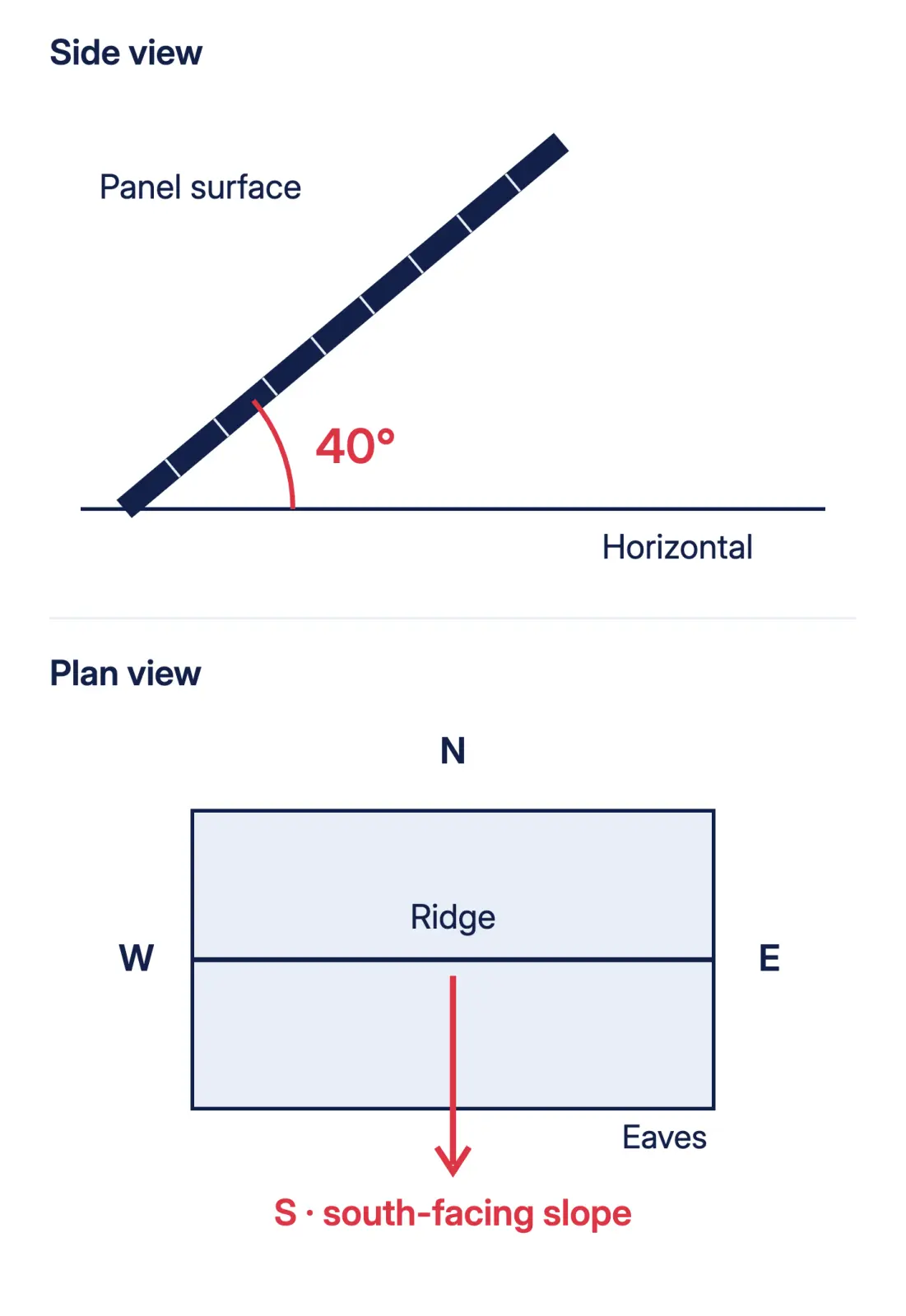
Tilt is measured from horizontal. Roof direction follows the slope from the ridge towards the eaves. Illustrative geometry, not an installation drawing.
Angle, also called tilt, measures how far a panel slopes upwards from horizontal. A flat panel is at 0°; a vertical panel is at 90°.
Direction, also called orientation, describes where the panel faces on the compass. A roof can have a 40° slope and face south, east, west or north: the measurements describe different things.
Panels on a pitched roof usually follow its existing slope. Flat roofs and ground-mounted systems allow more choice through their mounting structures.
What is the best angle for solar panels in the UK?
Around 35–40° is a useful general guide, but it is not a pass-or-fail range for your roof. Our south-facing PVGIS examples returned optimum tilts of 40° in London, 39° in Cardiff and Manchester, 41° in Belfast and 42° in Edinburgh.
These are representative city locations, not exact recommendations for every property in those areas. They also explain why guides give slightly different answers: a calculated optimum is one number, while a practical range includes angles that perform almost as well.
How much difference do 30°, 40° and 50° make?
In this London example, changing a south-facing system from 40° to 30° or 50° reduces annual generation by about 1.1%. A 45° roof is even closer to the 40° result.
Panel tilt from horizontal | Modelled generation per year | Difference from 40° |
|---|---|---|
30° | 4,041 kWh | 1.1% lower |
35° | 4,075 kWh | 0.3% lower |
40° | 4,087 kWh | Reference |
45° | 4,076 kWh | 0.3% lower |
50° | 4,043 kWh | 1.1% lower |
Source: PVGIS 5.3; London, due south, 4 kWp, 14% system-loss input, ventilated mounting and no shading. Historical weather data: 2005–2023. Generation is rounded to whole kWh; percentage differences use unrounded values. These are estimates, not guarantees.
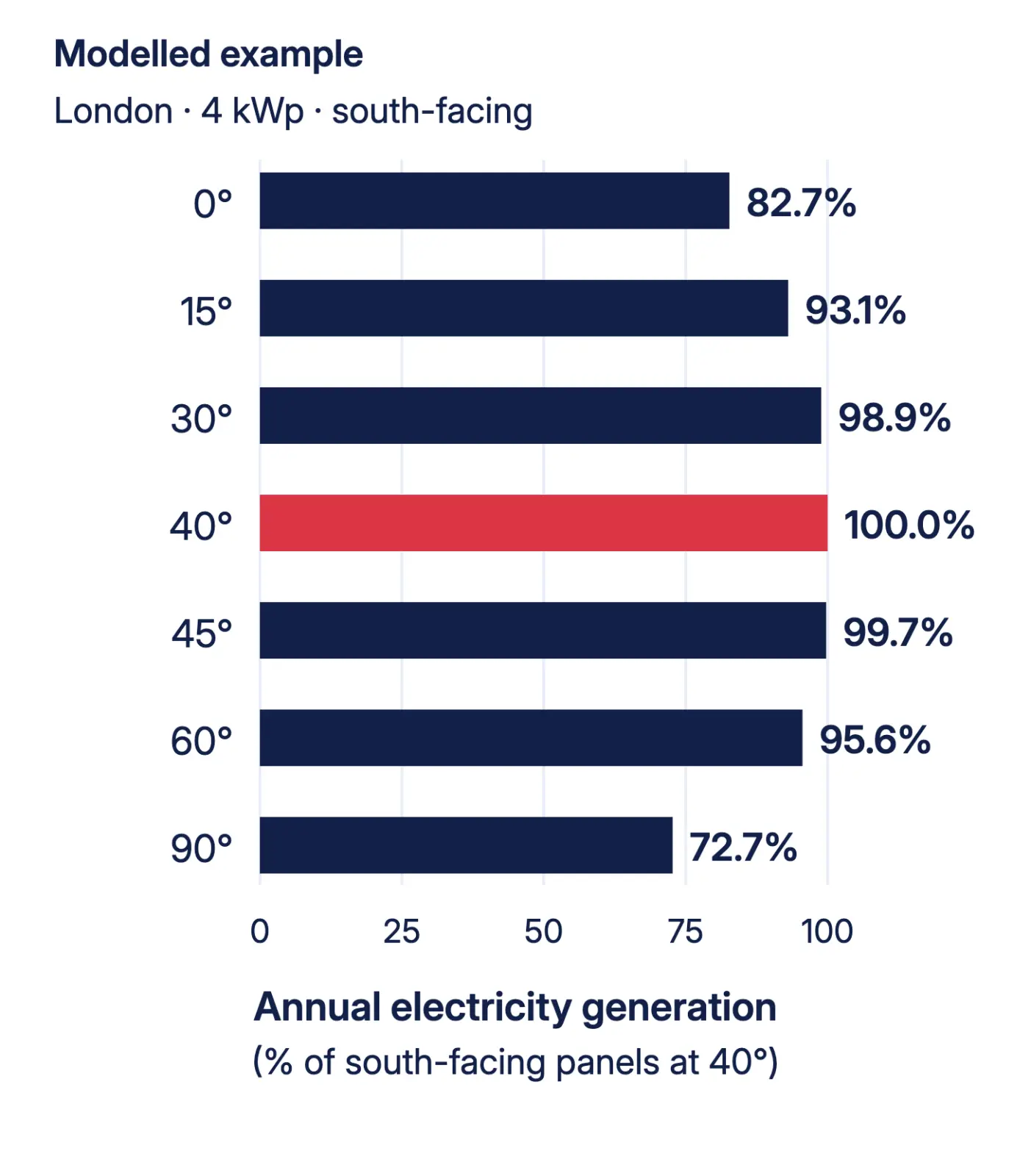
PVGIS 5.3 model: London, 4 kWp, south-facing, 14% system-loss input, ventilated mounting and no shading. Weather data: 2005–2023. Modelled estimates, relative to panels at 40°.
For this example, changing from 45° to 40° adds only about 11 kWh a year. That is a small gain to weigh against extra mounting work. A different roof pitch alone is not a reason to alter an otherwise suitable roof.
kWp describes the panels’ rated peak capacity. kWh measures the electricity generated or used over time. Our 4 kWp example does not produce 4 kW continuously.
Should panels be steeper in winter?
A steeper tilt can favour the lower winter sun, while a shallower tilt can favour summer generation. A fixed rooftop system normally balances output across the year.
Our London model illustrates the trade-off: a south-facing 60° system generates about 176 kWh in December, compared with 154 kWh at 40°. However, its annual total is lower: 3,906 kWh versus 4,087 kWh.
Adjusting a panel cannot compensate fully for short winter days. Seasonal adjustment is mainly a consideration for purpose-designed adjustable systems; ordinary rooftop panels are normally left at their installed angle.
Which direction should solar panels face?
South generally gives the highest annual output when system size, tilt and shading are comparable. In the UK, the sun is in the southern sky around the middle of the day, making a southerly orientation favourable over the year.
Here is how different directions compare in the same London model, with every system fixed at 40° and rated at 4 kWp.
Direction | Modelled generation per year | Compared with south |
|---|---|---|
South | 4,087 kWh | 100.0% |
South-east | 3,871 kWh | 94.7% |
South-west | 3,778 kWh | 92.4% |
East | 3,222 kWh | 78.8% |
West | 3,094 kWh | 75.7% |
North | 1,998 kWh | 48.9% |
Source: PVGIS 5.3, with the same assumptions as the angle table. Only direction changes. Local weather patterns mean east and west need not produce identical results.
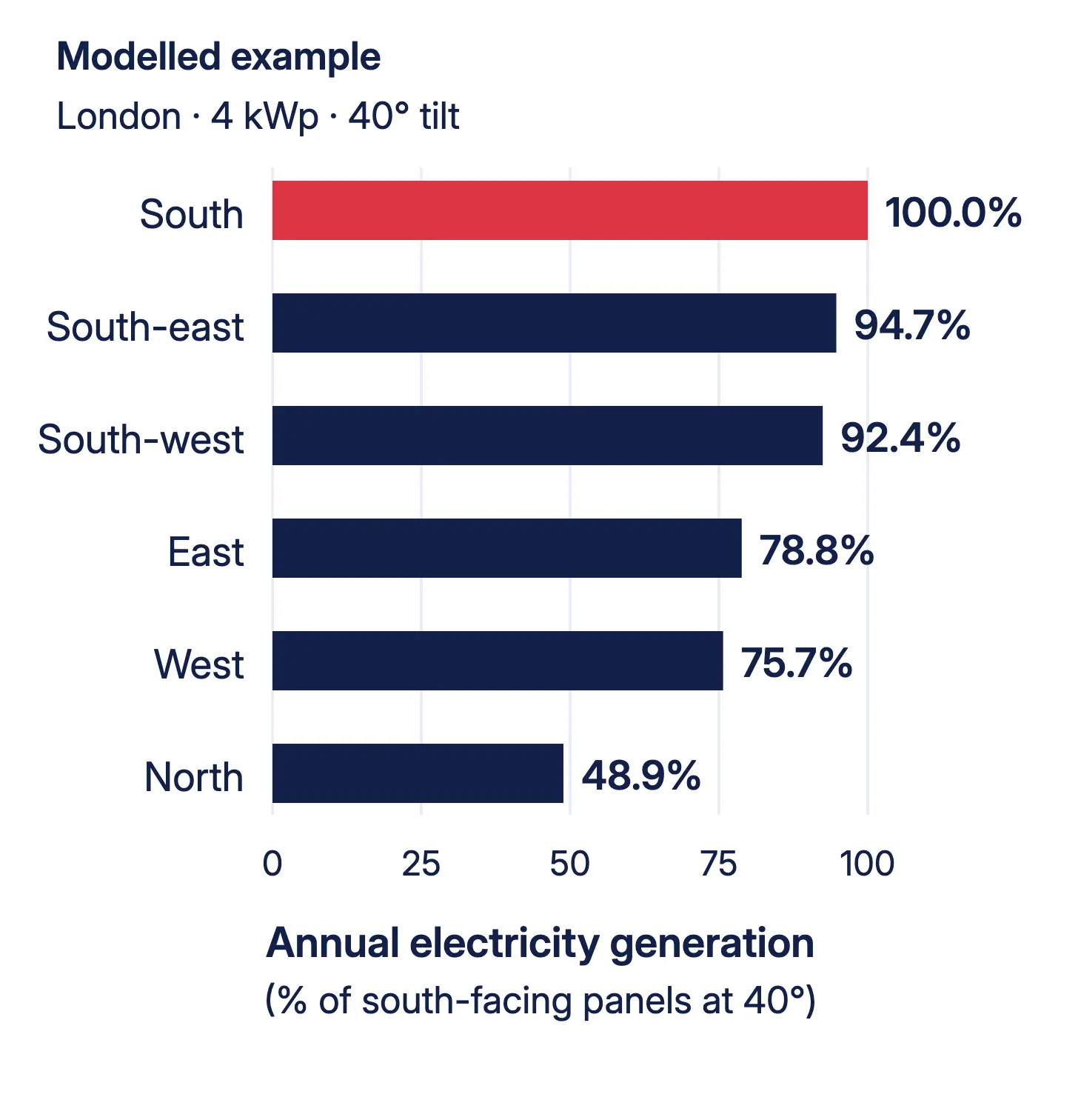
PVGIS 5.3 model: London, equal 4 kWp systems, 40° tilt, 14% system-loss input, ventilated mounting and no shading. Weather data: 2005–2023. Percentages describe this example, not every UK roof.
South-east and south-west remain close to south in this example. East and west produce less annually, but still generate substantial electricity. These percentages should not be applied unchanged to another location or roof pitch.
Is east or west better for your household?
East-facing panels favour morning generation; west-facing panels favour the afternoon and early evening while daylight remains. Splitting panels between both sides spreads generation across the day. Source: Energy Saving Trust.
That can improve the match with your routine, but it does not automatically make an east–west system better value. Compare total generation, when you use electricity, installation cost and the rates you pay for imports and receive for exports. West-facing panels cannot supply solar electricity after dark.
A battery can store daytime generation for later. It does not create extra sunlight, and storage involves energy losses and additional cost. Include those in the comparison rather than assuming a battery makes every layout worthwhile. Source: Energy Saving Trust’s battery guidance.
Can more east–west panels outperform fewer south-facing panels?
Yes. A larger east–west system can generate more overall than a smaller south-facing system, even if each installed kWp produces less.
Using the London results above, consider this illustrative comparison with 400 W panels:
10 panels facing south: 4 kWp total capacity; approximately 4,087 kWh a year.
Seven panels facing east and seven facing west: 5.6 kWp total capacity; approximately 4,421 kWh a year.
The larger east–west arrangement generates about 8% more electricity in this simplified example because it has 40% more panel capacity.
The calculation scales each 4 kWp direction result to 2.8 kWp, then adds the two sides. It excludes shading, inverter clipping and export constraints. It also does not establish which option gives the better financial return: the larger system requires more panels and installation work.
Compare the complete layouts your roof can accommodate, rather than treating compass direction as the only deciding factor.
Can you put solar panels on a north-facing roof?
North-facing panels can generate electricity, but the roof pitch makes a substantial difference. A shallow north-facing panel receives sunlight differently from one tilted steeply away from the southern sky.
In our London model:
At 15°, the north-facing system generates 2,838 kWh a year, around 75% of the equivalent south-facing system at 15°.
At 40°, the north-facing system generates 1,998 kWh a year, around 49% of the equivalent south-facing system at 40°.
Both comparisons use 4 kWp systems and the same unshaded conditions. The model shows why “north-facing” alone does not describe the whole picture.
However, technical generation is not the same as a worthwhile purchase. A system installed only on a steep north-facing roof needs a particularly careful assessment. Adding panels to a north-facing section during a larger installation is a different decision, based on the extra cost and generation.
Look at suitable south, east or west-facing roof sections first, including a garage or extension where available.
What angle should solar panels be on a flat roof?
A flat roof does not require flat panels, and a lower mounting angle can be a sensible design choice. For example, K2 offers flat-roof mounting systems with a 15° elevation. Source: K2 Systems.
The best layout must balance output per panel with the number of panels that fit, spacing between rows, wind exposure and structural loading. Steeper rows can need more separation to avoid shading the panels behind them.
In our London south-facing example, 15° produces about 93% of the annual electricity generated at 40°, for equal system capacity. A lower angle therefore does not automatically mean a poor design.
The roof also needs a suitable covering, drainage and adequate strength for the proposed mounting arrangement. Compare the annual output of the whole installation, alongside these practical requirements.
How to check your roof’s direction and pitch
You can get a useful initial idea without climbing onto the roof.
To check direction:
Find your property in a satellite map and set the view so north is at the top.
Identify the roof ridge and the slope you are considering.
Follow that slope from the ridge towards its lower edge. The compass direction of that line is the direction the roof faces.
For example, a slope running downwards towards the right of a north-up map faces east. The front door’s direction is not necessarily the direction of the roof section being assessed.
To check pitch: look for the roof angle in building plans or survey documents. A satellite image viewed from above does not reliably show pitch. If you do not have a recorded measurement, leave the precise angle to the site survey rather than guessing it from a photograph.
Can shading matter more than angle or direction?
Yes. A shaded south-facing roof can generate less than an unshaded east or west-facing roof. Trees, chimneys, dormers and neighbouring buildings can all change the best panel positions. Shading should be assessed across different times of day and seasons. Source: Energy Saving Trust’s installation guide.
Our modelled comparisons exclude shading so that you can see the effect of angle and direction alone. A real roof may behave differently.
Optimisers or microinverters can limit some of the electrical effects of shading, depending on the design. They cannot recover sunlight that never reaches a shaded panel. Avoiding a shaded position may be more useful than changing tilt by a few degrees.
Choosing the right layout for your home
For a suitable, unshaded pitched roof, start with its existing angle. Then compare available roof sections by total annual generation, timing of generation and installed cost.
Your proposal should identify the panel positions and capacity in kWp, predicted generation in kWh, shading assumptions, and how much electricity you are expected to use, store or export.
At iHeat, every solar installation includes a home survey covering roof space, orientation, shading, the proposed panel layout and access. Your proposal sets out the assumptions behind the estimates. Source: iHeat’s solar FAQs.
You can explore solar panel installation with iHeat to find out which arrangement suits your property.
How the comparisons were calculated: PVGIS 5.3, using SARAH3 weather data from 2005–2023, a 4 kWp crystalline-silicon system, a 14% system-loss input and the ventilated mounting setting. Horizon shading was switched off and no local shading was added. The London point was 51.5074°N, 0.1278°W. Regional runs optimised tilt while holding direction due south. PVGIS also calculates temperature and other losses; 14% is not the total modelled loss. Results were retrieved on 3 October 2026. Figures are modelled long-term averages, not a forecast for a particular year, a roof survey or a savings calculation. PVGIS methodology and settings.
Last updated:
Written by Bethany Armstrong
Renewables Manager at iHeat
Bethany Armstrong is a renewables expert and operations manager at iHeat, specialising in heat pump solutions and solar project delivery across the UK.
LinkedInArticles by Bethany Armstrong are reviewed by iHeat’s technical team to ensure accuracy and reliability.
Contributors

Managing Director
More solar & battery storage help & advice

30th September, 2026
Solar Panel Grants
Find out what help is available towards solar panel installation, who may qualify and how...
 Read Article
29th September, 2026
Solar Panels on Finance: Sprea...
iHeat offer solar finance at 9.9%
Read Article

08th September, 2026
Can You Replace Your Solar Inv...
Yes, you can replace a solar inverter with a different brand, as long as it's compatible w...
Read Article