Home battery storage without solar: costs and savings


Written by Bethany Armstrong
Renewables Manager
Updated:
15 min read
Can a home battery save you money without solar panels? Explore real iHeat quote examples, understand potential savings and find out what your home needs.
In this article
Key takeaways
- Home batteries can charge from cheaper grid electricity without solar panels.
- Three selected iHeat quotes ranged from £5,895 to £11,500, depending on equipment and installation scope.
- Savings depend on tariff rates, charging losses and how much higher-priced electricity the battery replaces.
- Power-cut backup requires a compatible system and installation, it is not included automatically.
Yes, you can install home battery storage without solar panels. A battery-only system charges from the electricity grid when your tariff is cheaper, then supplies your home when electricity costs more. Whether it pays for itself depends on the installed price, charging losses and how much expensive electricity you can replace.
This guide explains the costs, shows how to calculate potential savings and covers tariffs, battery sizing and backup power. It focuses on professionally installed home batteries connected to the mains.
Is home battery storage without solar worth it?
A battery without solar is most likely to be worthwhile when you regularly use electricity outside your tariff’s cheap hours and can store enough cheaper energy to cover that demand. High annual consumption helps only if the battery can replace electricity you would otherwise buy at a higher price.
For example, an electric car charged directly overnight may already use your cheapest electricity. Passing that energy through a home battery first adds losses, so EV ownership alone does not establish a financial case for battery storage.
A stronger case: substantial daytime or evening demand, a suitable time-of-use tariff, a competitively priced installation and controls that match charging to your tariff.
A weaker case: little demand outside cheap hours, a small price difference between rates, an oversized battery or an expensive installation.
A separate benefit: backup power may matter to you, but it needs a suitable installation and should be assessed separately from bill savings.
Before buying, compare the battery against what you could save by switching tariff and moving flexible use into cheaper hours without one. That gives you a fairer measure of the battery’s additional value.
Imagine two homes with the same annual electricity bill. In the first, much of the demand comes from a car that already charges overnight. In the second, demand rises during the afternoon and evening, when the household is cooking, working and using appliances. The second home may have more expensive electricity for a battery to replace, even though the annual totals are identical.
That is why a useful battery recommendation starts with your daily pattern. The question is how much of your consumption can genuinely move into a cheaper period, and what it costs to make that possible.
How much does home battery storage cost without solar?
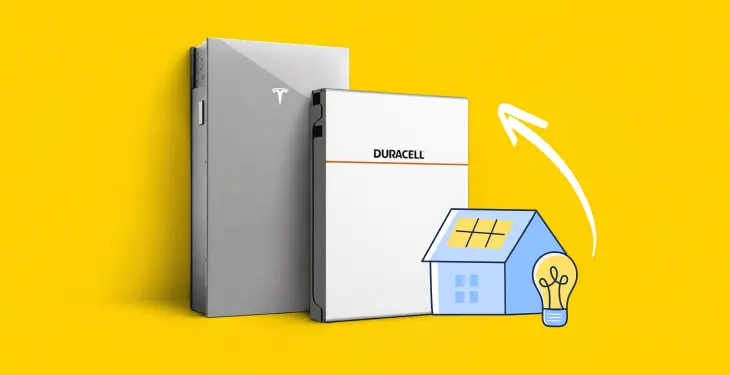
In three selected iHeat proposals for homes without existing solar, quoted battery installations ranged from £5,895 for a 16 kWh Duracell system to £11,500 for a 27 kWh Tesla system with a gateway. A 32 kWh Duracell proposal was £8,745. These examples show why storage capacity alone does not determine the price.
Three anonymised iHeat quote examples for homes without solar:
16 kWh Duracell Energy Dura16: £5,895. Battery installation; the proposal does not separately name an inverter model.
32 kWh Duracell Energy Dura16: £8,745. Batteries with a 6 kW Duracell Dura-i inverter.
27 kWh Tesla Powerwall 3 system: £11,500. Battery system with inverter and gateway; the total includes a price-match adjustment.
Source and scope: three selected iHeat proposals reviewed on 14 September 2026. Each records no existing solar and includes installation and commissioning. These are historical quotes, not current offers, completed-installation invoices or a representative UK price survey. Listed capacities are those recorded in the proposals, not a guarantee of usable energy delivered to the home. The Tesla total includes a price-match adjustment.
The 16 kWh quote does not separately specify an inverter model, so it should not be treated as a like-for-like equipment comparison. Your price depends on the equipment, property and installation scope; request a current, itemised design.
Ask for an itemised quote covering the battery, inverter, installation, VAT treatment, network application work and any electrical upgrades. Confirm whether backup equipment is included: two systems with the same storage capacity can have different capabilities and costs.
For more context, see our battery storage cost guide.
How much could a battery without solar save?
Estimate savings using the electricity the battery actually delivers to your home, after losses. The useful comparison is the cost of buying that electricity directly versus the cost of charging the battery to provide it.
Daily energy saving = electricity delivered by the battery × (avoided unit rate − charging unit rate ÷ round-trip efficiency).
Use rates in pounds per kWh and efficiency as a decimal. Round-trip efficiency describes how much electricity you get back after charging and discharging; 90% means buying 10 kWh returns 9 kWh at the measurement boundary used.
Worked example: shifting 8 kWh per day
This is an illustrative calculation, not a customer result, live tariff quote or prediction. Assume:
8 kWh delivered to the home each day, replacing electricity costing 30p/kWh.
Charging electricity costing 10p/kWh.
90% round-trip efficiency across the charging and discharging path.
The same usage and prices on 365 days, with sufficient battery capacity and power to achieve this.
Buying 8 kWh directly would cost £2.40. Delivering it through the battery requires about 8.89 kWh of charging electricity, costing £0.89. The difference is approximately £1.51 a day, or £552 a year, calculated before rounding.
How daily usage changes the illustrative saving:
4 kWh delivered per day: approximately £0.76 daily or £276 annually.
8 kWh delivered per day: approximately £1.51 daily or £552 annually.
12 kWh delivered per day: approximately £2.27 daily or £827 annually.
All three examples assume a 30p/kWh avoided rate, a 10p/kWh charging rate and 90% round-trip efficiency. Annual figures are calculated before rounding the daily saving.
These examples show different amounts of energy used, not recommended battery sizes. Actual results vary with seasonal demand, rates, usable capacity and available charging time. The calculation excludes standby consumption, degradation, fees, maintenance and finance costs. It assumes no change in standing charges and includes no export income.
How long would it take to pay back?
At a hypothetical £5,500 installed price and approximately £552 annual savings, simple payback would be about 10 years. That assumes savings stay constant and no additional costs arise. It is not a forecast of lifetime profit.
If the avoided rate in the 8 kWh example fell to 25p/kWh, with all other assumptions unchanged, annual savings would fall to about £406 and simple payback would stretch to roughly 13.6 years.
Ask for a whole-year comparison against a suitable tariff without a battery. It should account for the electricity you still buy directly, standing charges, likely degradation and any finance or replacement costs. A long payback period deserves particular scrutiny against the system’s warranty and expected service life.
How does a battery-only system work?
A home battery stores electricity for later use. With no solar panels, all its charging energy comes from the grid. An inverter converts electricity between the form used by the battery and the form used in your home.
Charge during cheaper periods. The system follows a schedule or compatible automated controls.
Supply the home during more expensive periods. Stored energy replaces some of your higher-rate grid purchases.
Use the grid when necessary. If the battery reaches its reserve level or cannot meet your home’s instantaneous demand, the grid supplies the shortfall while the grid is available.
Cheap periods are not always overnight. Some tariffs have several price windows each day; others change every half hour. The charging schedule must match the tariff you actually use.
What might this look like on an ordinary day? Imagine a household with a fixed overnight charging window. The battery charges while everyone is asleep. In the morning it supplies some of the breakfast-time demand, then continues covering appliances and other use during the day. If enough charge remains, it also helps with the evening’s electricity use.
If the household uses more energy than expected, the battery may reach its reserve before the next cheap window. The home then buys electricity at the rate applicable at that time. You still have a normal grid supply; the consequence is a smaller saving that day.
There is also a difference between running out of energy and reaching a power limit. In an illustrative setup with a 3 kW battery output limit, a simultaneous 5 kW household demand would still require about 2 kW from the grid, even with a full battery. That is why the inverter specification matters alongside the storage capacity.
The Energy Saving Trust confirms that batteries can be used without solar and explains that storing energy introduces losses. A battery can reduce the price you pay for energy without reducing the amount you buy.
Which electricity tariff works with a battery without solar?
Look for an eligible tariff with a useful difference between charging prices and the prices you would otherwise pay. Compare the full tariff, including daytime rates and standing charges. A cheap overnight headline rate alone does not tell you the annual saving.
Predictable time windows: make it easier to set a repeatable charging schedule. Check whether the window is long enough to charge your chosen system.
Dynamic prices: can reward flexible charging, but prices also rise. Agile Octopus, for example, uses half-hourly prices linked to wholesale costs.
Equipment-specific tariffs: can require more than a home battery. Intelligent Octopus Go’s terms require a qualifying EV or plug-in hybrid and other eligibility conditions. Cosy Octopus requires eligible electric heating.
These are examples, not a ranking of suppliers or a recommendation for every home. Check current eligibility, regional prices, meter requirements and battery-control compatibility before committing. Octopus says its smart tariffs require a meter it can receive half-hourly readings from; see its smart tariff joining guidance.
Automation can handle charging where the equipment and tariff support it. Ask who sets it up, whether there are subscription fees and what happens if the internet connection or supplier integration stops working.
Can a battery save money on a flat-rate tariff? Buying electricity at one price and using it later at that same price does not create a time-shifting saving. Charging losses make the stored electricity more expensive per usable kWh. Backup or a separate paid flexibility arrangement might still have value, but the basic cheap-charge, expensive-use calculation would not apply.
What size battery do you need without solar?
Size the battery around demand between cheap charging periods, rather than annual consumption alone. Your half-hourly electricity readings are more useful than the number of bedrooms because they show when energy is used.
Compare three separate specifications:
Usable capacity, in kWh: the energy available within the battery’s operating limits. A backup reserve and conversion losses can reduce the amount available for everyday savings.
Charge and discharge power, in kW: how quickly energy can enter or leave the system. A large battery with a low-power inverter may still need grid electricity when several appliances run together.
Charging time: a four-hour window at 3 kW permits at most 12 kWh of input before losses and other limits. A larger battery will not necessarily recharge fully within that window.
If you normally use 6 kWh between cheap periods, a system designed to deliver 15 kWh during that interval may spend much of its capacity unused. Ask the installer to show how the proposed size fits both summer and winter demand. Our battery sizing guide explains the terminology in more detail.
Try this before requesting a design. Open your supplier’s app or download your half-hourly readings. Look at a typical working day, a weekend and a colder period. Add up the electricity used outside the tariff’s cheap windows, and note large loads that already run cheaply. Give those readings to the installer alongside your annual total.
A heat pump or electric heating can make that seasonal comparison especially useful: a battery selected around winter demand may be used much less in summer. The aim is to find a size that earns its keep across the year, rather than one that covers every possible high-use day.
Will a home battery work during a power cut?
Only if the system is designed and installed to provide backup power. Buying a battery does not automatically mean your lights, fridge or whole home will stay on during an outage.
For a concrete example, Tesla states that Powerwall 3 in its non-backup configuration does not supply the home during a grid outage. Backup requires additional equipment and the appropriate installation.
Ask which circuits will be supported, the maximum backup power, whether switching is automatic and how much energy is reserved. Keeping energy for emergencies reduces the capacity available for daily tariff savings.
Backup duration depends on the available energy and the appliances running. Illustratively, 4 kWh available at the household output would cover a steady 0.5 kW load for about eight hours. A battery without solar cannot recharge from the grid while the grid is down.
Do you need DNO approval for battery storage?
Your distribution network operator (DNO) needs to be involved in a grid-connected battery installation. In Great Britain, the connection route depends on the electrical rating, equipment compliance and complete installation, including any existing generation. Battery capacity in kWh does not determine the route by itself.
G98: generally covers compliant, fully type-tested equipment with an aggregate registered capacity up to 16 amps per phase, equivalent to 3.68 kW per phase at 230 V. Eligible single-premises installations can follow a notification process.
G99: applies above that threshold or where G98 requirements are not met. Your installer should obtain the required DNO agreement before proceeding.
National Grid Electricity Distribution explains the G98 criteria and G99 process. G99 also covers installations larger than 50 kW; that figure is not its overall upper limit. Northern Ireland has its own network requirements.
At iHeat, we assess the connection route and handle the DNO paperwork for your installation. Confirm the agreed export limit and any network conditions in your proposal.
Can you get a grant or 0% VAT without solar?
Qualifying installations of standalone electrical storage batteries in UK homes currently benefit from 0% VAT until 31 March 2027. Solar panels are not required. Under the current rules, qualifying installations revert to 5% VAT from 1 April 2027.
The relief applies to qualifying installation work and equipment supplied by the installer as part of that work. A battery bought separately from a retailer is not automatically zero-rated. See HMRC’s standalone battery guidance and VAT Notice 708/6.
Grant eligibility is different. In England, the July 2026 Warm Homes: Local Grant guidance says domestic batteries must complement existing or new solar PV. This does not establish eligibility for a battery-only installation without solar. Other schemes vary by location; confirm eligibility and funding before booking work.
Can you earn money by exporting stored grid electricity?
Possibly, but payment depends on your supplier’s terms and connection permissions. A grid-charged battery alone does not make you eligible for payments under the Smart Export Guarantee (SEG).
Ofgem’s SEG guidance covers eligible low-carbon generation in Great Britain. Ofgem also explains that suppliers are not obliged to pay SEG rates for grid-sourced electricity exported from storage in its storage guidance, Appendix 3.
Commercial export or flexibility arrangements may offer other options. Ask the supplier to confirm that your battery-only setup qualifies, including metering, certification and equipment requirements. Leave export income out of your savings forecast until those terms are confirmed.
How do you choose a battery system?
Choose the complete installation around your intended use. Ask the installer to specify:
The exact battery and inverter models, with confirmation of grid-only operation.
Usable capacity, sustained power and efficiency figures, including how efficiency is measured.
Tariff automation, app access and any ongoing charges.
Backup capability and whether additional hardware is included.
Warranty years, retained-capacity terms and any cycle or energy-throughput limits.
An appropriate installation location and the cost of any future expansion or solar connection.
Energy Saving Trust gives a typical battery lifespan of around 10–12 years, while noting that lifespan varies with the product and use. A warranty is not a promise of unchanged capacity or guaranteed financial payback.
What does battery degradation mean for you? Capacity can fall over time, leaving less energy available between charges. If your savings estimate assumes the same daily delivery for ten years, ask how the forecast changes as capacity reduces. Also check whether the warranty covers the battery alone or includes labour and other components.
Can you add solar panels later?
Yes, if your chosen battery system and installation support it. Tell your installer before buying: future solar may need a separate inverter, additional wiring or changes to the network connection agreement. Request a design that explains what can be reused and what would need to be added.
Solar adds generation, while a battery alone changes when you buy electricity. If your roof is suitable, compare a solar and battery system against battery-only storage using the additional installation cost, expected generation and export terms. Solar electricity stored for later use also has an opportunity cost if you could otherwise have sold it.
What should you check before getting a quote?
Bring your last 12 months of electricity use, ideally with half-hourly readings, and your current tariff. Explain whether you want bill savings, backup power or both, and mention plans for an EV, heat pump or solar panels.
Ask for a proposal that shows the installed price, expected annual savings with assumptions, and how a cheaper-rate or lower-use scenario affects payback. At handover, keep the electrical and commissioning documents, network paperwork, applicable certification and warranty details, and make sure you know how the controls work.
You arrange your electricity tariff with the supplier; the installer should explain the battery settings and provide support details. Completion of the installation does not remove applicable warranty or aftercare obligations.
Explore home battery installation with iHeat to find a system that fits your usage and property.
Get a battery installation quote tailored to your home:
Last updated: