Best Boiler for a Large House: A Guide for Big Families

Written by Stephen Day
Gas Safe Engineer
Updated:
17 min read
A system boiler with a hot water cylinder is often best for large homes with multiple bathrooms, but the right choice depends on your household's heating and hot water needs.
In this article
Key takeaways
- Best for busy families: System boiler with a hot water cylinder.
- Best for limited space: Combi boiler, if water supply is suitable.
- Best for traditional systems: Regular boiler, if the existing setup is suitable.
For most large houses with multiple bathrooms, a system boiler paired with a correctly sized hot water cylinder is often the best choice. It provides stored hot water for busy periods, making it particularly suitable for families who regularly use several showers, baths or taps around the same time.
If you're comparing actual models, the Worcester Bosch Greenstar 4000 and Vaillant ecoTEC Plus system boilers are two options worth investigating. For households with different requirements, a higher-output combi or a regular boiler may be more appropriate.
The best boiler for a large house depends on the property's heating requirements, how your family uses hot water and your existing heating system, rather than bedroom count alone.
What is the best boiler for a large house?
A system boiler is often the best choice for a large house with high hot water demand, particularly when several people need showers or baths during the same period.
However, not every large house needs the same type of boiler.
A five-bedroom property occupied by two people may have relatively modest hot water requirements. The same property occupied by six people, with several bathrooms used every morning, will place much greater demands on its hot water system.
The main boiler types to consider are:
Boiler type | Best suited to | Main consideration |
System boiler | Large families with frequent simultaneous hot water demand | Requires a suitable hot water cylinder |
Combi boiler | Larger homes where hot water is generally used at different times | Hot water delivery is limited by the boiler and mains supply |
Regular boiler | Properties with an existing traditional heating system | Cylinder, tanks and pipework must remain suitable |
For most busy households with several bathrooms, a system boiler is the sensible starting point. However, the correct model and output must be established through a professional assessment.
Best boilers for large houses: Four models worth considering
If you're choosing a new boiler for a large house, the following models provide useful options for different household requirements.
These four models appear in iHeat's boiler product list. They cover system, combi and regular boiler arrangements, rather than simply ranking boilers by output.
Boiler model | Type | Best suited to | What to consider |
Worcester Bosch Greenstar 4000 | System | Families needing stored hot water where the property's heating requirement suits the model | Cylinder capacity, recovery and calculated heat loss |
Vaillant ecoTEC Plus | System | Homes requiring a cylinder-based setup with suitable heating capacity | Heating output, modulation and cylinder compatibility |
Worcester Bosch Greenstar 8000+ | Combi | Larger homes with limited cylinder space and suitable mains water supply | Hot water flow, simultaneous demand and incoming mains performance |
Ideal Logic² Plus | Regular | Larger properties retaining a suitable traditional heating system | Existing cylinder, tanks, controls and pipework |
These are models worth comparing, not universal recommendations for a particular number of bedrooms. A higher-output boiler is not automatically better for a larger household.
Worcester Bosch Greenstar 4000 system boiler
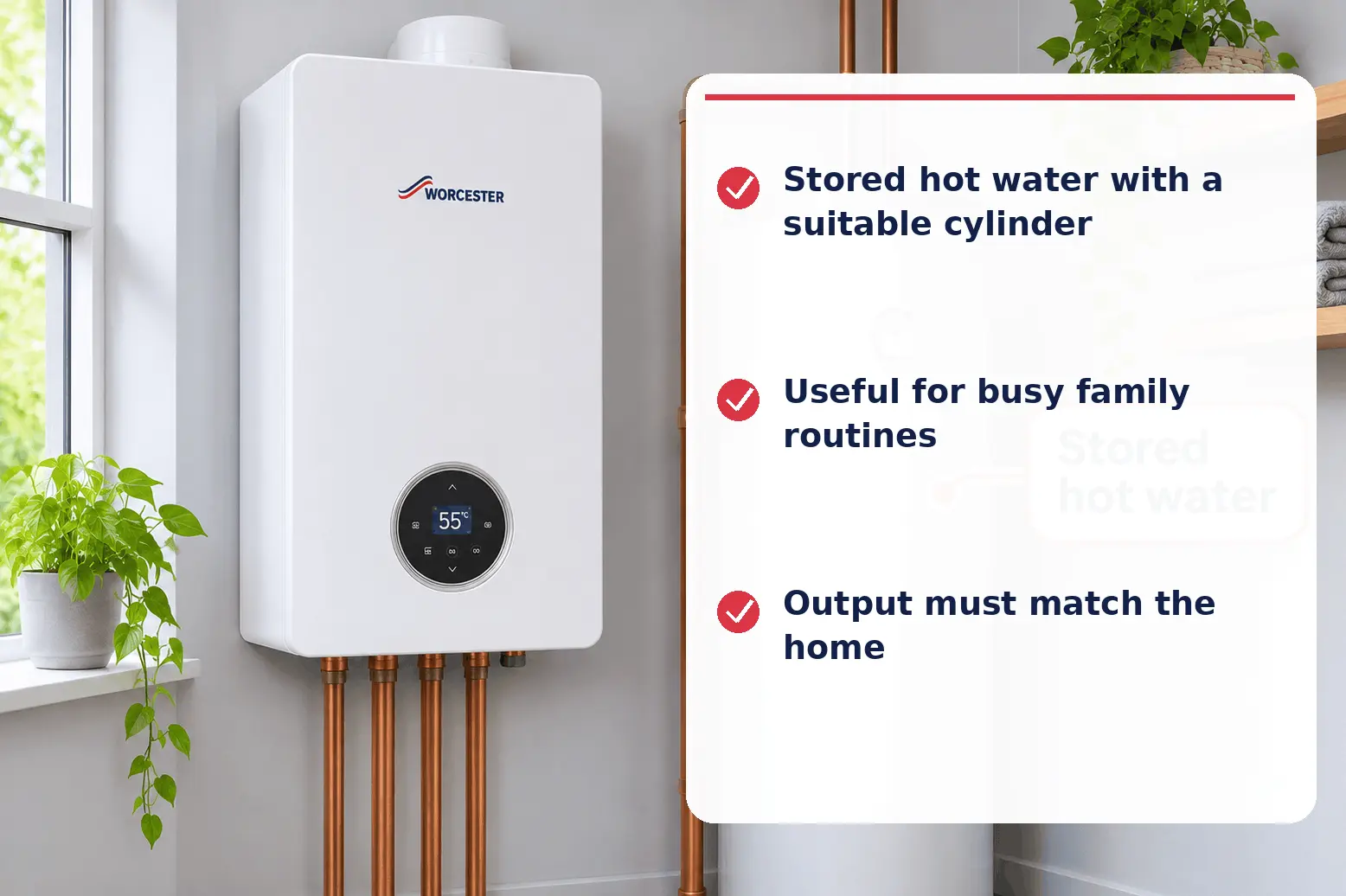
The Worcester Bosch Greenstar 4000 system boiler is worth considering for a larger household that needs stored hot water but does not necessarily have a particularly high central heating requirement.
When paired with a suitable hot water cylinder, it can form part of a system designed around periods of concentrated demand, such as several family members showering before work or school.
The key consideration is how the boiler works with a suitably sized hot water cylinder, rather than its output alone.
Why consider it?
It provides an option for households prioritising stored hot water, provided a heat-loss calculation confirms that the selected boiler output is appropriate.
What should you check?
The cylinder must have sufficient usable capacity and recovery performance for your household. An installer should also confirm that the boiler suits the property's heating requirements.
Vaillant ecoTEC Plus system boiler
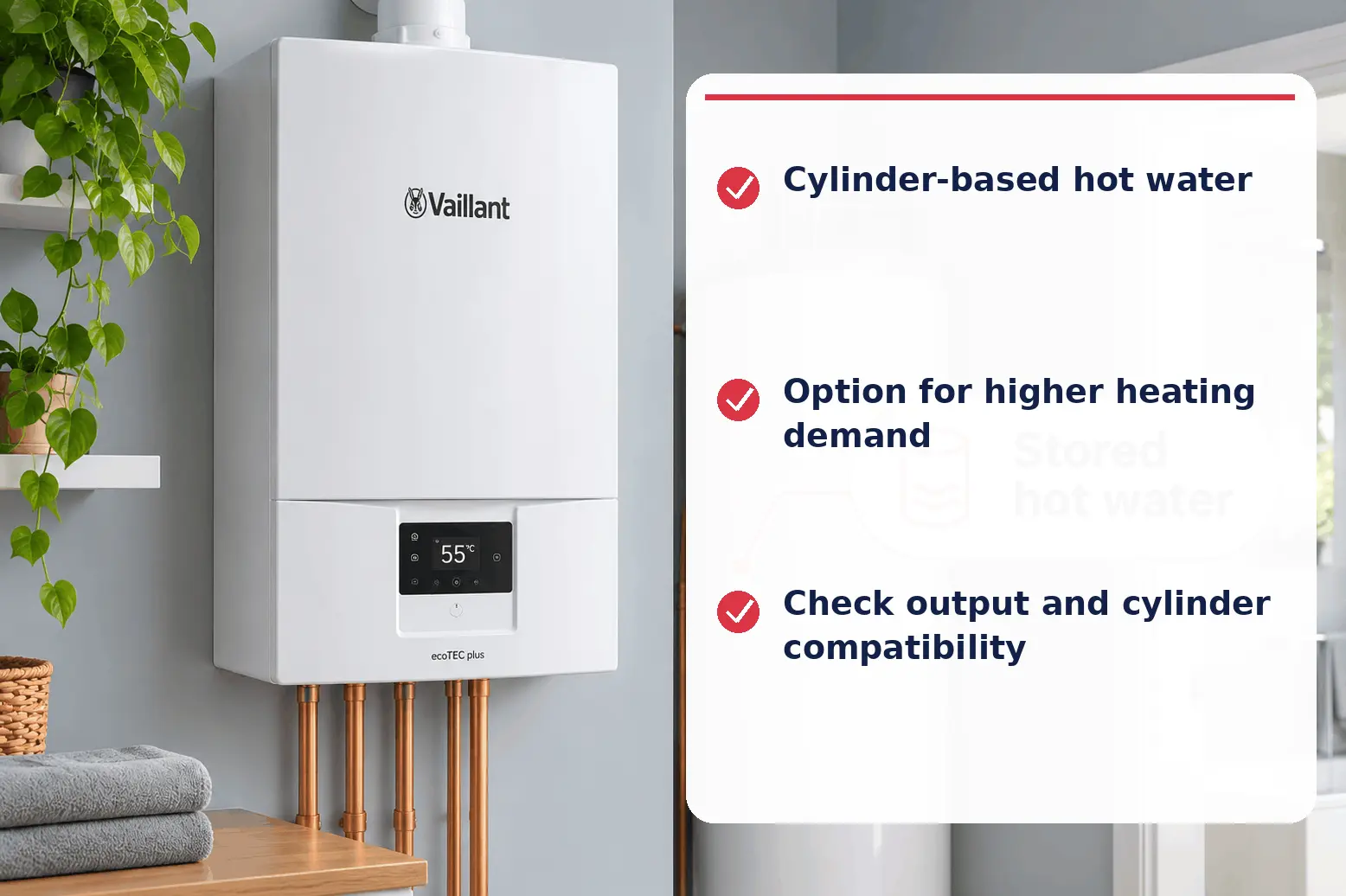
The Vaillant ecoTEC Plus system boiler is another option for a large home where a separate hot water cylinder is preferred.
As with the Worcester Bosch model above, the appropriate output must be selected to match the property's requirements.
However, a higher output does not automatically mean better hot water performance. The cylinder, heating controls, water supply and complete system design all influence how well the arrangement works.
Why consider it?
It offers another system boiler option where the property's calculated heating requirements and cylinder arrangement justify the selected model.
What should you check?
An installer should assess the boiler's heating output range, modulation, cylinder compatibility and reheat requirements.
For a detailed comparison of system models, see our guide to the best system boilers.
Worcester Bosch Greenstar 8000+ combi boiler
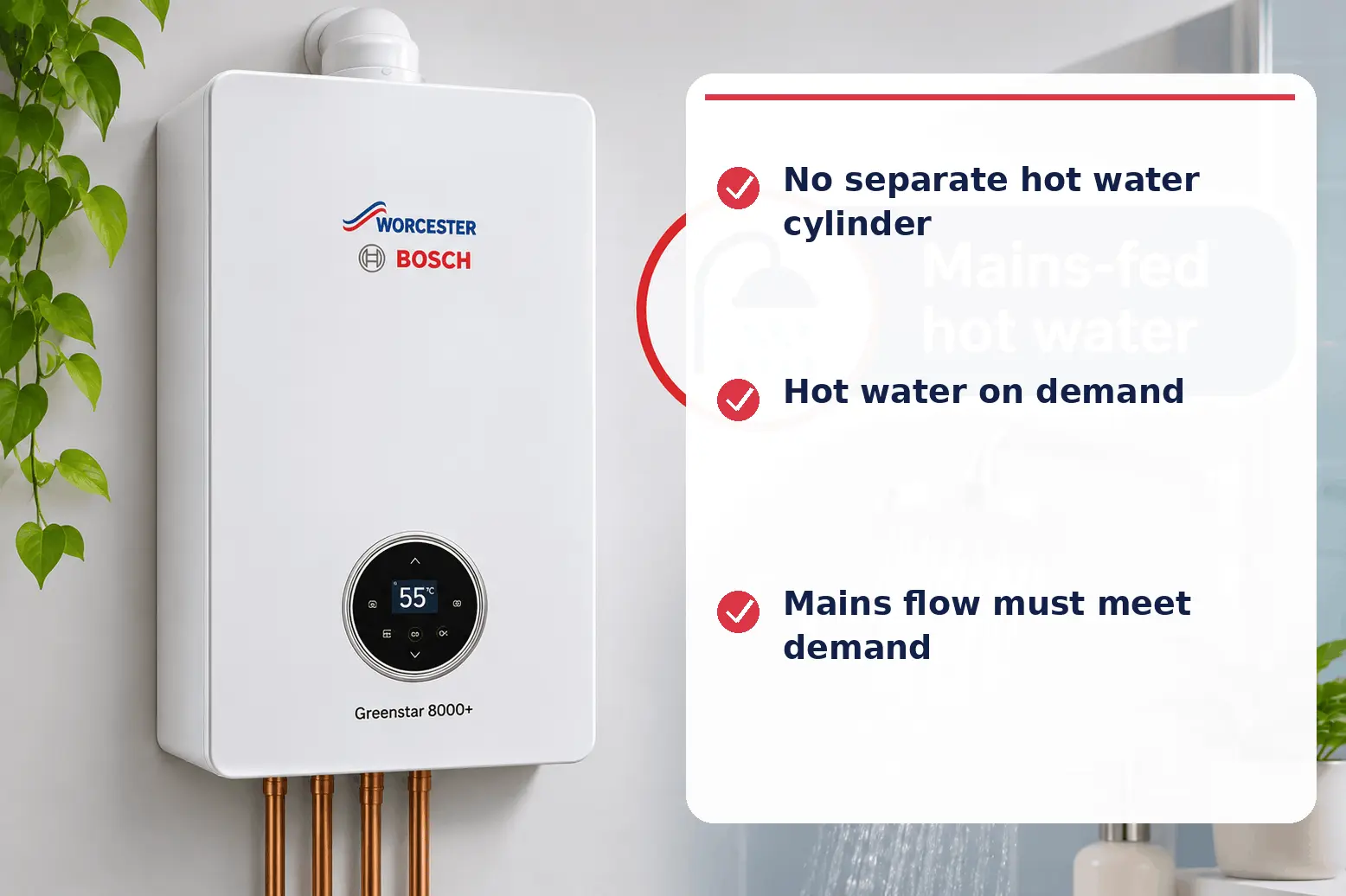
The Worcester Bosch Greenstar 8000+ combi boiler is worth investigating if you have a large property but would prefer not to install a separate hot water cylinder.
A combi boiler heats domestic hot water directly when a tap or shower is opened. This removes the need for stored domestic hot water, although its delivery capacity is limited.
A higher domestic hot water output may be useful where household demand is greater than a smaller combi can comfortably serve.
However, choosing a higher-output model does not guarantee that multiple showers will run comfortably at once.
Why consider it?
It offers a cylinder-free alternative for larger homes where the incoming mains supply and expected hot water demand make a combi arrangement practical.
What should you check?
Compare the manufacturer's domestic hot water flow rate at a stated temperature rise with your household's requirements. Incoming mains flow and pressure must also be assessed.
If several showers are frequently used together, a system boiler and cylinder may still be more suitable.
Ideal Logic² Plus regular boiler
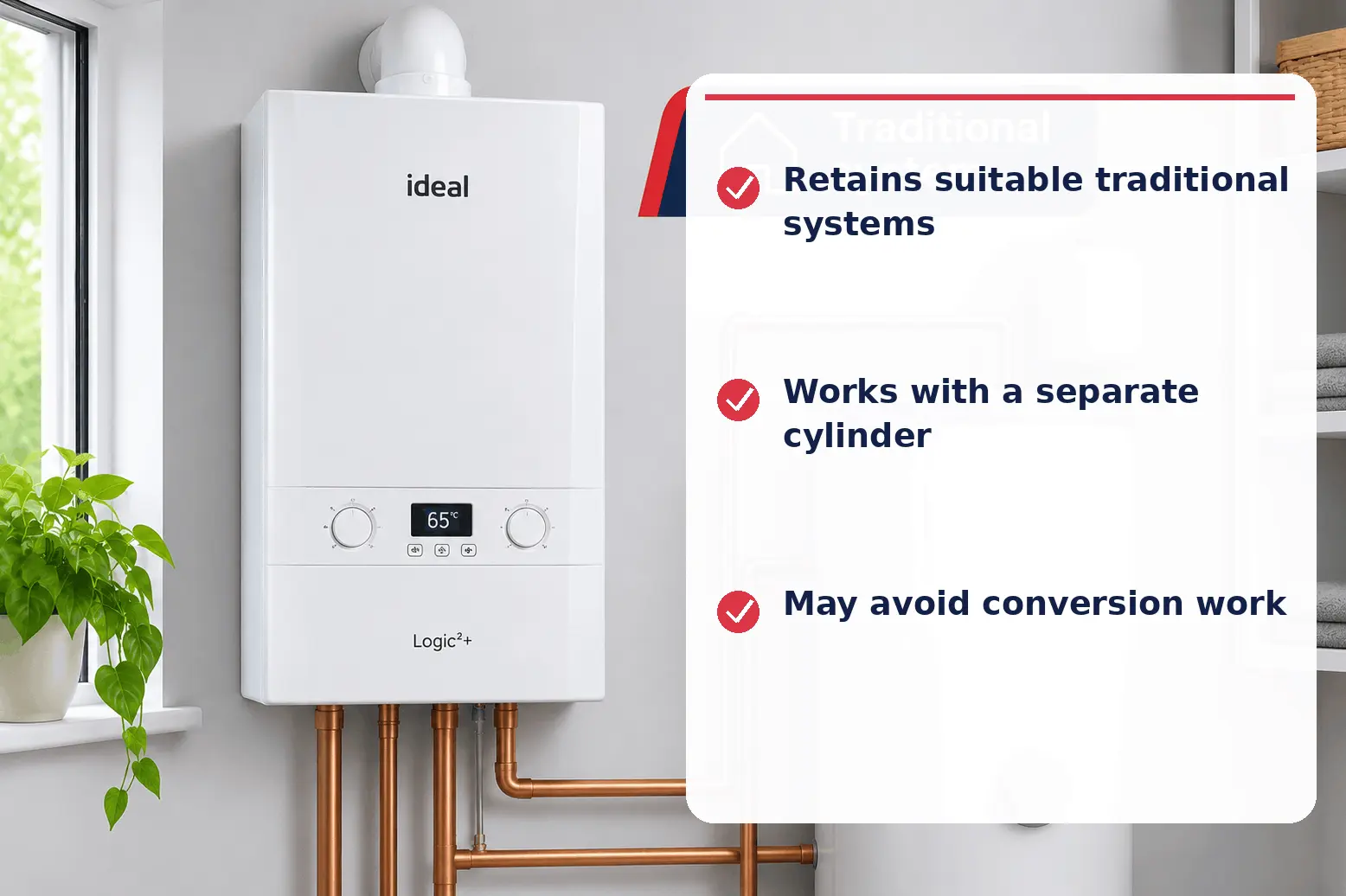
The Ideal Logic² Plus regular boiler is worth considering if your large house already has a traditional heating arrangement.
Regular boilers, also known as heat-only boilers, commonly work with a separate hot water cylinder and, in traditional vented systems, loft storage tanks.
If your existing arrangement meets the household's needs, replacing the boiler without converting the entire system may be practical.
Why consider it?
It provides an option for retaining a suitable existing regular boiler setup, potentially avoiding unnecessary changes to the heating arrangement.
What should you check?
An installer should assess the condition and compatibility of the cylinder, tanks, pipework and controls, as well as the property's calculated heat loss.
How should you choose between these models?
The right choice starts with your household's needs, not the boiler's maximum output.
The four models above represent different installation arrangements and heating requirements. They were selected to help compare those options, rather than as the results of independent product testing.
Before choosing, establish:
Whether your household regularly uses multiple hot water outlets together.
Whether you have space for a suitable hot water cylinder.
Whether your existing heating system can be retained.
What central heating output the property actually requires.
Whether your incoming water supply can support the proposed arrangement.
Once the most suitable boiler type has been established, you can compare individual models, controls, warranty conditions and installation requirements.
Is a system boiler best for a large family?
A system boiler is often the best option for a large family because it works with a hot water cylinder, providing a reserve of heated water during busy periods.
Unlike a combi boiler, which heats domestic hot water on demand, a system boiler heats water stored in a separate cylinder.
This arrangement can be particularly useful when several people need hot water within a short period.
Why are system boilers suitable for multiple bathrooms?
A correctly designed system boiler and cylinder arrangement can supply stored hot water to several outlets without requiring the boiler to heat the entire demand instantaneously.
For example, a household might regularly have two showers running while someone uses the kitchen tap.
A suitable cylinder can help meet this concentrated demand, although actual performance depends on its capacity, recovery time, water supply and pipework.
System boilers are particularly worth considering when:
Two or more bathrooms are regularly used together.
Several family members shower during the same morning period.
Hot water demand is concentrated into busy periods.
There is suitable space for a hot water cylinder.
Our what is a system boiler guide explains the arrangement in more detail.
What are the disadvantages of a system boiler?
The main disadvantage is the space required for a separate hot water cylinder.
Stored hot water is also finite. If it is used faster than the system can replenish it, there may be a wait while the cylinder reheats.
Cylinders experience standing heat losses, although modern insulated cylinders are designed to limit them.
A system boiler also does not automatically improve water pressure. An unvented cylinder depends on a suitable mains supply, while traditional vented arrangements have different requirements.
Can a combi boiler work in a five-bedroom house?
Yes, a combi boiler can work in a five-bedroom house if its heating output and domestic hot water performance suit the property.
The number of bedrooms does not determine whether a combi is suitable.
A modern combi may be capable of heating a large property's radiators, but that does not necessarily mean it can comfortably supply several showers simultaneously.
When might a combi boiler be suitable?
A combi may be worth considering when:
Bathrooms are generally used at different times.
The household has relatively modest simultaneous hot water demand.
There is limited space for a hot water cylinder.
The incoming mains supply is suitable.
A heating assessment confirms the boiler can meet the property's requirements.
For example, a five-bedroom house occupied by two people who rarely use hot water together may be well suited to a different arrangement from the same house occupied by a family of six.
Why can combi boilers struggle with multiple showers?
A combi boiler has a limited rate at which it can heat incoming cold water.
Domestic hot water performance is normally expressed in litres per minute at a specified temperature rise.
When several showers or taps are used simultaneously, the available hot water delivery must be shared between them.
Depending on the boiler and water supply, this may reduce flow or make it harder to maintain the desired temperature at each outlet.
Central heating output and domestic hot water performance are different considerations. A boiler capable of heating a large property may still be unsuitable for its busiest hot water periods.
For households regularly using multiple showers, a stored hot water arrangement may be more appropriate.
You can compare other options in our guide to the best combi boilers.
When is a regular boiler better for a large house?
A regular boiler may be the better option when a large property already has a suitable traditional heating system and retaining it avoids unnecessary conversion work.
Regular boilers are commonly found in older UK properties.
A traditional vented arrangement typically includes a boiler, separate hot water cylinder, cold water storage cistern and feed and expansion cistern.
If the existing arrangement works well and remains in good condition, replacing the boiler like for like may be practical.
Should you replace a regular boiler with a system boiler?
Not necessarily.
Converting to a system boiler may allow some traditional components to be removed, but it can also require changes to pipework, controls and the hot water arrangement.
The installer must establish whether the existing system and cylinder are suitable for the proposed conversion.
Retaining a regular boiler may make sense when the current arrangement meets household demand.
However, ageing cylinders, unsuitable pipework or inadequate hot water performance may justify a more substantial upgrade.
The decision should be based on the condition and suitability of the complete system.
How much hot water does a large family need?
A large family's hot water requirements depend on how many people use it, how often outlets run together and how quickly stored water can be replenished.
Two households with the same number of occupants may have very different requirements.
One family might take short showers throughout the day. Another might use several showers and baths within the same hour.
The second household will generally place greater demands on its hot water system.
How can you estimate your family's hot water demand?
Before choosing a replacement boiler, consider your household's busiest period.
Ask yourself:
How many people regularly use hot water? Consider everyone living in the property.
How many showers or baths are used during the busiest hour? Morning routines are often particularly demanding.
How often are several outlets used together? Include showers, baths and kitchen taps.
Does your current system keep up? Note whether hot water runs out or flow and temperature change during busy periods.
As an illustration, a shower delivering 10 litres per minute uses approximately 80 litres of mixed water during an eight-minute shower.
Two showers operating at that rate for eight minutes would use approximately 160 litres of mixed water.
This is an illustrative usage calculation, not a recommended cylinder size. Actual requirements depend on shower flow, duration, storage temperature, incoming cold water temperature and cylinder recovery.
What size hot water cylinder does a large house need?
There is no single cylinder size that suits every four-bedroom or five-bedroom property.
The correct capacity depends on the number of occupants, shower flow rates, bath usage, simultaneous demand and the cylinder's recovery performance.
A larger cylinder stores more hot water, but capacity is only part of the calculation.
Recovery time also matters. This describes how quickly the system can replenish the cylinder's hot water supply after use.
A cylinder that reheats effectively between periods of demand may suit one household, while another may need more stored water to cover several showers in quick succession.
An installer should assess usable capacity and recovery together rather than selecting a cylinder solely from the number of bedrooms.
Why do water pressure and flow matter?
Water pressure and flow are related, but they are not the same thing.
Pressure describes the force available to move water through the plumbing system.
Flow rate describes how much water is delivered over time, usually measured in litres per minute.
A property can have apparently good water pressure but insufficient flow to support several outlets simultaneously.
An unvented cylinder depends on a suitable incoming mains supply, while a traditional vented arrangement uses stored cold water and the height of the storage cistern to provide pressure.
The appropriate arrangement depends on the property's plumbing and expected demand.
Which boiler setup suits different household needs?
Household situation | Setup worth considering | Why |
Five-bedroom home with two occupants and one shower usually running | Suitably specified combi or system boiler | Simultaneous hot water demand may be modest |
Four-bedroom home with five occupants regularly using two bathrooms | System boiler with a suitable cylinder | Stored hot water can help meet concentrated demand |
Older five-bedroom home with an existing regular boiler and loft tanks | Regular replacement or assessed system conversion | Existing infrastructure affects installation requirements |
Large home with three bathrooms and frequent simultaneous showers | Carefully designed stored hot water system | Capacity, recovery and water delivery need particular attention |
These are starting points rather than fixed specifications. The final recommendation depends on the individual property.
What size boiler does a large house need?
The correct boiler size for a large house should be determined by its calculated heat loss and hot water requirements, not simply its number of bedrooms or radiators.
Boiler output is measured in kilowatts (kW), but central heating output and domestic hot water performance must be considered separately.
How many kW does a house need by bedrooms and bathrooms?
The table below offers a broad illustration of central heating output for different property sizes. It is not a boiler-sizing chart: the number of bedrooms and bathrooms alone cannot establish the output your home needs.
Bedrooms | Bathrooms | Illustrative central heating output |
3 | 1 | 10–18 kW |
3–4 | 1–2 | 12–20 kW |
4–5 | 2 | 15–25 kW |
5–6 | 2–3 | 18–30 kW |
6+ | 3+ | Individual assessment required |
These figures are broad examples, not verified recommendations for a particular property. They must be checked by a heating specialist before being used as published sizing guidance. A well-insulated five-bedroom house may require less central heating output than a smaller, poorly insulated home.
Bathrooms and household occupancy matter most when assessing hot water demand. A combi boiler's domestic hot water performance needs to be checked separately, while a system or regular boiler also requires an appropriately specified cylinder and recovery capacity.
How is central heating output calculated?
The central heating output must be sufficient to replace the heat the property loses during cold conditions.
A professional heat-loss assessment considers:
Heated floor area and room dimensions.
Wall, roof and floor insulation.
Window and door performance.
Ventilation and draughts.
Local design temperatures.
Radiator sizes and heating system design.
A large, well-insulated house may need less heating output than expected. An older property with poor insulation could require substantially more.
Choosing an unnecessarily powerful boiler can create problems if its minimum output is too high for the property's demand during milder weather.
This may lead to frequent cycling, where the boiler repeatedly switches on and off rather than operating steadily.
Does a larger family need a higher-output boiler?
Not necessarily for central heating.
The number of occupants affects domestic hot water demand more directly than the building's heat loss.
For a combi boiler, the installer must assess both the central heating requirement and domestic hot water delivery.
For a system or regular boiler, the cylinder and its reheat requirements also need consideration.
The aim is to match the complete heating and hot water arrangement to the property, rather than choosing the highest available boiler output.
What should you check before replacing a boiler in a large house?
Before replacing your boiler, check the existing heating arrangement, household hot water demand, water supply and available installation space.
A professional survey should establish whether your current setup can be retained, improved or needs more substantial changes.
Existing boiler and cylinder
Identify whether you currently have a combi, system or regular boiler.
If you're unsure, our guide to what type of boiler do I have explains the main differences.
Where a cylinder is already installed, its condition, capacity and compatibility with the proposed arrangement should be assessed.
Water supply and pipework
The installer should check incoming mains pressure and flow where relevant, particularly when considering a combi boiler or unvented cylinder.
Pipework condition and layout can also affect hot water delivery.
Installation space
A combi boiler generally requires less space because it does not need a separate domestic hot water cylinder.
System and regular boiler arrangements require suitable cylinder space. Traditional regular systems may also need loft storage.
Access for installation, servicing and maintenance should also be considered.
Heating controls
Suitable controls can help manage heating and stored hot water around your household's routine.
Depending on the arrangement, these may include programmable thermostats, heating zones and separate hot water schedules.
Control compatibility should be confirmed before choosing equipment.
Warranty and servicing
Warranty conditions vary between manufacturers and models.
Check servicing requirements, installation conditions and registration deadlines rather than comparing warranty length alone.
Gas boiler installation, servicing and internal repairs must be carried out by a Gas Safe registered engineer qualified for the work.
Which boiler should you choose for your large house?
For a busy family regularly using several bathrooms, a system boiler with a correctly sized hot water cylinder is often the strongest starting point.
The Worcester Bosch Greenstar 4000 and Vaillant ecoTEC Plus system boilers are two options worth comparing, provided their outputs suit your property's calculated requirements.
If you have limited cylinder space and generally use hot water at different times, a suitably specified combi such as the Worcester Bosch Greenstar 8000+ may be worth considering.
For an older property with a suitable traditional heating arrangement, retaining a regular boiler setup with a model such as the Ideal Logic² Plus may be more practical.
The next step is to have your heating requirements and hot water demand assessed before choosing a model.
iHeat can help you explore replacement boiler options, with the final specification depending on your property and installation requirements.
The best boiler for a large house is not necessarily the most powerful or expensive. It is the one that provides the heating and hot water your household needs without unnecessary capacity or installation work.
Need a new boiler?
Get a quote in 60 seconds, fitted as fast as next day!
0% APR finance available.
Last updated: